Mirhadi Hosein, Abbaszadegan Abbas, Ranjbar Mohammad Ali, Azar Mohammad Reza, Geramizadeh Bita, Torabi Shima, Sadat Aleyasin Zeinab, Gholami Ahmad
Dept. of Endodontics, School of Dentistry, Shiraz University of Medical Sciences; Shiraz, Iran.
Dept. of Oral and Maxillofacial Pathology, School of Dentistry, Shiraz University of Medical Sciences, Shiraz, Iran.
J Dent (Shiraz). 2015 Dec;16(4):349-55.
Hydrogen peroxide (H2O2) has been suggested to be used in sequence or in combination with chlorhexidine (CHX) to enhance the antibacterial activity against Enterococcus faecalis, but there is no research in the literature on the safety and effectiveness of this irrigation protocol.
This study aimed to assess the cytocompatibility and antibacterial activity of different concentrations of CHX combined with H2O2in comparison with the activity of 5.25 and 2.5% sodium hypochlorite (NaOCl).
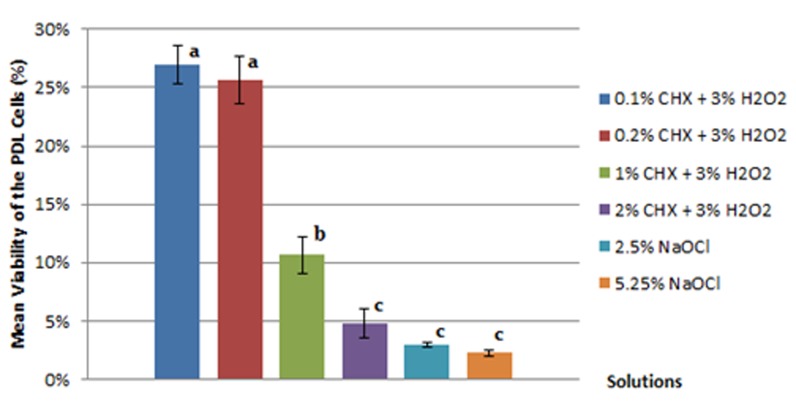
Different concentrations of H2O2 (10, 5, 3 and 1%) were exposed to the PDL cells. Then, the solution with minimal cytotoxicity was selected (3% H2O2). The cytocompatibility and antibacterial activity of 0.1, 0.2, 1 and 2% CHX combined with 3% H2O2 were evaluated and compared with 5.25 and 2.5% NaOCl. The differences in the mean viability of PDL cells were evaluated by one-way ANOVA. Kruskal-Wallis and post-hoc Dunn's tests were adopted to compare the antibacterial activity of the solutions against E.faecalis.
The viability of PDL cells was lower when treated with 5.25 or 2.5% NaOCl than all combinations of CHX and H2O2.There was no significant difference in the antibacterial activity of the solutions against E.faecalis, except for the 0.1% CHX + 3% H2O2 combination, which had significantly lower efficacy than other groups.
All combinations of CHX and H2O2 (used in this study)except 0.1% CHX + 3% H2O2 were efficient irrigants against planktonic E.faecalis and had a better cytocompatibility with PDL cells than 5.25 and 2.5% NaOCl.
有人建议将过氧化氢(H2O2)与氯己定(CHX)按顺序使用或联合使用,以增强对粪肠球菌的抗菌活性,但文献中尚无关于该冲洗方案安全性和有效性的研究。
本研究旨在评估不同浓度的CHX与H2O2联合使用时的细胞相容性和抗菌活性,并与5.25%和2.5%的次氯酸钠(NaOCl)的活性进行比较。
将不同浓度的H2O2(10%、5%、3%和1%)作用于牙周膜细胞。然后,选择细胞毒性最小的溶液(3% H2O2)。评估0.1%、0.2%、1%和2%的CHX与3% H2O2联合使用时的细胞相容性和抗菌活性,并与5.25%和2.5%的NaOCl进行比较。采用单因素方差分析评估牙周膜细胞平均活力的差异。采用Kruskal-Wallis检验和事后Dunn检验比较各溶液对粪肠球菌的抗菌活性。
与CHX和H2O2的所有组合相比,用5.25%或2.5%的NaOCl处理时,牙周膜细胞的活力较低。除0.1% CHX + 3% H2O2组合外,各溶液对粪肠球菌的抗菌活性无显著差异,该组合的疗效明显低于其他组。
CHX和H2O2的所有组合(本研究中使用的),除了0.1% CHX + 3% H2O2外,都是针对浮游粪肠球菌的有效冲洗剂,并且与5.25%和2.5%的NaOCl相比,对牙周膜细胞具有更好的细胞相容性。