Lai Chao-Chih, Ji Dar-Der, Wu Fang-Tzy, Mu Jung-Jung, Yang Ji-Rong, Jiang Donald Dah-Shyong, Lin Wen-Yun, Chen Wei-Ting, Yen Muh-Yong, Wu Ho-Sheng, Chen Tony Hsiu-Hsi
Emergency Department, Taipei City Hospital, Ren-Ai Branch.
J Epidemiol. 2016;26(4):216-23. doi: 10.2188/jea.JE20150061. Epub 2015 Dec 5.
The causative pathogen is rarely identified in the emergency department (ED), since the results of cultures are usually unavailable. As a result, antimicrobial treatment may be overused. The aim of our study was to investigate the pathogens, risk factors of acute gastroenteritis, and predictors of acute bacterial gastroenteritis in the ED.
We conducted a matched case-control study of 627 stool samples and 612 matched pairs.
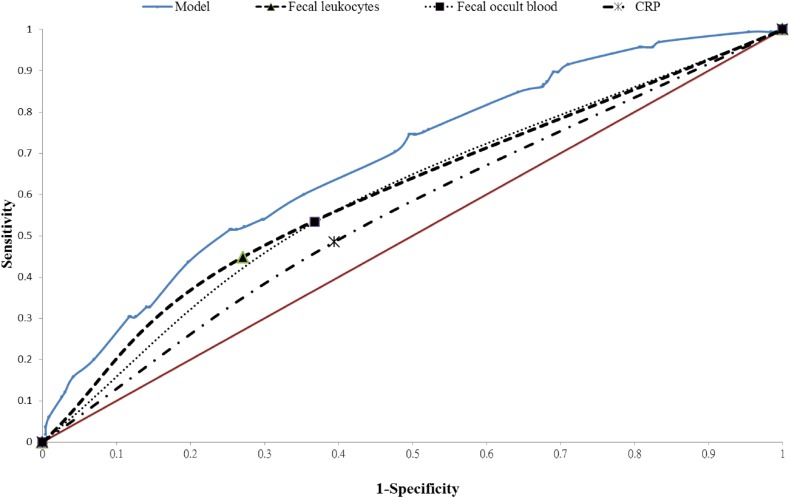
Viruses (41.3%) were the leading cause of gastroenteritis, with noroviruses (32.2%) being the most prevalent, followed by bacteria (26.8%) and Giardia lamblia (12.4%). Taking antacids (adjusted odds ratio [aOR] 4.10; 95% confidence interval [CI], 2.57-6.53), household members/classmates with gastroenteritis (aOR 4.69; 95% CI, 2.76-7.96), attending a banquet (aOR 2.29; 95% CI, 1.64-3.20), dining out (aOR 1.70; 95% CI, 1.13-2.54), and eating raw oysters (aOR 3.10; 95% CI, 1.61-5.94) were highly associated with gastroenteritis. Elders (aOR 1.04; 05% CI, 1.02-1.05), those with CRP >10 mg/L (aOR 2.04; 95% CI, 1.15-3.62), or those who were positive for fecal leukocytes (aOR 2.04; 95% CI, 1.15-3.62) or fecal occult blood (aOR 1.97; 95% CI, 1.03-3.77) were more likely to be hospitalized in ED. In addition, presence of fecal leukocytes (time ratio [TR] 1.22; 95% CI, 1.06-1.41), abdominal pain (TR 1.20; 95% CI, 1.07-1.41), and frequency of vomiting (TR 0.79; 95% CI, 0.64-0.98) were significantly associated with the duration of acute gastroenteritis. Presence of fecal leukocytes (aOR 2.08; 95% CI, 1.42-3.05), winter season (aOR 0.45; 95% CI, 0.28-0.74), frequency of diarrhea (aOR 1.69; 95% CI, 1.01-2.83), and eating shrimp or crab (aOR 1.53; 95% CI, 1.05-2.23) were highly associated with bacterial gastroenteritis. The area under the receiver operating characteristic curve of the final model was 0.68 (95% CI, 0.55-0.63).
Acute bacterial gastroenteritis was highly associated with season, frequency of diarrhea, frequency of vomiting, and eating shrimp or crab.
由于培养结果通常无法及时获得,急诊科(ED)很少能确定致病病原体。因此,抗菌治疗可能会被过度使用。我们研究的目的是调查急诊科急性胃肠炎的病原体、危险因素以及急性细菌性胃肠炎的预测因素。
我们对627份粪便样本和612对匹配样本进行了匹配病例对照研究。
病毒(41.3%)是胃肠炎的主要病因,其中诺如病毒(32.2%)最为常见,其次是细菌(26.8%)和蓝氏贾第鞭毛虫(12.4%)。服用抗酸剂(调整优势比[aOR]4.10;95%置信区间[CI],2.57 - 6.53)、有胃肠炎的家庭成员/同学(aOR 4.69;95% CI,2.76 - 7.96)、参加宴会(aOR 2.29;95% CI,1.64 - 3.20)、外出就餐(aOR 1.70;95% CI,1.13 - 2.54)以及食用生牡蛎(aOR 3.10;95% CI,1.61 - 5.94)与胃肠炎高度相关。老年人(aOR 1.04;05% CI,1.02 - 1.05)、C反应蛋白>10 mg/L者(aOR 2.04;95% CI,1.15 - 3.62)、粪便白细胞阳性者(aOR 2.04;95% CI,1.15 - 3.62)或粪便潜血阳性者(aOR 1.97;95% CI,1.03 - 3.77)在急诊科更有可能住院。此外,粪便白细胞的存在(时间比[TR]1.22;95% CI,1.06 - 1.41)、腹痛(TR 1.20;95% CI,1.07 - 1.41)以及呕吐频率(TR 0.79;95% CI,0.64 - 0.98)与急性胃肠炎的病程显著相关。粪便白细胞的存在(aOR 2.08;95% CI,1.42 - 3.05)、冬季(aOR 0.45;95% CI,0.28 - 0.74)、腹泻频率(aOR 1.69;95% CI,1.01 - 2.83)以及食用虾或蟹(aOR 1.53;95% CI,1.05 - 2.23)与细菌性胃肠炎高度相关。最终模型的受试者工作特征曲线下面积为0.68(95% CI,0.55 - 0.63)。
急性细菌性胃肠炎与季节、腹泻频率、呕吐频率以及食用虾或蟹高度相关。