Temme Andries A, Liu Jin Chun, Cornwell William K, Cornelissen Johannes H C, Aerts Rien
Department of Ecological Science VU University De Boelelaan 1085 1081HV Amsterdam The Netherlands.
Department of Ecological Science VU University De Boelelaan 1085 1081HV Amsterdam The Netherlands ; Key Laboratory of Eco-Environment in Three Gorges Reservoir Region School of Life Science Southwest University Beibei Chongqing 400715 China.
Ecol Evol. 2015 Oct 15;5(21):4949-61. doi: 10.1002/ece3.1687. eCollection 2015 Nov.
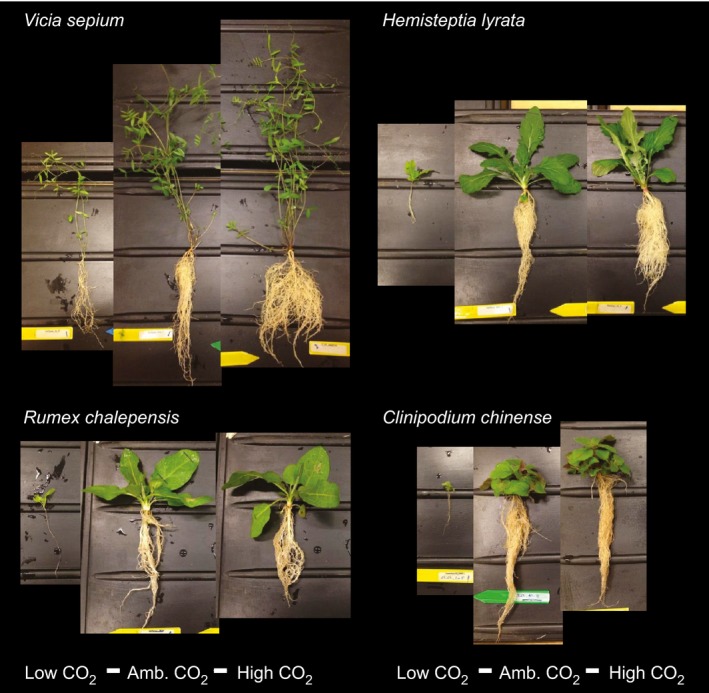
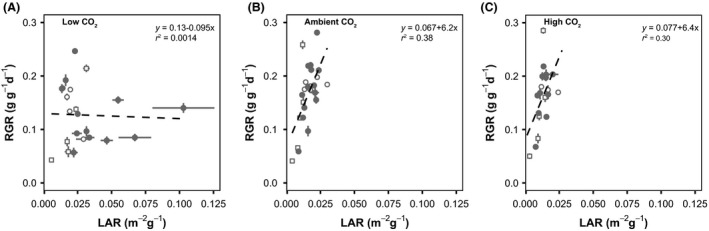
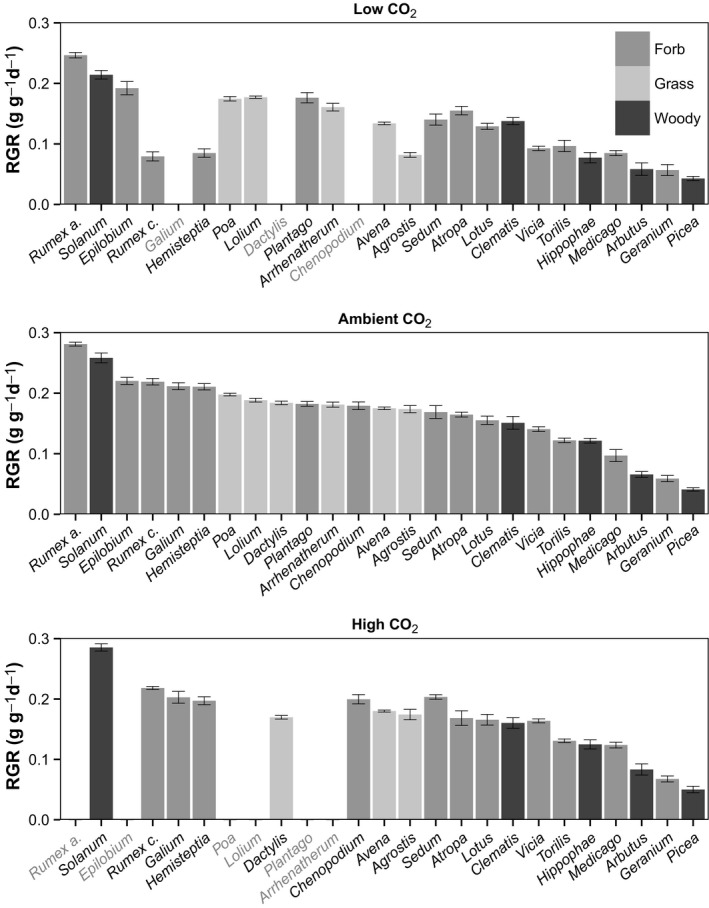
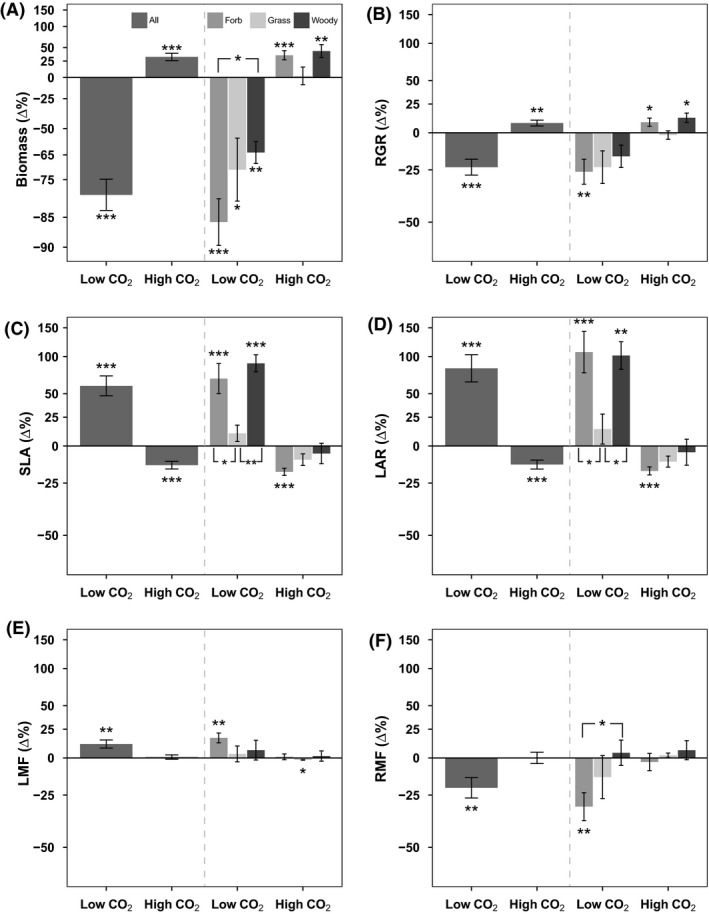
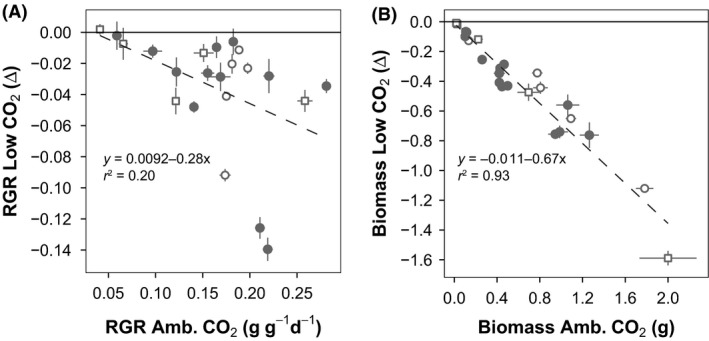
Evolutionary adaptation to variation in resource supply has resulted in plant strategies that are based on trade-offs in functional traits. Here, we investigate, for the first time across multiple species, whether such trade-offs are also apparent in growth and morphology responses to past low, current ambient, and future high CO 2 concentrations. We grew freshly germinated seedlings of up to 28 C3 species (16 forbs, 6 woody, and 6 grasses) in climate chambers at 160 ppm, 450 ppm, and 750 ppm CO 2. We determined biomass, allocation, SLA (specific leaf area), LAR (leaf area ratio), and RGR (relative growth rate), thereby doubling the available data on these plant responses to low CO 2. High CO 2 increased RGR by 8%; low CO 2 decreased RGR by 23%. Fast growers at ambient CO 2 had the greatest reduction in RGR at low CO 2 as they lost the benefits of a fast-growth morphology (decoupling of RGR and LAR [leaf area ratio]). Despite these shifts species ranking on biomass and RGR was unaffected by CO 2, winners continued to win, regardless of CO 2. Unlike for other plant resources we found no trade-offs in morphological and growth responses to CO 2 variation, changes in morphological traits were unrelated to changes in growth at low or high CO 2. Thus, changes in physiology may be more important than morphological changes in response to CO 2 variation.
对资源供应变化的进化适应导致了基于功能性状权衡的植物策略。在此,我们首次对多个物种进行研究,探究这种权衡在对过去低浓度、当前环境浓度和未来高浓度二氧化碳的生长及形态反应中是否也很明显。我们在气候箱中,将多达28种C3植物(16种草本植物、6种木本植物和6种草)刚萌发的幼苗培养在二氧化碳浓度分别为160 ppm、450 ppm和750 ppm的环境中。我们测定了生物量、分配情况、比叶面积(SLA)、叶面积比(LAR)和相对生长速率(RGR),从而使关于这些植物对低二氧化碳反应的现有数据增加了一倍。高二氧化碳浓度使相对生长速率提高了8%;低二氧化碳浓度使相对生长速率降低了23%。在环境二氧化碳浓度下生长快的植物,在低二氧化碳浓度时相对生长速率下降幅度最大,因为它们失去了快速生长形态的优势(相对生长速率与叶面积比[LAR]解耦)。尽管有这些变化,但物种在生物量和相对生长速率上的排名不受二氧化碳的影响,赢家仍然是赢家,与二氧化碳浓度无关。与其他植物资源不同,我们发现对二氧化碳变化的形态和生长反应不存在权衡,形态性状的变化与低二氧化碳或高二氧化碳浓度下的生长变化无关。因此,生理变化可能比形态变化在应对二氧化碳变化方面更重要。