Tapsas Dimitrios, Hollén Elisabet, Stenhammar Lars, Fälth-Magnusson Karin
Department of Clinical and Experimental Medicine, Division of Paediatrics, Linköping University, Linköping, Sweden.
Department of Clinical and Experimental Medicine, Linköping University, Linköping, Sweden.
PLoS One. 2015 Dec 11;10(12):e0144346. doi: 10.1371/journal.pone.0144346. eCollection 2015.
The prevalence of coeliac disease in Sweden during the "epidemic period" (1984-1996) was one of the highest in the world. The aim of this study was to assess the coeliac disease incidence in our region over the 41-year period, and how diagnostic activity and diagnostic accuracy were affected by the introduction of antibody testing. We also looked into how patients with mild enteropathy were evaluated.
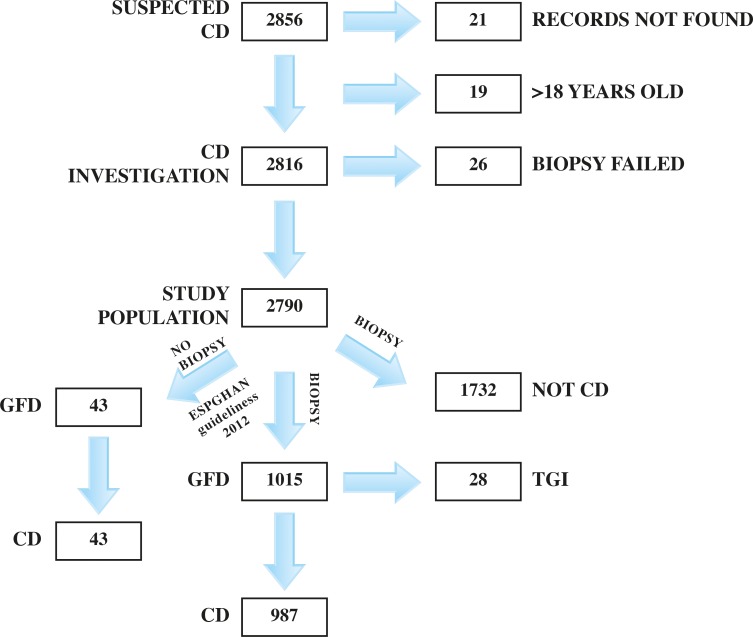
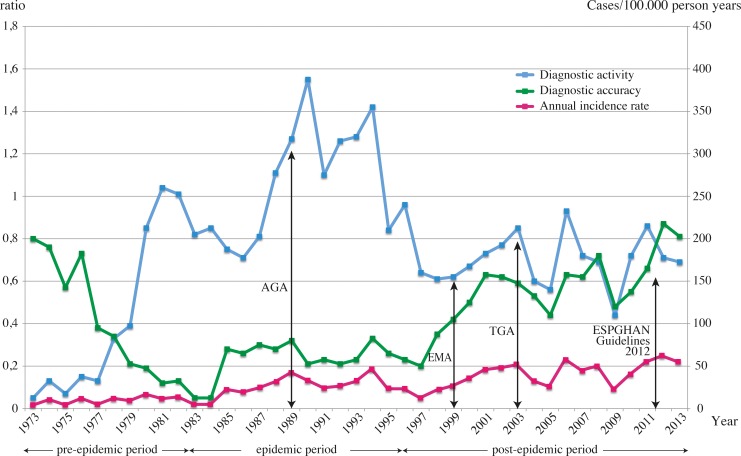
In the county of Östergötland in Sweden, 2790 paediatric patients were investigated for suspected coeliac disease between 1973 and 2013. Notes were scrutinised for data on sex, age, histopathological reports and final diagnosis. For comparative purposes this period was divided into three sub-periods (1973-1983, 1984-1996 and 1997-2013) named pre-epidemic, epidemic and post-epidemic.
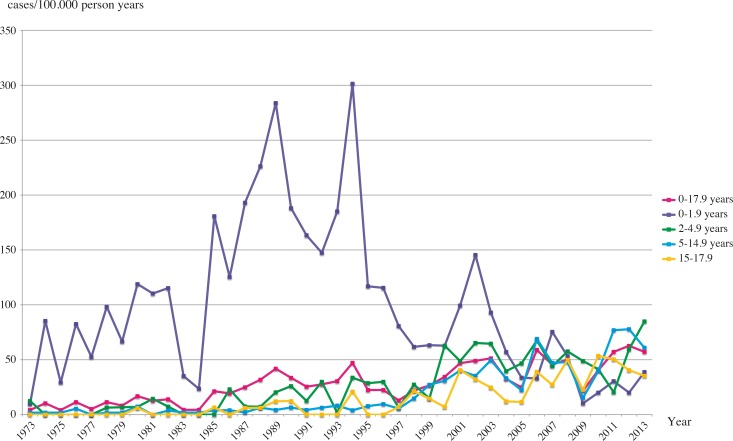
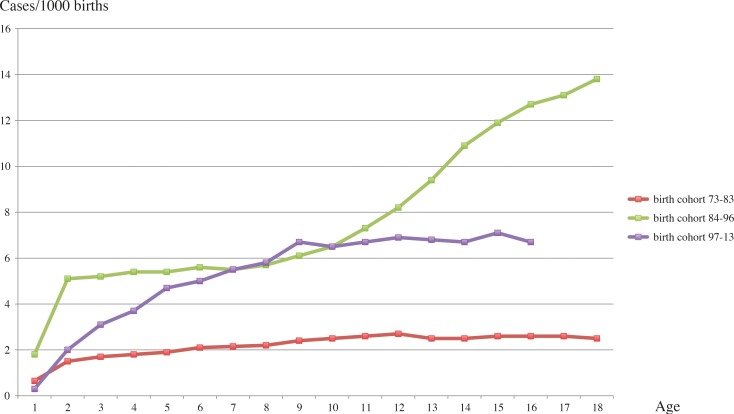
Coeliac disease diagnosis was received by 1,030 patients. The peak incidence rate, 301 cases/100,000 in 1994 for the age group 0-1.9 years is the highest figure ever reported. The other age groups, 2-4.9, 5-14.9, and 15-17.9 years, also had high incidence rates. After the 1984-1996 "epidemic period" the incidence decreased for the youngest group but continued to increase for the other groups. The cumulative incidence at 18 years-of-age for children born during the epidemic reached 14 cases/1000 births, the highest figure hitherto reported. Diagnostic activity differed significantly between the three sub-periods (p<0.001) increasing gradually from 1984 and reaching a peak value of 0.87 in 2012. Cases of mild enteropathy were more frequently regarded as non-coeliac disease cases, decreasing significantly in the "post-epidemic" period (p<0.001).
The incidence rate and cumulative incidence of coeliac disease were possibly the highest ever reported. Changes in diagnostic activity and accuracy could not be attributed to the introduction of new antibody tests, possibly because of other changes e.g. variations in the symptoms at presentation and improved knowledge of the disease among parents and health professionals.
在“流行期”(1984 - 1996年),瑞典乳糜泻的患病率位居世界前列。本研究旨在评估我们地区41年间乳糜泻的发病率,以及抗体检测的引入对诊断活动和诊断准确性的影响。我们还研究了轻度小肠病患者是如何被评估的。
在瑞典东约特兰省,1973年至2013年间对2790名疑似乳糜泻的儿科患者进行了调查。仔细查阅病历以获取有关性别、年龄、组织病理学报告和最终诊断的数据。为便于比较,这一时期被分为三个子时期(1973 - 1983年、1984 - 1996年和1997 - 2013年),分别称为流行前、流行期和流行后。
1030名患者被诊断为乳糜泻。1994年0 - 1.9岁年龄组的发病率峰值为301例/10万,是有记录以来的最高数字。其他年龄组,即2 - 4.9岁、5 - 14.9岁和15 - 17.9岁,发病率也很高。在1984 - 1996年的“流行期”之后,最年幼组的发病率下降,但其他组的发病率仍持续上升。流行期间出生的儿童18岁时的累积发病率达到14例/1000例出生,是迄今报告的最高数字。三个子时期的诊断活动差异显著(p<0.001),从1984年开始逐渐增加,在2012年达到峰值0.87。轻度小肠病病例更常被视为非乳糜泻病例,在“流行后”时期显著减少(p<0.001)。
乳糜泻的发病率和累积发病率可能是有记录以来最高的。诊断活动和准确性的变化不能归因于新抗体检测的引入,可能是由于其他变化,例如就诊时症状的差异以及家长和卫生专业人员对该疾病认识的提高。