Morey R A, Dunsmoor J E, Haswell C C, Brown V M, Vora A, Weiner J, Stjepanovic D, Wagner H R, LaBar K S
Mid-Atlantic Mental Illness Research Education and Clinical Center, Durham VA Medical Center, Durham, NC, USA.
Department of Psychiatry and Behavioral Sciences, Duke University, Durham, NC, USA.
Transl Psychiatry. 2015 Dec 15;5(12):e700. doi: 10.1038/tp.2015.196.
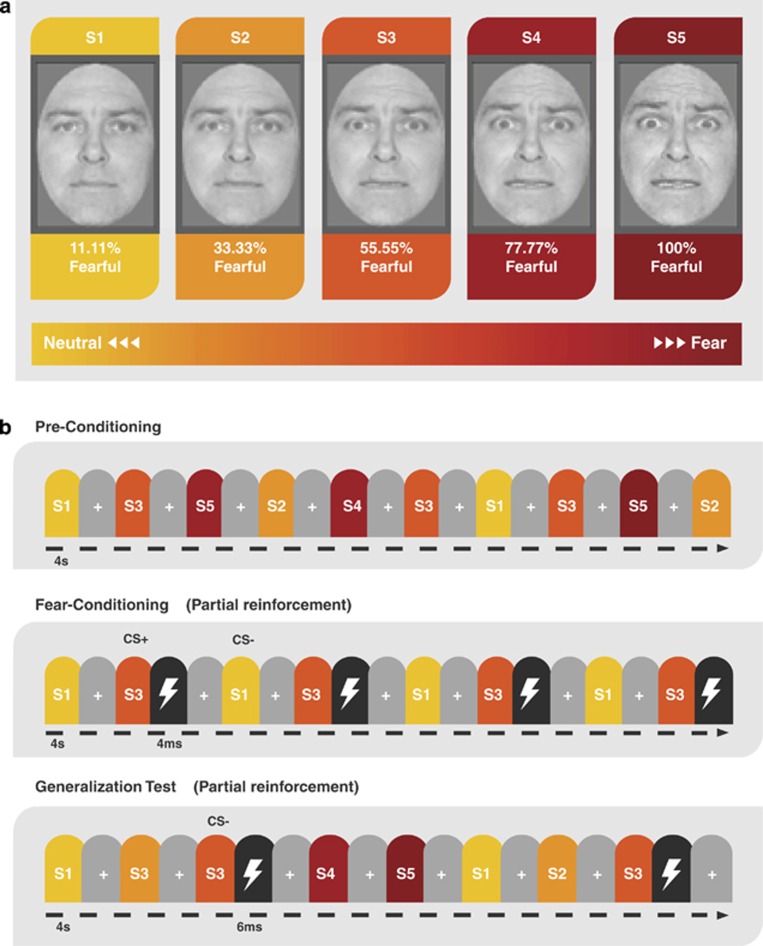
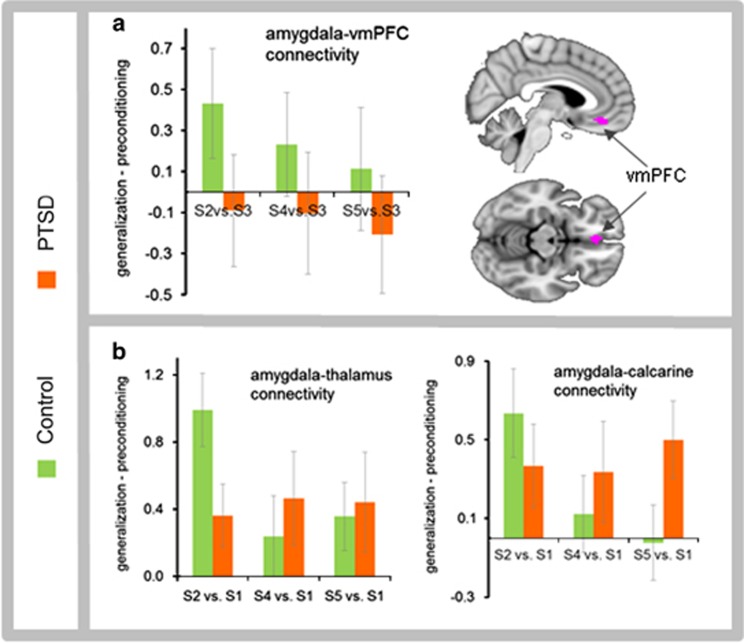
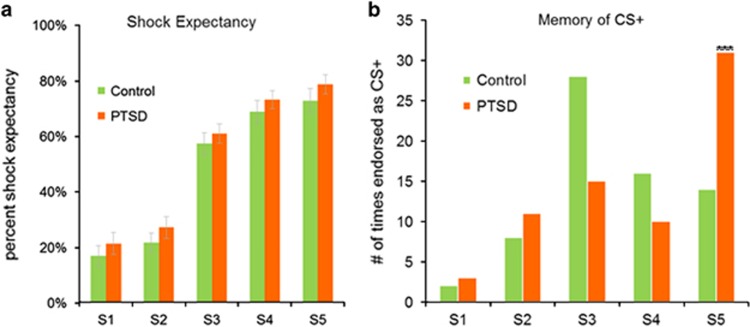
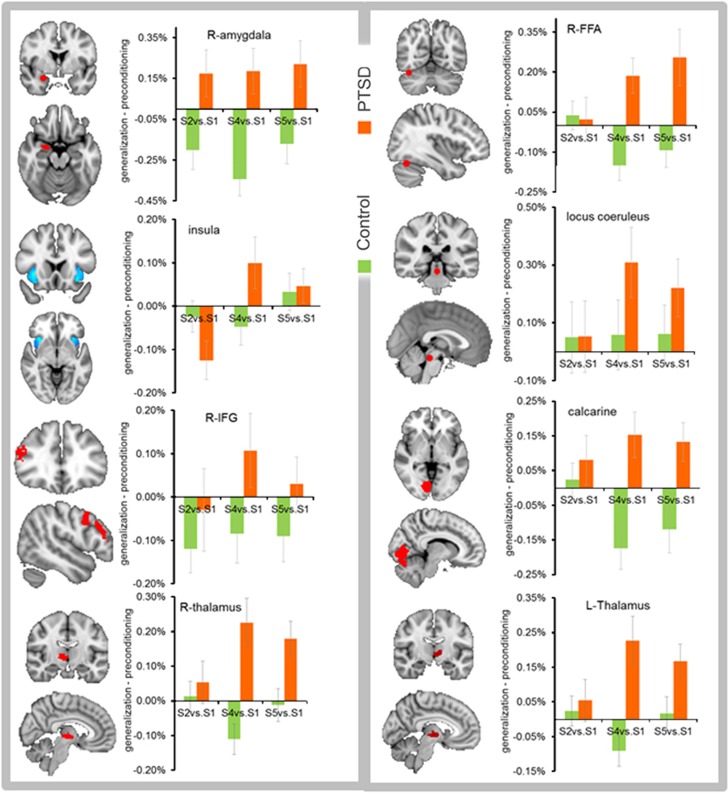
Fear conditioning is an established model for investigating posttraumatic stress disorder (PTSD). However, symptom triggers may vaguely resemble the initial traumatic event, differing on a variety of sensory and affective dimensions. We extended the fear-conditioning model to assess generalization of conditioned fear on fear processing neurocircuitry in PTSD. Military veterans (n=67) consisting of PTSD (n=32) and trauma-exposed comparison (n=35) groups underwent functional magnetic resonance imaging during fear conditioning to a low fear-expressing face while a neutral face was explicitly unreinforced. Stimuli that varied along a neutral-to-fearful continuum were presented before conditioning to assess baseline responses, and after conditioning to assess experience-dependent changes in neural activity. Compared with trauma-exposed controls, PTSD patients exhibited greater post-study memory distortion of the fear-conditioned stimulus toward the stimulus expressing the highest fear intensity. PTSD patients exhibited biased neural activation toward high-intensity stimuli in fusiform gyrus (P<0.02), insula (P<0.001), primary visual cortex (P<0.05), locus coeruleus (P<0.04), thalamus (P<0.01), and at the trend level in inferior frontal gyrus (P=0.07). All regions except fusiform were moderated by childhood trauma. Amygdala-calcarine (P=0.01) and amygdala-thalamus (P=0.06) functional connectivity selectively increased in PTSD patients for high-intensity stimuli after conditioning. In contrast, amygdala-ventromedial prefrontal cortex (P=0.04) connectivity selectively increased in trauma-exposed controls compared with PTSD patients for low-intensity stimuli after conditioning, representing safety learning. In summary, fear generalization in PTSD is biased toward stimuli with higher emotional intensity than the original conditioned-fear stimulus. Functional brain differences provide a putative neurobiological model for fear generalization whereby PTSD symptoms are triggered by threat cues that merely resemble the index trauma.
恐惧条件反射是研究创伤后应激障碍(PTSD)的一种成熟模型。然而,症状触发因素可能与最初的创伤事件有模糊的相似之处,在各种感觉和情感维度上存在差异。我们扩展了恐惧条件反射模型,以评估PTSD中条件性恐惧对恐惧加工神经回路的泛化情况。由PTSD患者(n = 32)和经历过创伤的对照组(n = 35)组成的退伍军人(n = 67)在对一张低恐惧表情的面孔进行恐惧条件反射过程中接受功能磁共振成像,而一张中性面孔则明确不给予强化。在条件反射之前呈现沿着中性到恐惧连续体变化的刺激,以评估基线反应,并在条件反射之后呈现,以评估神经活动中依赖于经验的变化。与经历过创伤的对照组相比,PTSD患者在研究后对恐惧条件刺激朝着表达最高恐惧强度的刺激表现出更大的记忆扭曲。PTSD患者在梭状回(P < 0.02)、脑岛(P < 0.001)、初级视觉皮层(P < 0.05)、蓝斑(P < 0.04)、丘脑(P < 0.01)以及在额下回呈趋势水平(P = 0.07)对高强度刺激表现出偏向性神经激活。除梭状回外,所有区域均受童年创伤的调节。在条件反射后,PTSD患者中杏仁核 - 距状裂(P = 0.01)和杏仁核 - 丘脑(P = 0.06)功能连接性针对高强度刺激选择性增加。相反,在条件反射后,与PTSD患者相比,经历过创伤的对照组中杏仁核 - 腹内侧前额叶皮层(P = 0.04)连接性针对低强度刺激选择性增加,代表安全学习。总之,PTSD中的恐惧泛化偏向于比原始条件性恐惧刺激具有更高情绪强度的刺激。大脑功能差异为恐惧泛化提供了一个假定的神经生物学模型,据此PTSD症状由仅仅类似于索引创伤的威胁线索触发。