Li Zongchang, Hu Maolin, Zong Xiaofen, He Ying, Wang Dong, Dai Lulin, Dong Min, Zhou Jun, Cao Hongbao, Lv Luxian, Chen Xiaogang, Tang Jinsong
Mental Health Institute of the Second Xiangya Hospital, Key Laboratory of Psychiatry and Mental Health of Hunan Province, Central South University, Hunan, Changsha 410011, China.
The State Key Laboratory of Medical Genetics, Central South University, Changsha, Hunan, China.
Sci Rep. 2015 Dec 18;5:18553. doi: 10.1038/srep18553.
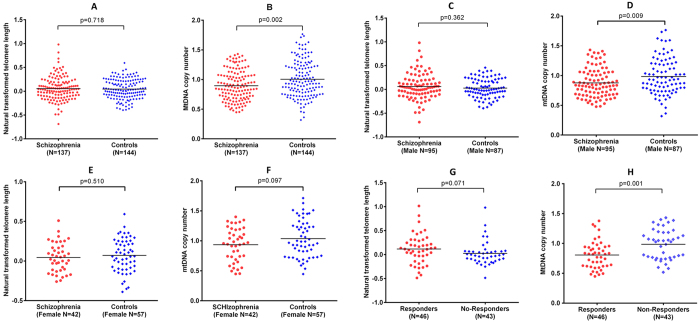
Accumulating evidence indicates a putative association of telomere length and mitochondrial function with antipsychotics response in schizophrenia (SCZ). However, pharmacological findings were limited and no previous work has assessed this in a prospective longitudinal study. This study assessed telomere length and mitochondrial DNA copy number in first-episode antipsychotic-naïve SCZ patients with 8-week risperidone treatment to evaluate the association between these biomarkers and clinical treatment response. We recruited 137 first-episode antipsychotic-naive SCZ patients (and 144 controls) at baseline and 89 patients completed the 8-week follow-up. Patients, completed follow-up, were divided into Responders (N = 46) and Non-Responders (N = 43) according to the percentage of symptoms improvement. Linear regression analyses show that SCZ patients had significantly lower mtDNA copy number (β = -0.108, p = 0.002), and no alteration of telomere length when compared with healthy controls. In addition, compared with Non-Responders, Responders had significantly lower mtDNA copy number (β = -0.178, p = 0.001), and longer telomere length (β = 0.111, p = 0.071) before the 8-week treatment. After treatment, Responders persisted lower mtDNA copy number comparing with No-Responders (partial η(2) = 0.125, p = 0.001). These findings suggest that telomere length and mtDNA copy number may hold the potential to serve as predictors of antipsychotic response of SCZ patients.
越来越多的证据表明,端粒长度和线粒体功能与精神分裂症(SCZ)患者对抗精神病药物的反应之间可能存在关联。然而,药理学研究结果有限,且此前尚无研究在前瞻性纵向研究中对此进行评估。本研究评估了首发未服用过抗精神病药物的SCZ患者在接受8周利培酮治疗前后的端粒长度和线粒体DNA拷贝数,以评估这些生物标志物与临床治疗反应之间的关联。我们在基线时招募了137名首发未服用过抗精神病药物的SCZ患者(以及144名对照者),其中89名患者完成了8周的随访。完成随访的患者根据症状改善百分比分为反应者(N = 46)和无反应者(N = 43)。线性回归分析显示,与健康对照相比,SCZ患者的线粒体DNA拷贝数显著降低(β = -0.108,p = 0.002),端粒长度无变化。此外,与无反应者相比,反应者在8周治疗前的线粒体DNA拷贝数显著降低(β = -0.178,p = 0.001),端粒长度更长(β = 0.111,p = 0.071)。治疗后,反应者的线粒体DNA拷贝数仍低于无反应者(偏η(2)= 0.125,p = 0.001)。这些发现表明,端粒长度和线粒体DNA拷贝数可能有潜力作为SCZ患者抗精神病药物反应的预测指标。