Ross Mark D, Malone Eva, Florida-James Geraint
School of Life, Sport and Social Sciences, Edinburgh Napier University, Edinburgh EH11 4BN, UK.
Oxid Med Cell Longev. 2016;2016:3583956. doi: 10.1155/2016/3583956. Epub 2015 Dec 1.
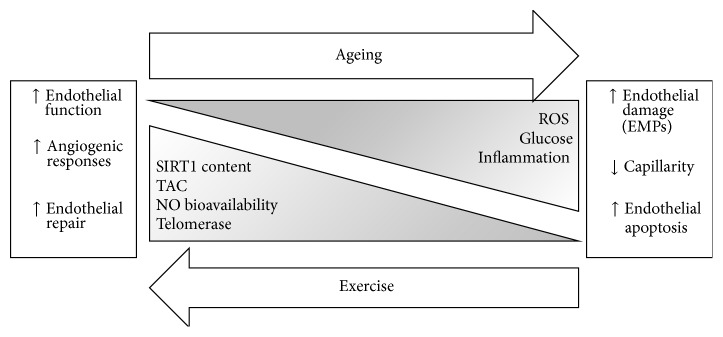
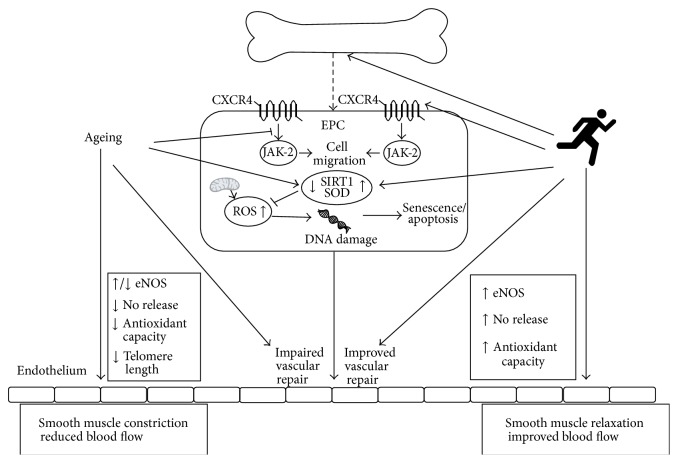
Ageing is associated with an increased risk of developing noncommunicable diseases (NCDs), such as diabetes and cardiovascular disease (CVD). The increased risk can be attributable to increased prolonged exposure to oxidative stress. Often, CVD is preceded by endothelial dysfunction, which carries with it a proatherothrombotic phenotype. Endothelial senescence and reduced production and release of nitric oxide (NO) are associated with "vascular ageing" and are often accompanied by a reduced ability for the body to repair vascular damage, termed "reendothelialization." Exercise has been repeatedly shown to confer protection against CVD and diabetes risk and incidence. Regular exercise promotes endothelial function and can prevent endothelial senescence, often through a reduction in oxidative stress. Recently, endothelial precursors, endothelial progenitor cells (EPC), have been shown to repair damaged endothelium, and reduced circulating number and/or function of these cells is associated with ageing. Exercise can modulate both number and function of these cells to promote endothelial homeostasis. In this review we look at the effects of advancing age on the endothelium and these endothelial precursors and how exercise appears to offset this "vascular ageing" process.
衰老与患非传染性疾病(如糖尿病和心血管疾病(CVD))的风险增加有关。风险增加可能归因于长期暴露于氧化应激的时间增加。通常,心血管疾病之前会出现内皮功能障碍,其具有促动脉粥样硬化血栓形成的表型。内皮细胞衰老以及一氧化氮(NO)生成和释放减少与“血管衰老”相关,并且常常伴随着身体修复血管损伤的能力降低,即“再内皮化”能力降低。反复研究表明,运动可预防心血管疾病和糖尿病风险及发病率。经常运动通常通过降低氧化应激来促进内皮功能,并可预防内皮细胞衰老。最近研究表明,内皮前体细胞,即内皮祖细胞(EPC),可修复受损内皮,而这些细胞循环数量和/或功能的减少与衰老相关。运动可调节这些细胞的数量和功能,以促进内皮稳态。在本综述中,我们探讨衰老对内皮细胞和这些内皮前体细胞的影响,以及运动如何似乎抵消这种“血管衰老”过程。