Li Peilun, Liu Ziqing, Wan Kewen, Wang Kangle, Zheng Chen, Huang Junhao
Guangdong Provincial Key Laboratory of Physical Activity and Health Promotion, Scientific Research Center, Guangzhou Sport University, Guangzhou, Guangdong, China.
Department of Sports Science and Physical Education, The Chinese University of Hong Kong, Hong Kong SAR, China.
J Exerc Sci Fit. 2023 Oct;21(4):313-325. doi: 10.1016/j.jesf.2023.06.002. Epub 2023 Jun 22.
Overweight and obese older adults have a high risk for developing cardiovascular disease. Aerobic exercise is a valuable strategy to improve vascular health, but the effects of aerobic exercise on vascular endothelial function in obese and overweight older adults remain controversial. The purpose of this meta-analysis was to investigate the effects of aerobic exercise on vascular function in obese and overweight older adults with or without comorbidity.
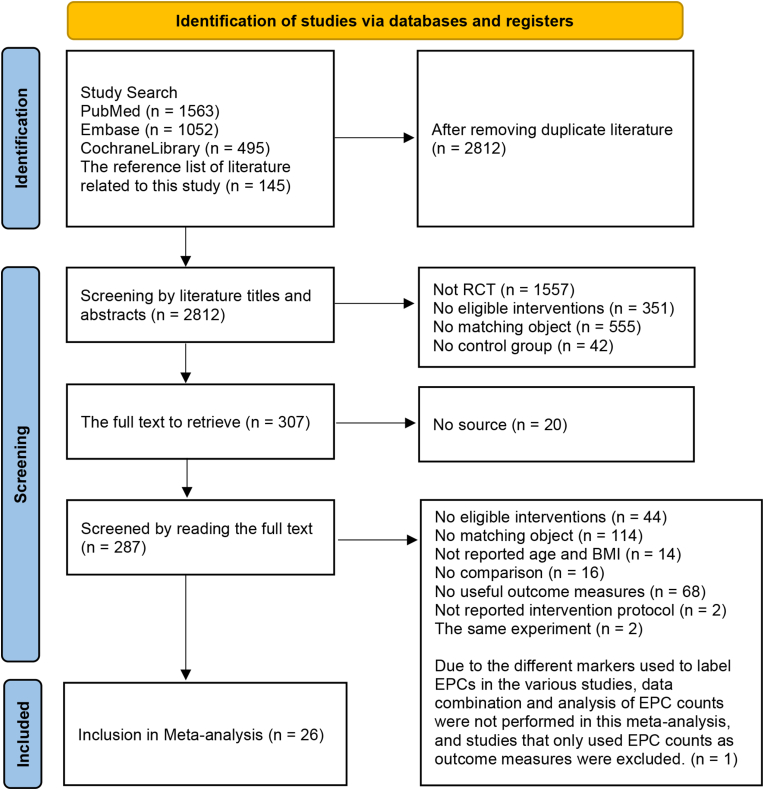
A systematic literature search for related studies published in English was conducted between January 1989 and October 30, 2022, in the PubMed, Embase, and Cochrane Library databases. A random effects model was chosen for meta-analysis, which calculated the effect sizes of control and intervention groups after exercise intervention using standardized mean differences (SMDs) corrected for Hedges' g bias and 95% confidence intervals (95% CIs).
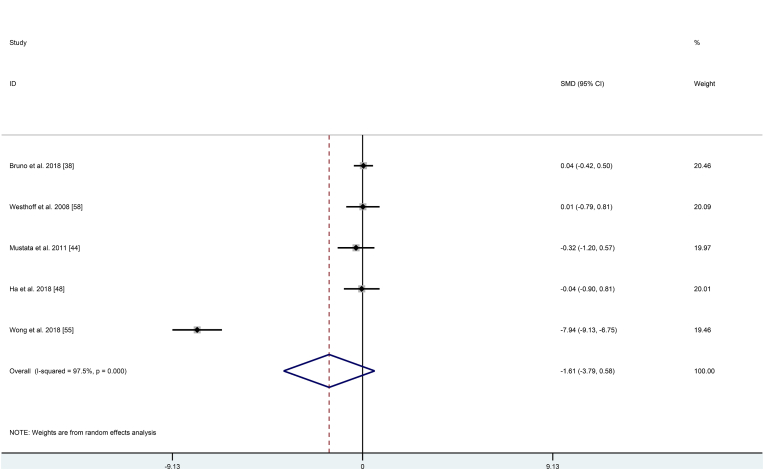
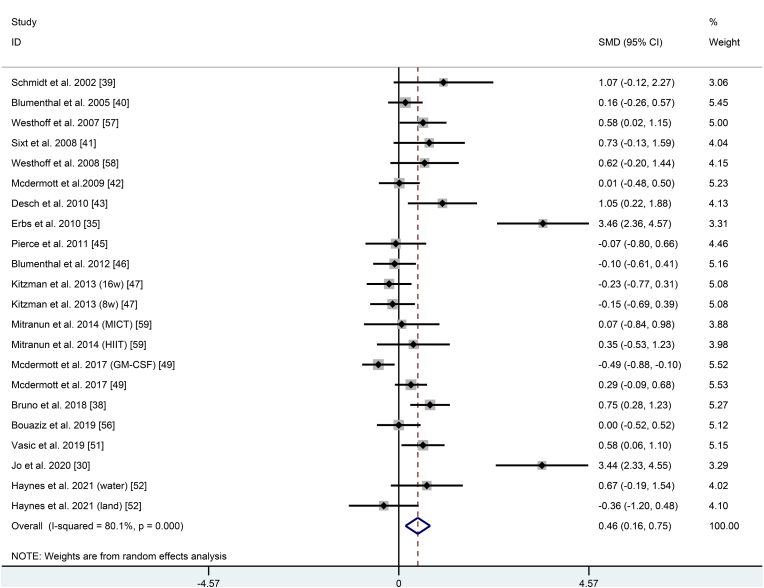
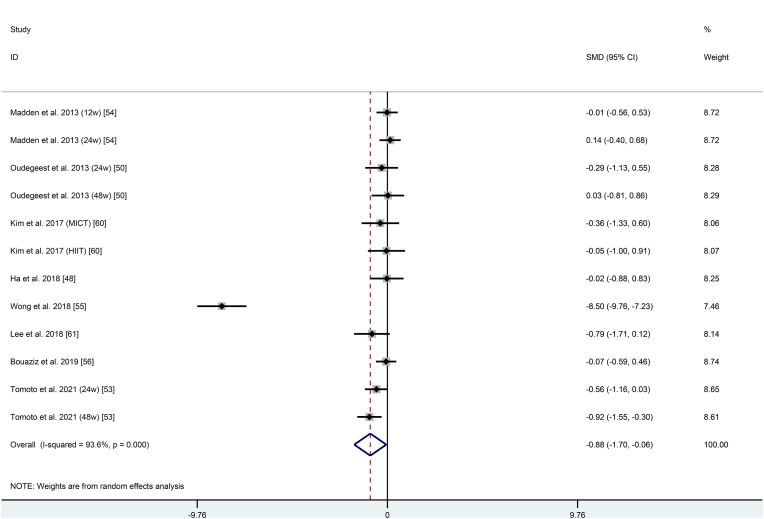
Twenty-six studies containing 1418 participants were included in the study. After excluding three studies contributing to higher heterogeneity by sensitivity analysis, there are small effects of regular aerobic exercise on vascular function of obese and overweight older adults, including flow-mediated dilation (FMD) [SMD = 0.21, 95% CI (0.02, 0.41), z = 2.16, df = 19, I = 52.2%, P = 0.031] and pulse wave velocity (PWV) [SMD = -0.24, 95% CI (-0.46, -0.02), z = 2.17, df = 10, I = 8.6%, P = 0.030], and no significant effect was observed on augmentation index (Aix). Subgroup analysis showed small effects of regular aerobic exercise on FMD [SMD = 0.37, 95% CI (0.13, 0.61), z = 3.05, df = 9, I = 52.6%, P = 0.002] in the overweight not obese subgroup (25 = BMI <30 kg/m), but no significant effect on the obese subgroup (BMI ≥30 kg/m). Regular aerobic exercise for more than 24 weeks improved FMD by small effect sizes [SMD = 0.48, 95% CI (0.04, 0.93), z = 2.12, df = 5, I = 56.4%, P = 0.034] and for more than three times per week improved FMD by moderate effect sizes [SMD = 0.55, 95% CI (0.12, 0.98), z = 2.50, df = 3, I = 31.1%, P = 0.012] in obese and overweight older adults with or without CVD.
In obese and overweight older adults with or without comorbidity, regular aerobic exercise for more than 24 weeks improved FMD by small effect sizes and exercise for more than three times per week improved FMD by moderate effect sizes and regular aerobic exercise reduced PWV by small effect sizes and had no influence on Aix. Taken together, it was recommended that obese and overweight older adults should adhere to regular aerobic exercise, training at least 3 times per week for better results.
超重和肥胖的老年人患心血管疾病的风险很高。有氧运动是改善血管健康的一项重要策略,但有氧运动对肥胖和超重老年人血管内皮功能的影响仍存在争议。本荟萃分析的目的是研究有氧运动对合并或未合并疾病的肥胖和超重老年人血管功能的影响。
于1989年1月至2022年10月30日期间,在PubMed、Embase和Cochrane图书馆数据库中对以英文发表的相关研究进行系统的文献检索。荟萃分析选择随机效应模型,该模型使用经赫奇斯g偏差校正的标准化均数差(SMD)和95%置信区间(95%CI)计算运动干预后对照组和干预组的效应量。
本研究纳入了26项研究,共1418名参与者。通过敏感性分析排除了3项导致异质性较高的研究后,规律有氧运动对肥胖和超重老年人的血管功能有微小影响,包括血流介导的血管舒张(FMD)[SMD = 0.21,95%CI(0.02,0.41),z = 2.16,df = 19,I = 52.2%,P = 0.031]和脉搏波速度(PWV)[SMD = -0.24,95%CI(-0.46,-0.02),z = 2.17,df = 10,I = 8.6%,P = 0.030],而对增强指数(Aix)未观察到显著影响。亚组分析显示,规律有氧运动对超重但不肥胖亚组(25≤BMI<30kg/m²)的FMD有微小影响[SMD = 0.37,95%CI(0.13,0.61),z = 3.05,df = 9,I = 52.6%,P = 0.002],但对肥胖亚组(BMI≥30kg/m²)无显著影响。规律有氧运动超过24周对FMD有微小改善作用[SMD = 0.48,95%CI(0.04,0.93),z = 2.12,df = 5,I = 56.4%,P = 0.034],每周进行三次以上运动对肥胖和超重且合并或未合并心血管疾病的老年人的FMD有中等程度的改善作用[SMD = 0.55,95%CI(0.12,0.98),z = 2.50,df = 3,I = 31.1%,P = 0.012]。
在合并或未合并疾病的肥胖和超重老年人中,规律有氧运动超过24周对FMD有微小改善作用,每周进行三次以上运动对FMD有中等程度的改善作用,规律有氧运动对PWV有微小降低作用,对Aix无影响。综上所述,建议肥胖和超重老年人应坚持规律有氧运动,每周至少锻炼3次以获得更好的效果。