Ekrami Alireza, Abbasi Montazeri Effat, Kaydani Gholam Abbas, Shokoohizadeh Leili
Infectious and Tropical Diseases Research Center, Ahvaz Jundishapur University of Medical Sciences, Ahvaz, Iran. ; Department of Medical laboratory Sciences, School of Para medicine, Ahvaz Jundishapur University of Medical Sciences, Ahvaz, Iran.
Department of Microbiology, School of Medicine, Ahvaz Jundishapur University of Medical Sciences, Ahvaz, Iran.
Iran J Microbiol. 2015 Aug;7(4):208-13.
Methicillin resistance Staphylococcus aureus (MRSA) and coagulase negative staphylococci (MRCoNS) have recognized as the major cause of nosocomial infections that threat the burn patient's life. The aims of this study were to determine the frequency of MRSA and MRCoNS and their antibiotic resistance patterns among burn patients in a burn center in Ahvaz, Iran.
A total of 340 clinical specimens: (80%) wound and (20%) blood were obtained from patients in Taleghani burn hospital during February 2013-2014. Staphylococci species identification and antibiogram were performed by standard procedures using disk diffusion method. The Methicillin resistance strains were detected by Etest and PCR using mecA specific primers.
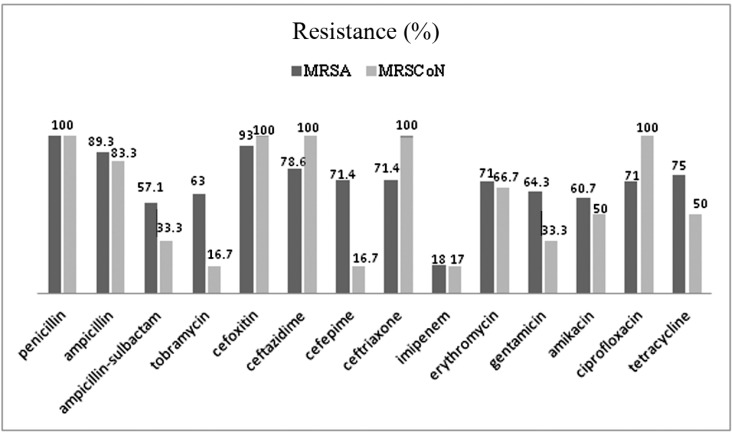
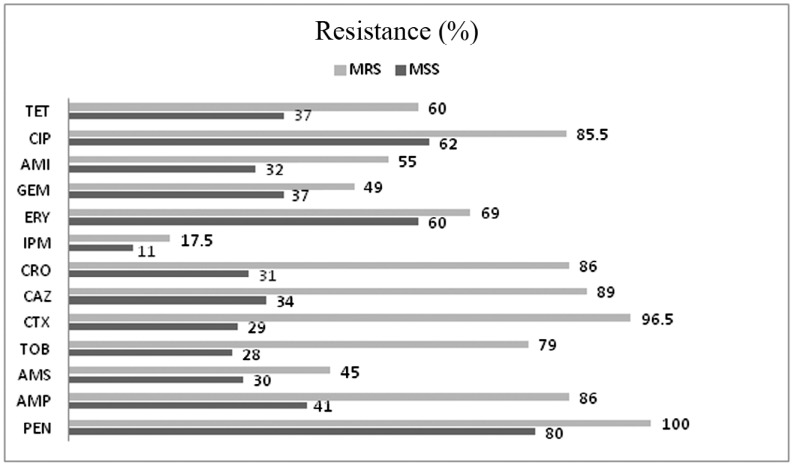
Out of 30.2% (103) isolates that were recognized as staphylococci, 82 % (84) and 18% (19) were identified as S. aureus and coagulase negative staphylococci (CoNS) respectively. Resistance to methicillin was detected in 60% and 63% of the S. aureus and CoNS isolates respectively. Seven different antimicrobial resistance patterns observed among methicillin resistant staphylococci. The MRSA and MRCoNS strains showed closed resistance phenotypes. All the methicillin resistant isolates showed a high rate resistance to the other studied antibiotics in comparison to methicilin sensitive isolates. Vancomycin and imipenem showed the greatest effect against methicillin resistant isolates. During 8 years in the studied burn hospital, no significant changes in the methicillin resistance staphylococci frequency were detected.
The presence of multi resistant MRSA and MRCoNS strains is cause of concern in burn hospitals. Vancomycin remains as a drug of choice for methicillin resistance staphylococci infections.
耐甲氧西林金黄色葡萄球菌(MRSA)和凝固酶阴性葡萄球菌(MRCoNS)已被确认为威胁烧伤患者生命的医院感染的主要原因。本研究的目的是确定伊朗阿瓦士一家烧伤中心烧伤患者中MRSA和MRCoNS的发生率及其抗生素耐药模式。
2013年2月至2014年期间,从塔莱哈尼烧伤医院的患者中采集了共340份临床标本:(80%)伤口标本和(20%)血液标本。采用纸片扩散法,通过标准程序进行葡萄球菌菌种鉴定和药敏试验。使用Etest和mecA特异性引物进行PCR检测耐甲氧西林菌株。
在被鉴定为葡萄球菌的30.2%(103株)分离株中,82%(84株)和18%(19株)分别被鉴定为金黄色葡萄球菌和凝固酶阴性葡萄球菌(CoNS)。金黄色葡萄球菌和CoNS分离株中分别有60%和63%检测到对甲氧西林耐药。在耐甲氧西林葡萄球菌中观察到七种不同的抗菌耐药模式。MRSA和MRCoNS菌株表现出相似的耐药表型。与甲氧西林敏感分离株相比,所有耐甲氧西林分离株对其他研究的抗生素均表现出高耐药率。万古霉素和亚胺培南对耐甲氧西林分离株显示出最大的抗菌效果。在所研究的烧伤医院的8年期间,未检测到耐甲氧西林葡萄球菌发生率的显著变化。
多重耐药的MRSA和MRCoNS菌株的存在是烧伤医院令人担忧的问题。万古霉素仍然是耐甲氧西林葡萄球菌感染的首选药物。