Suriyakhun Nawarat, Jangsangthong Arunee, Tunyong Witawat, Kong-Ngoen Thida, Santajit Sirijan, Indrawattana Nitaya, Buranasinsup Shutipen
Prasu-Arthorn Animal Hospital, Faculty of Veterinary Science, Mahidol University, 73170 Nakhon Pathom, Thailand.
Department of Pre-clinic and Applied Animal Science, Faculty of Veterinary Science, Mahidol University, 73710 Nakorn Pathom, Thailand.
Vet World. 2024 Jun;17(6):1328-1335. doi: 10.14202/vetworld.2024.1328-1335. Epub 2024 Jun 21.
Staphylococci, which inhabit skin and mucous membranes in humans and animals, are opportunistic pathogens. Coagulase-positive and coagulase-negative staphylococci (CoNS) are the two main groups. Clinical abscesses in rabbits often harbor and CoNS. This study estimated and CoNS prevalence, resistance profiles, antimicrobial-resistant genes, and the accessory gene regulator () group in rabbit clinical abscesses.
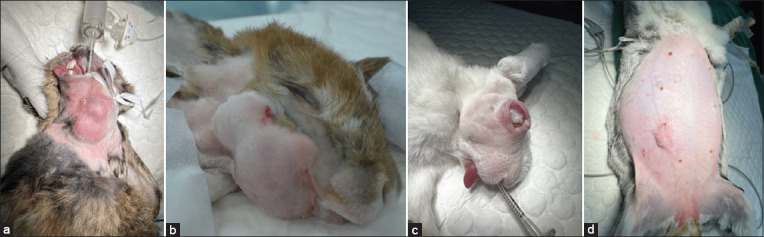
Sixty-seven abscesses were gathered from 67 rabbits who visited Prasu-Arthorn Animal Hospital in Nakornpathom, Thailand, from January 2014 to October 2015. Thirty-four subcutaneous, 29 dental, 2 ocular, 1 mammary gland, and 1 uterine abscess were present. Conventional methods, including Gram staining, mannitol fermentation, hemolysis on blood agar, catalase testing, and coagulase production, identified and isolated and CoNS from all abscesses. All and CoNS isolates underwent antimicrobial susceptibility testing using the disk diffusion method. Polymerase chain reaction was used to detect the presence of Z, A-D, A, K, A, A, G, and antimicrobial-resistant genes. Methicillin resistance was identified through the detection of a cefoxitin-resistant phenotype and the presence of A gene. Further investigation was conducted on the group of isolates.
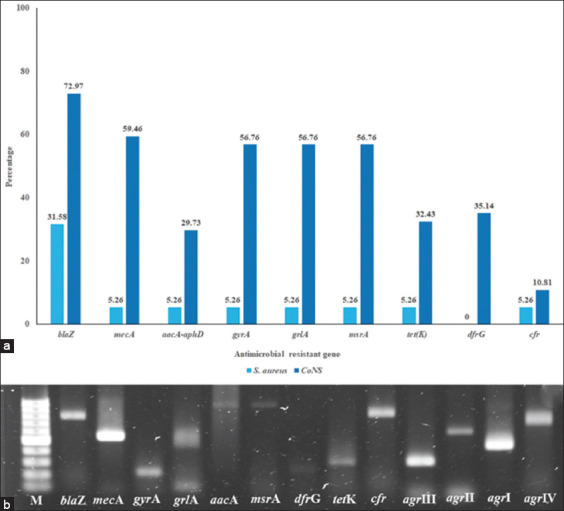
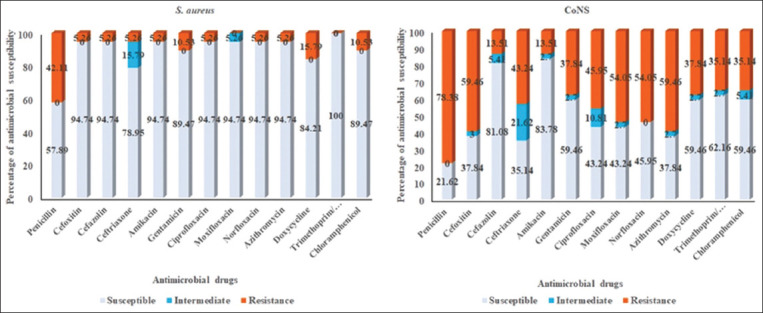
In 67 abscesses, we found 19 isolates in 9 abscesses (13.43%) and 37 CoNS isolates in 18 abscesses (26.87%), both majorly located at subcutaneous sites. About 59.46% of CoNS isolates were methicillin-resistant compared to 5.26% of isolates. Methicillin-resistant (MRSA) and methicillin-resistant CoNS (MRCoNS) both displayed multidrug resistance (MDR). Both MRSA and MRCoNS expressed multiple antimicrobial resistance genes, including Z, A-D, A, A, A, K, and G. Approximately 73.68% of the groups were I, 15.79% were III, and 10.53% were II.
This study found a high prevalence of MRCoNS with antimicrobial resistance and multiple antimicrobial-resistant genes in rabbits with clinical abscesses. The effectiveness of antibiotics against infections caused by such strains is a matter of concern. Owners should be educated about the importance of good hygiene practices and judicious antibiotic use to prevent widespread antimicrobial resistance.
葡萄球菌寄居于人和动物的皮肤及黏膜,是机会致病菌。凝固酶阳性葡萄球菌和凝固酶阴性葡萄球菌(CoNS)是两个主要类别。兔的临床脓肿中常含有CoNS。本研究评估了兔临床脓肿中CoNS的患病率、耐药谱、耐药基因及葡萄球菌辅助基因调节子(agr)组。
2014年1月至2015年10月期间,从泰国佛统府Prasu - Arthorn动物医院就诊的67只兔身上采集了67个脓肿样本。其中有34个皮下脓肿、29个牙源性脓肿、2个眼部脓肿、1个乳腺脓肿和1个子宫脓肿。通过常规方法,包括革兰氏染色、甘露醇发酵、血琼脂平板上的溶血试验、过氧化氢酶检测和凝固酶生成试验,从所有脓肿样本中鉴定并分离出CoNS。所有CoNS分离株采用纸片扩散法进行药敏试验。采用聚合酶链反应检测Z、A - D、A、K、A、A、G和agr抗菌耐药基因的存在情况。通过检测头孢西丁耐药表型和A基因的存在来鉴定耐甲氧西林情况。对CoNS分离株的agr组进行了进一步研究。
在67个脓肿样本中,我们在9个脓肿(13.43%)中发现了19株CoNS分离株,在18个脓肿(26.87%)中发现了37株CoNS分离株,两者主要位于皮下部位。约59.46%的CoNS分离株耐甲氧西林,而CoNS分离株为5.26%。耐甲氧西林金黄色葡萄球菌(MRSA)和耐甲氧西林CoNS(MRCoNS)均表现出多重耐药(MDR)。MRSA和MRCoNS均表达多种抗菌耐药基因,包括Z, A - D, A, A, A, K和G。约73.68%的agr组为agr I,15.79%为agr III,10.53%为agr II。
本研究发现兔临床脓肿中MRCoNS的患病率较高,且具有抗菌耐药性和多种抗菌耐药基因。针对此类菌株引起的感染,抗生素治疗的有效性令人担忧。应教育兔主人注意良好卫生习惯和合理使用抗生素的重要性,以防止抗菌耐药性的广泛传播。