Halaweh Hadeel, Svantesson Ulla, Rosberg Susanne, Willen Carin
Department of Physiotherapy, Institute of Neuroscience and Physiology, University of Gothenburg, Gothenburg, Sweden.
Med Princ Pract. 2016;25(1):1-7. doi: 10.1159/000441128. Epub 2015 Oct 20.
The aim of this study was to evaluate the validity and reliability of an Arabic language version (Ar) of the Falls Efficacy Scale-International (FES-I) with respect to its use with Arabic-speaking elderly subjects.
For cross-cultural adaptation, the translation of the original English version of the scale was conducted based on the protocol of the Prevention of Falls Network Europe (ProFaNE). The FES-I (Ar) was administered via face-to-face interviews to 108 community-dwelling elderly Palestinians (61 women and 47 men, aged 60-84 years). Statistical analyses were used to determine group differences with respect to age, gender and fall history. To assess validity, Spearman's rank correlation coefficient was used to examine the correlation between the total scores of FES-I (Ar) and the Timed Up and Go (TUG) test, gait speed and balance. Test-retest reliability between the two test occasions was assessed in accordance with Svensson's method.
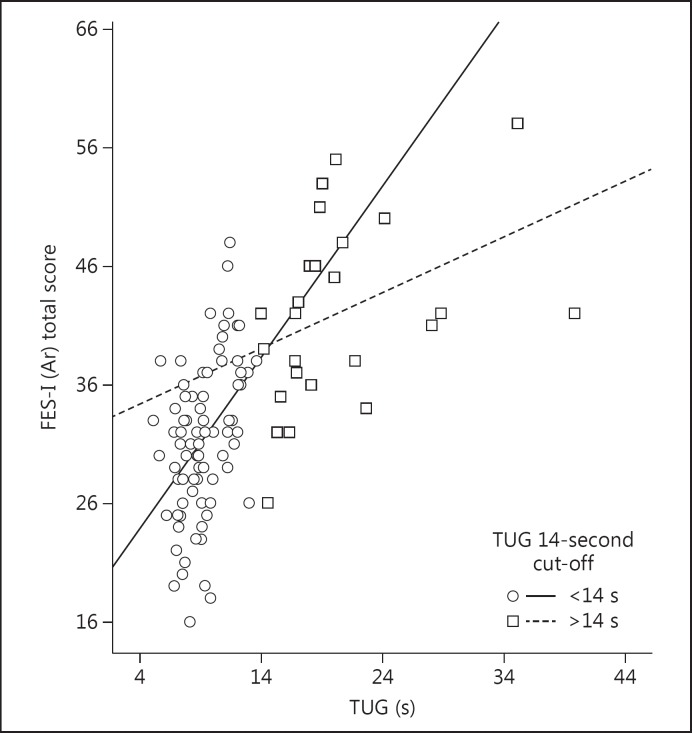
The FES-I (Ar) total scores were positively correlated with TUG (r(s) = 0.641, p < 0.001) and negatively correlated with gait speed (r(s) = -0.670, p < 0.001) and balance (r(s) = -0.592, p < 0.001). All items of the FES-I (Ar) indicated a high percentage agreement (from 88 to 93%), and the relative position ranged from 0.01 to 0.06.
In this study, the FES-I (Ar) was shown to be a comprehensible, valid and reliable measure of the concern about falling among community-dwelling elderly subjects. In clinical practice and future research, the FES-I (Ar) instrument could be used to effectively assess concern about falling in Arabic-speaking elderly persons.
本研究旨在评估国际跌倒效能量表(FES-I)阿拉伯语版本(Ar)在说阿拉伯语的老年受试者中使用的有效性和可靠性。
为进行跨文化改编,根据欧洲预防跌倒网络(ProFaNE)的方案对该量表的原始英文版进行翻译。通过面对面访谈对108名居住在社区的巴勒斯坦老年受试者(61名女性和47名男性,年龄60 - 84岁)施测FES-I(Ar)。采用统计分析确定年龄、性别和跌倒史方面的组间差异。为评估有效性,使用Spearman等级相关系数检验FES-I(Ar)总分与计时起立行走(TUG)测试、步速和平衡之间的相关性。根据Svensson方法评估两次测试之间的重测信度。
FES-I(Ar)总分与TUG呈正相关(r(s) = 0.641,p < 0.001),与步速呈负相关(r(s) = -0.670,p < 0.001),与平衡呈负相关(r(s) = -0.592,p < 0.001)。FES-I(Ar)的所有项目显示出较高的百分比一致性(从88%到93%),相对位置范围为0.01至0.06。
在本研究中,FES-I(Ar)被证明是一种可理解、有效且可靠的衡量社区居住老年受试者跌倒担忧程度的指标。在临床实践和未来研究中,FES-I(Ar)工具可用于有效评估说阿拉伯语老年人的跌倒担忧。