Rogan Slavko, Radlinger Lorenz, Imhasly Caroline, Kneubuehler Andrea, Hilfiker Roger
Department of Health, Discipline of Physiotherapy, Bern University of Applied Sciences, Bern, Switzerland ; Academy for Integrative Physiotherapy and Training Education, Grenzach-Wyhlen, Germany.
Department of Health, Discipline of Physiotherapy, Bern University of Applied Sciences, Bern, Switzerland.
Asian J Sports Med. 2015 Dec;6(4):e25561. doi: 10.5812/asjsm.25561. Epub 2015 Dec 1.
In the field of vertical jump diagnostics, force plates (FP) are the reference standard. Recently, despite a lack of evidence, jump mats have been used increasingly. Important factors in favor of jumping mats are their low cost and portability.
This validity study compared the Haynl-Elektronik jump mat (HE jump mat) with the reference standard force plate.
Ten healthy volunteers participated and each participant completed three series of five drop jumps (DJ). The parameters ground contact time (GCT) and vertical jump height (VJH) from the HE jump mat and the FP were used to evaluate the concurrent validity. The following statistical calculations were performed: Pearson's correlation (r), Bland-Altman plots (standard and for adjusted trend), and regression equations.
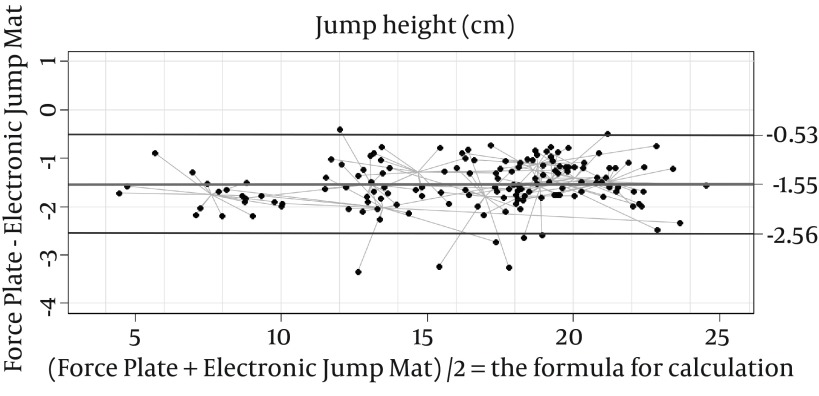
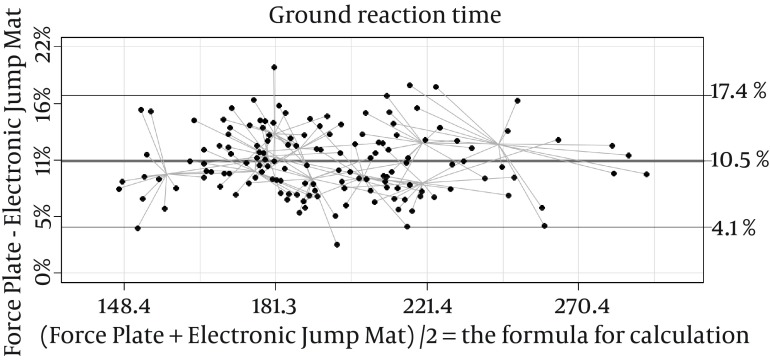
The Bland-Altman plots suggest that the HE jump mat measures shorter contact times and higher jump heights than the FP. The trend-adjusted Bland-Altman plot shows higher mean differences and wider wing-spreads of confidence limits during longer GCT. During the VJH the mean differences and the wing-spreads of the confidence limits throughout the range present as relatively constant. The following regression equations were created, as close as possible to the true value: GCT = 5.920385 + 1.072293 × [value HE jump mat] and VJH = -1.73777 + 1.011156 × [value HE jump mat].
The HE jump mat can be recommended in relation to the validity of constraints. In this study, only a part of the quality criteria were examined. For the final recommendation it is advised to examine the HE jump mat on the other quality criteria (test-retest reliability, sensitivity change).
在垂直跳跃诊断领域,测力板(FP)是参考标准。最近,尽管缺乏证据,但跳跃垫的使用越来越多。支持跳跃垫的重要因素是其低成本和便携性。
本效度研究将海尼尔电子跳跃垫(HE跳跃垫)与参考标准测力板进行比较。
10名健康志愿者参与,每位参与者完成三组,每组五次下蹲跳(DJ)。使用HE跳跃垫和测力板的地面接触时间(GCT)和垂直跳跃高度(VJH)参数来评估同时效度。进行了以下统计计算:皮尔逊相关性(r)、布兰德-奥特曼图(标准图和调整趋势图)以及回归方程。
布兰德-奥特曼图表明,HE跳跃垫测量的接触时间比测力板短,跳跃高度比测力板高。趋势调整后的布兰德-奥特曼图显示,在较长的GCT期间,平均差异更大,置信区间的翼展更宽。在VJH期间,整个范围内的平均差异和置信区间的翼展呈现相对恒定。创建了以下尽可能接近真实值的回归方程:GCT = 5.920385 + 1.072293 × [HE跳跃垫的值],VJH = -1.73777 + 1.011156 × [HE跳跃垫的值]。
就限制条件的效度而言,HE跳跃垫可以被推荐。在本研究中,仅检查了部分质量标准。为了给出最终推荐,建议根据其他质量标准(重测信度、敏感性变化)对HE跳跃垫进行检验。