Szanto Katalin, Bruine de Bruin Wändi, Parker Andrew M, Hallquist Michael N, Vanyukov Polina M, Dombrovski Alexandre Y
Department of Psychiatry, University of Pittsburgh, 3811 O'Hara St, Pittsburgh, PA 15213
J Clin Psychiatry. 2015 Dec;76(12):e1590-7. doi: 10.4088/JCP.15m09778.
The propensity of people vulnerable to suicide to make poor life decisions is increasingly well documented. Do they display an extreme degree of decision biases? The present study used a behavioral-decision approach to examine the susceptibility of low-lethality and high-lethality suicide attempters to common decision biases that may ultimately obscure alternative solutions and deterrents to suicide in a crisis.
We assessed older and middle-aged (42-97 years) individuals who made high-lethality (medically serious) (n = 31) and low-lethality suicide attempts (n = 29). Comparison groups included suicide ideators (n = 30), nonsuicidal depressed participants (n = 53), and psychiatrically healthy participants (n = 28). Attempters, ideators, and nonsuicidal depressed participants had nonpsychotic major depression (DSM-IV criteria). Decision biases included sunk cost (inability to abort an action for which costs are irrecoverable), framing (responding to superficial features of how a problem is presented), underconfidence/overconfidence (appropriateness of confidence in knowledge), and inconsistent risk perception. Data were collected between June 2010 and February 2014.
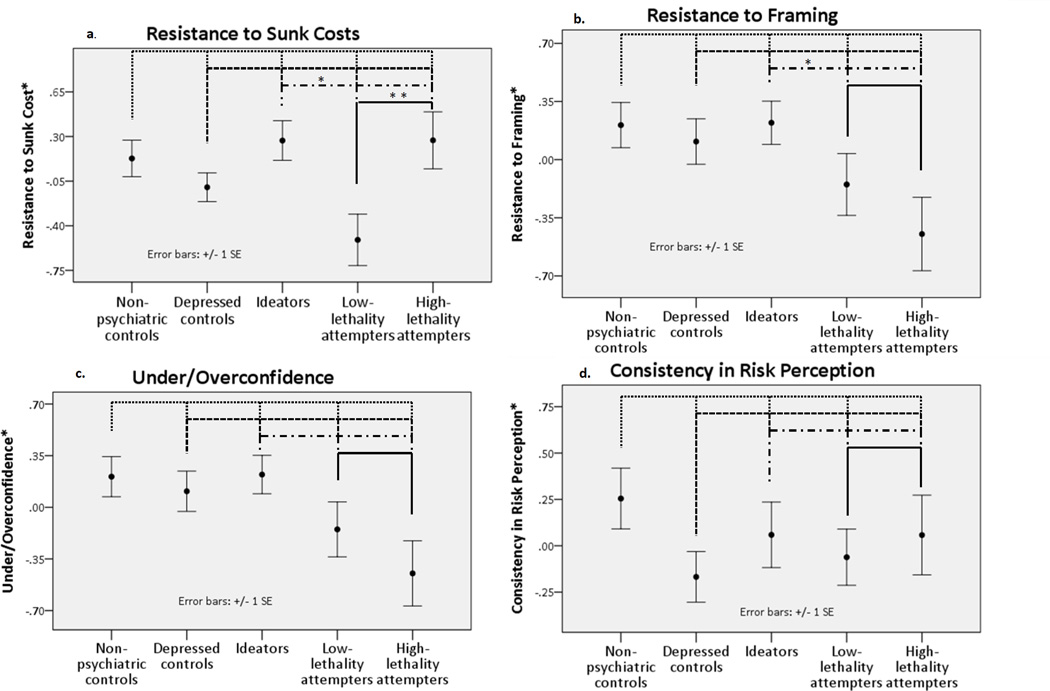
Both high- and low-lethality attempters were more susceptible to framing effects as compared to the other groups included in this study (P ≤ .05, ηp2 = 0.06). In contrast, low-lethality attempters were more susceptible to sunk costs than both the comparison groups and high-lethality attempters (P ≤ .01, ηp2 = 0.09). These group differences remained after accounting for age, global cognitive performance, and impulsive traits. Premorbid IQ partially explained group differences in framing effects.
Suicide attempters' failure to resist framing may reflect their inability to consider a decision from an objective standpoint in a crisis. Failure of low-lethality attempters to resist sunk cost may reflect their tendency to confuse past and future costs of their behavior, lowering their threshold for acting on suicidal thoughts.
越来越多的文献记载了易自杀人群做出糟糕生活决策的倾向。他们是否表现出极端程度的决策偏差?本研究采用行为决策方法,来检验低致死率和高致死率自杀未遂者对常见决策偏差的易感性,这些偏差最终可能会掩盖危机中自杀的替代解决方案和威慑因素。
我们评估了年龄较大和中年(42 - 97岁)的个体,他们分别进行了高致死率(医学上严重)的自杀未遂(n = 31)和低致死率的自杀未遂(n = 29)。对照组包括有自杀意念者(n = 30)、无自杀行为的抑郁症患者(n = 53)和精神健康参与者(n = 28)。自杀未遂者、有自杀意念者和无自杀行为的抑郁症患者均患有非精神病性重度抑郁症(符合《精神疾病诊断与统计手册第四版》标准)。决策偏差包括沉没成本(无法中止一项成本已无法收回的行动)、框架效应(对问题呈现方式的表面特征做出反应)、信心不足/过度自信(对知识的信心是否恰当)以及不一致的风险认知。数据收集于2010年6月至2014年2月期间。
与本研究中的其他组相比,高致死率和低致死率的自杀未遂者都更容易受到框架效应的影响(P≤.05,ηp2 = 0.06)。相比之下,低致死率的自杀未遂者比对照组和高致死率的自杀未遂者更容易受到沉没成本的影响(P≤.01,ηp2 = 0.09)。在考虑了年龄、整体认知能力和冲动特质后,这些组间差异仍然存在。病前智商部分解释了框架效应中的组间差异。
自杀未遂者无法抗拒框架效应,可能反映出他们在危机中无法从客观角度考虑决策。低致死率的自杀未遂者无法抗拒沉没成本,可能反映出他们倾向于混淆其行为的过去和未来成本,降低了他们依据自杀念头采取行动的阈值。