Department of Psychiatry and Human Behavior, Alpert Medical School, Brown University, Providence, RI, USA.
Center for Neurorestoration and Neurotechnology, Providence VA Medical Center, Providence, RI, USA.
Neuromodulation. 2021 Jul;24(5):930-937. doi: 10.1111/ner.13376. Epub 2021 Mar 1.
Repetitive transcranial magnetic stimulation (TMS) is a promising treatment for suicidality, but it is underlying neural mechanisms remain poorly understood. Our prior findings indicated that frontostriatal functional connectivity correlates with the severity of suicidal thoughts and behaviors. In this secondary analysis of data from an open label trial, we evaluated whether changes in frontostriatal functional connectivity would accompany suicidality reductions following TMS. We also explored the relationship between frontostriatal connectivity change and underlying white matter (WM) organization.
We conducted seed-based functional connectivity analysis on participants (N = 25) with comorbid post-traumatic stress disorder and depression who received eight weeks of 5 Hz TMS to left dorsolateral prefrontal cortex. We measured clinical symptoms with the Inventory of Depressive Symptomatology-Self Report (IDS-SR) and the PTSD Checklist for DSM-5 (PCL-5). We derived suicidality from IDS-SR item 18. Magnetic resonance imaging data were collected before TMS, and at treatment end point. These data were entered into analyses of covariance, evaluating the effect of suicidality change across treatment on striatal and thalamic functional connectivity. Changes in other PTSD and depression symptoms were included as covariates and results were corrected for multiple comparisons. Diffusion connectometry in a participant subsample (N = 17) explored the relationship between frontal WM integrity at treatment baseline and subsequent functional connectivity changes correlated with differences in suicidality.
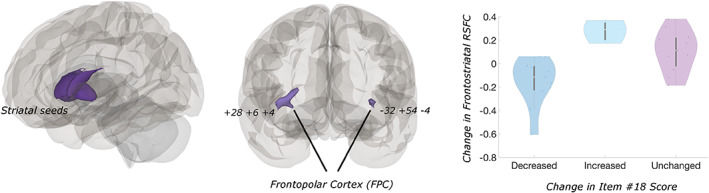
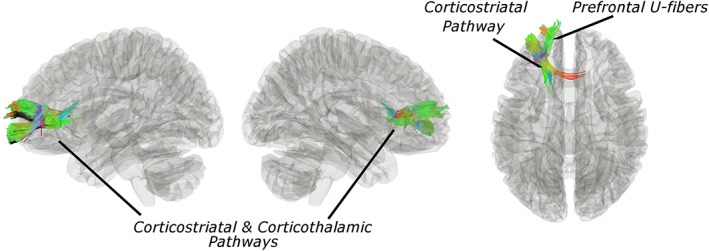
Suicidal ideation decreased in 65% of participants. Reductions in suicidality and functional connectivity between the dorsal striatum and frontopolar cortex were correlated (p-False Discover Rate-corrected < 0.001), after covariance for clinical symptom change. All other results were nonsignificant. Our connectometry results indicated that the integrity of frontostriatal WM may circumscribe functional connectivity response to TMS for suicide.
Targeted reduction of fronto-striatal connectivity with TMS may be a promising treatment for suicidality. Future research can build on this multimodal approach to advance individualized stimulation approaches in high-risk patients.
重复经颅磁刺激(TMS)是一种有前途的治疗自杀的方法,但它的潜在神经机制仍知之甚少。我们之前的研究结果表明,额-纹状体功能连接与自杀念头和行为的严重程度相关。在这项开放标签试验数据的二次分析中,我们评估了 TMS 后自杀意念减轻是否伴随着额-纹状体功能连接的变化。我们还探讨了额-纹状体连接变化与潜在的白质(WM)组织之间的关系。
我们对 25 名患有创伤后应激障碍和抑郁症共病的参与者进行了基于种子的功能连接分析,这些参与者接受了 8 周的 5Hz TMS 治疗左背外侧前额叶皮层。我们使用抑郁症状自评量表-自我报告(IDS-SR)和 PTSD 检查表-5(PCL-5)来衡量临床症状。我们从 IDS-SR 项目 18 中得出自杀倾向。在 TMS 之前和治疗结束时采集磁共振成像数据。这些数据被输入协方差分析,评估治疗过程中自杀倾向变化对纹状体和丘脑功能连接的影响。将其他 PTSD 和抑郁症状的变化作为协变量纳入,并对结果进行了多次比较校正。在一个参与者亚样本(N=17)中进行扩散连接测量,以探索治疗基线时额 WM 完整性与随后与自杀倾向差异相关的功能连接变化之间的关系。
65%的参与者出现自杀意念减少。在协方差为临床症状变化后,自杀倾向和背侧纹状体与额极皮质之间的功能连接减少呈正相关(p-False Discover Rate 校正<0.001)。所有其他结果均无统计学意义。我们的连接测量结果表明,额纹状体 WM 的完整性可能限制了 TMS 对自杀的功能连接反应。
TMS 靶向减少额-纹状体连接可能是治疗自杀的一种有前途的方法。未来的研究可以在此多模态方法的基础上,为高危患者推进个体化刺激方法。