Halland Magnus, Bharucha Adil E
Division of Gastroenterology and Hepatology, Department of Internal Medicine, Mayo Clinic, Rochester, Minnesota.
Division of Gastroenterology and Hepatology, Department of Internal Medicine, Mayo Clinic, Rochester, Minnesota.
Clin Gastroenterol Hepatol. 2016 Jul;14(7):929-36. doi: 10.1016/j.cgh.2015.11.021. Epub 2015 Dec 21.
BACKGROUND & AIMS: Hyperglycemia is implicated as a major risk factor for delayed gastric emptying in diabetes mellitus and vice versa. However, the extent to which hyperglycemia can affect gastric emptying and vice versa and the implications for clinical practice are unclear. We systematically reviewed the evidence for this bidirectional relationship and the effects of pharmacotherapy for diabetes on gastric emptying.
Full-length articles investigating the relationship between diabetes mellitus and gastroparesis were reviewed primarily to quantify the relationship between blood glucose concentrations and gastrointestinal sensorimotor functions, particularly gastric emptying, and gastrointestinal symptoms. The effects of drugs and hormones that affect glycemia on gastrointestinal sensorimotor functions were also evaluated.
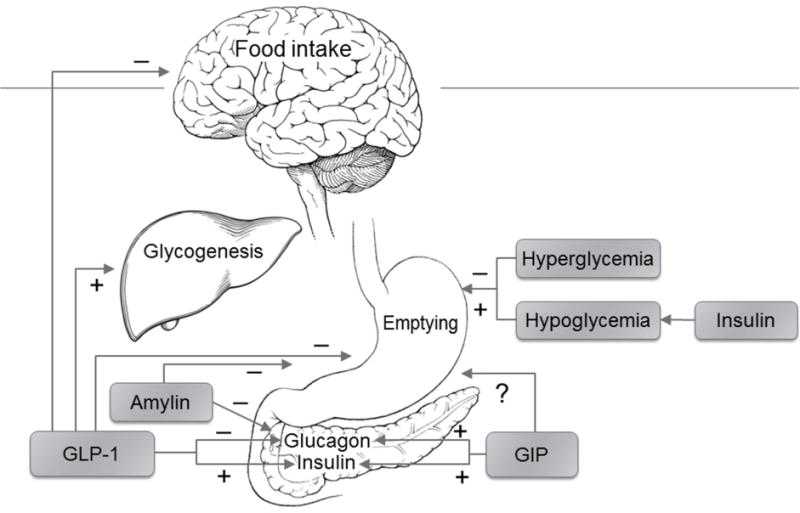
Acute severe hyperglycemia delayed gastric emptying relative to euglycemia in type 1 diabetes; the corresponding effects in type 2 diabetes are unknown. Limited evidence suggests that even mild hyperglycemia (8 mmol/L) can delay gastric emptying in type 1 diabetes. Long-term hyperglycemia is an independent risk factor for delayed gastric emptying in type 1 diabetes. There is little evidence that delayed gastric emptying causes hypoglycemia in diabetes and no evidence that improved control of glycemia improves gastric emptying or vice versa. Glucagon-like peptide-1 agonists but not dipeptidylpeptidase-4 inhibitors given acutely delay gastric emptying, but tachyphylaxis may occur.
Although acute severe and chronic hyperglycemia can delay gastric emptying, there is limited evidence that delayed gastric emptying is an independent risk factor for impaired glycemic control or hypoglycemia in diabetes. The impact of improved glycemic control on gastric emptying and vice versa in diabetes is unknown.
高血糖被认为是糖尿病患者胃排空延迟的主要危险因素,反之亦然。然而,高血糖对胃排空的影响程度以及胃排空对高血糖的影响程度,及其对临床实践的意义尚不清楚。我们系统回顾了这种双向关系的证据以及糖尿病药物治疗对胃排空的影响。
主要回顾了研究糖尿病与胃轻瘫关系的全文文章,以量化血糖浓度与胃肠道感觉运动功能(尤其是胃排空)及胃肠道症状之间的关系。还评估了影响血糖的药物和激素对胃肠道感觉运动功能的影响。
与1型糖尿病患者的正常血糖水平相比,急性严重高血糖会延迟胃排空;2型糖尿病患者的相应影响尚不清楚。有限的证据表明,即使是轻度高血糖(8 mmol/L)也会延迟1型糖尿病患者的胃排空。长期高血糖是1型糖尿病患者胃排空延迟的独立危险因素。几乎没有证据表明胃排空延迟会导致糖尿病患者低血糖,也没有证据表明改善血糖控制能改善胃排空,反之亦然。急性给予胰高血糖素样肽-1激动剂而非二肽基肽酶-4抑制剂会延迟胃排空,但可能会出现快速耐受。
尽管急性严重和慢性高血糖会延迟胃排空,但有限的证据表明胃排空延迟是糖尿病患者血糖控制受损或低血糖的独立危险因素。改善血糖控制对糖尿病患者胃排空的影响以及反之亦然尚不清楚。