Gimenez Fernanda, Mulik Sachin, Veiga-Parga Tamara, Bhela Siddheshvar, Rouse Barry T
Department of Biomedical and Diagnostic Sciences, College of Veterinary Medicine, University of Tennessee, 1414 Cumberland Avenue, Knoxville, TN, 37996, United States of America.
Immune Disease Institute and Program in Cellular and Molecular Medicine, Children's Hospital Boston, Harvard Medical School, Boston, MA, United States of America.
PLoS One. 2015 Dec 31;10(12):e0141925. doi: 10.1371/journal.pone.0141925. eCollection 2015.
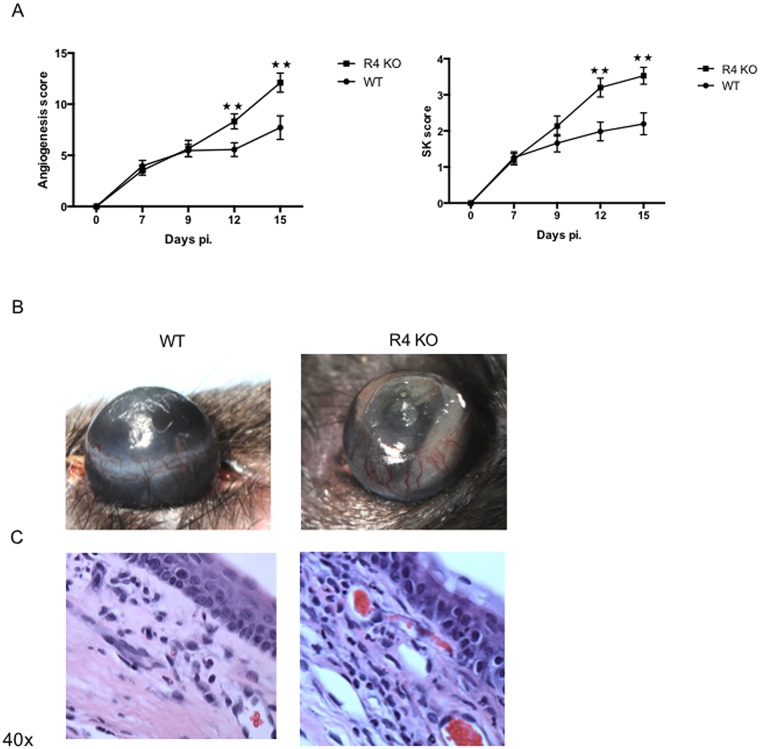
The cornea is a complex tissue that must preserve its transparency to maintain optimal vision. However, in some circumstances, damage to the eye can result in neovascularization that impairs vision. This outcome can occur when herpes simplex virus type 1 (HSV-1) causes the immunoinflammatory lesion stromal keratitis (SK). Potentially useful measures to control the severity of SK are to target angiogenesis which with herpetic SK invariably involves VEGF. One such way to control angiogenesis involves the endothelial receptor Robo4 (R4), which upon interaction with another protein activates an antiangiogenic pathway that counteracts VEGF downstream signaling. In this study we show that mice unable to produce R4 because of gene knockout developed significantly higher angiogenesis after HSV-1 ocular infection than did infected wild type (WT) controls. Moreover, providing additional soluble R4 (sR4) protein by subconjunctival administration to R4 KO HSV-1 infected mice substantially rescued the WT phenotype. Finally, administration of sR4 to WT HSV-1 infected mice diminished the extent of corneal angiogenesis compared to WT control animals. Our results indicate that sR4 could represent a useful therapeutic tool to counteract corneal angiogenesis and help control the severity of SK.
角膜是一种复杂的组织,必须保持其透明度以维持最佳视力。然而,在某些情况下,眼部损伤会导致新血管形成,从而损害视力。当1型单纯疱疹病毒(HSV-1)引起免疫炎性病变基质性角膜炎(SK)时,就会出现这种结果。控制SK严重程度的潜在有用措施是针对血管生成,疱疹性SK总是涉及血管内皮生长因子(VEGF)。一种控制血管生成的方法涉及内皮受体Robo4(R4),它与另一种蛋白质相互作用后会激活一条抗血管生成途径,该途径可抵消VEGF的下游信号传导。在本研究中,我们发现由于基因敲除而无法产生R4的小鼠在HSV-1眼部感染后产生的血管生成明显高于受感染的野生型(WT)对照小鼠。此外,通过结膜下给药向R4基因敲除的HSV-1感染小鼠提供额外的可溶性R4(sR4)蛋白,可显著恢复野生型表型。最后,与野生型对照动物相比,向野生型HSV-1感染小鼠给药sR4可减少角膜血管生成的程度。我们的结果表明,sR4可能是一种有用的治疗工具,可对抗角膜血管生成并有助于控制SK的严重程度。