Um Ji Hyun, Choi Myounggeun, Park Hyeji, Cho Yong-Hun, Dunand David C, Choe Heeman, Sung Yung-Eun
School of Chemical and Biological Engineering, Seoul National University, Seoul 151-742, Republic of Korea.
Center for Nanoparticle Research, Institute for Basic Science (IBS), Seoul 151-742, Republic of Korea.
Sci Rep. 2016 Jan 4;6:18626. doi: 10.1038/srep18626.
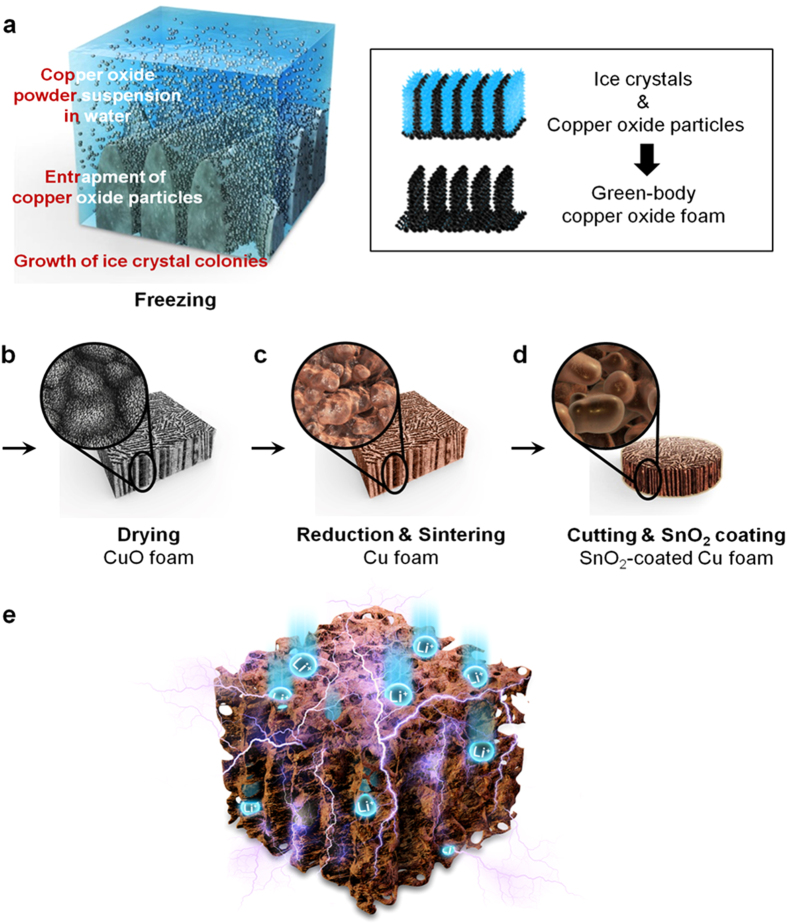
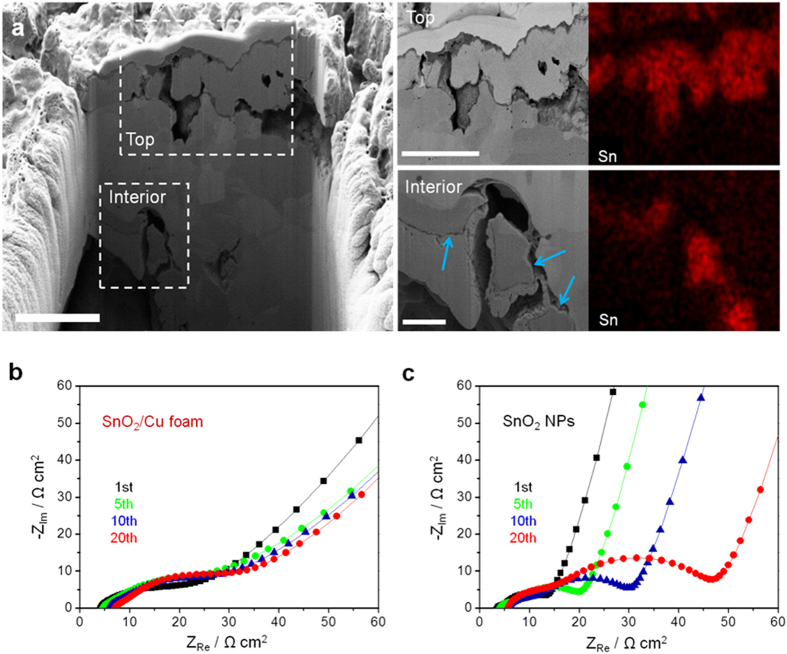
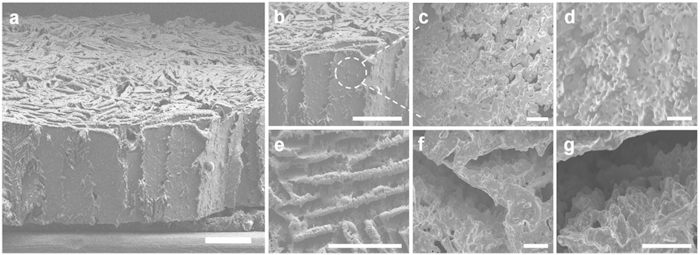
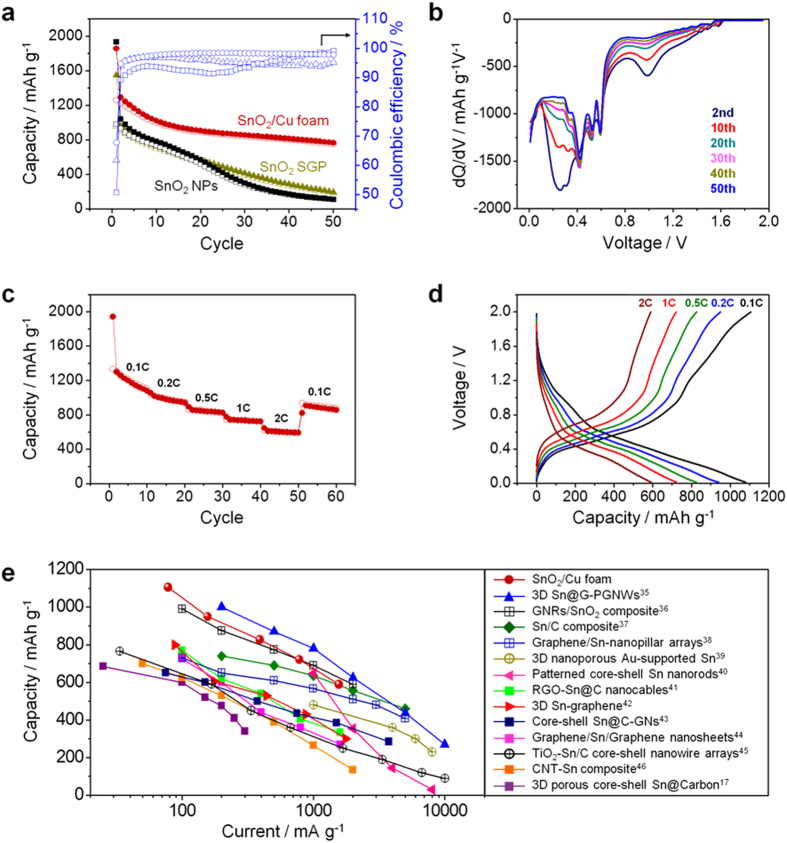
A three-dimensional porous architecture makes an attractive electrode structure, as it has an intrinsic structural integrity and an ability to buffer stress in lithium-ion batteries caused by the large volume changes in high-capacity anode materials during cycling. Here we report the first demonstration of a SnO2-coated macroporous Cu foam anode by employing a facile and scalable combination of directional freeze-casting and sol-gel coating processes. The three-dimensional interconnected anode is composed of aligned microscale channels separated by SnO2-coated Cu walls and much finer micrometer pores, adding to surface area and providing space for volume expansion of SnO2 coating layer. With this anode, we achieve a high reversible capacity of 750 mAh g(-1) at current rate of 0.5 C after 50 cycles and an excellent rate capability of 590 mAh g(-1) at 2 C, which is close to the best performance of Sn-based nanoscale material so far.
三维多孔结构构成了一种引人注目的电极结构,因为它具有内在的结构完整性,并且能够缓冲锂离子电池在循环过程中由高容量负极材料的大体积变化所引起的应力。在此,我们报告了通过采用定向冷冻铸造和溶胶 - 凝胶涂层工艺的简便且可扩展的组合,首次展示了一种SnO₂包覆的大孔泡沫铜负极。这种三维互连负极由被SnO₂包覆的铜壁分隔的排列整齐的微米级通道以及更细小的微米级孔隙组成,增加了表面积并为SnO₂涂层的体积膨胀提供了空间。使用这种负极,我们在50次循环后以0.5 C的电流倍率实现了750 mAh g⁻¹的高可逆容量,在2 C时具有590 mAh g⁻¹的优异倍率性能,这接近目前基于Sn的纳米级材料的最佳性能。