Sosa-Gutierrez Carolina G, Vargas-Sandoval Margarita, Torres Javier, Gordillo-Pérez Guadalupe
Unit of Research in Infectious Diseases, Children Hospital, National Medical Center, Institute of Mexico Social Security, Mexico City 06720, Mexico.
Department of Entomology, Faculty of Agrobiology, Universidad Michoacana de San Nicolás de Hidalgo, Uruapan 60150, Mexico.
J Vet Sci. 2016 Sep 30;17(3):353-60. doi: 10.4142/jvs.2016.17.3.353.
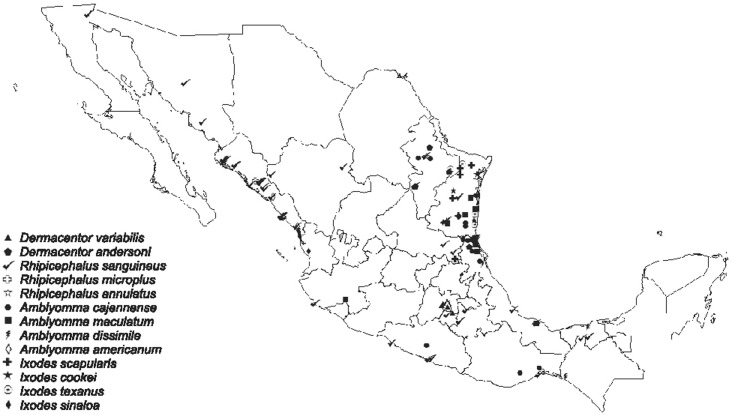
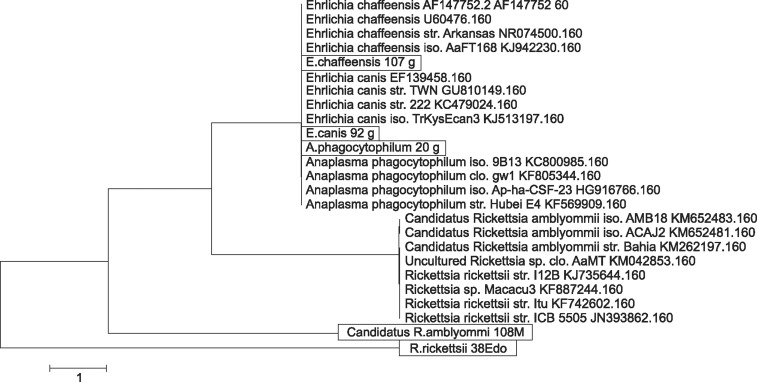
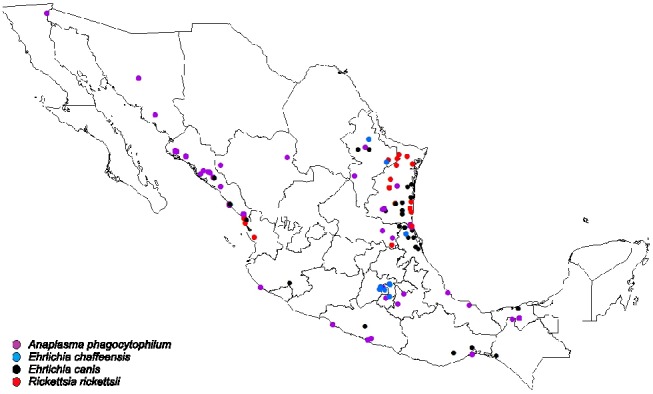
Tick-borne rickettsial diseases (TBRD) are commonly encountered in medical and veterinary clinical settings. The control of these diseases is difficult, requiring disruption of a complex transmission chain involving a vertebrate host and ticks. The geographical distribution of the diseases is related to distribution of the vector, which is an indicator of risk for the population. A total of 1107 were collected by tick drag from forests, ecotourism parks and hosts at 101 sites in 22 of the 32 states of Mexico. Collected ticks were placed in 1.5 mL cryovials containing 70% ethanol and were identified to species. Ticks were pooled according to location/host of collection, date of collection, sex, and stage of development. A total of 51 ticks were assayed by polymerase chain reaction (PCR) to confirm species identification using morphological methods. A total of 477 pools of ticks were assayed using PCR techniques for selected tick-borne pathogens. Anaplasma phagocytophilum was the most commonly detected pathogen (45 pools), followed by, Ehrlichia (E.) canis (42), Rickettsia (R.) rickettsii (11), E. chaffeensis (8), and R. amblyommii (1). Rhipicephalus sanguineus was the tick most frequently positive for selected pathogens. Overall, our results indicate that potential tick vectors positive for rickettsial pathogens are distributed throughout the area surveyed in Mexico.
蜱传立克次体病(TBRD)在医学和兽医临床环境中较为常见。这些疾病的控制难度较大,需要打破涉及脊椎动物宿主和蜱的复杂传播链。疾病的地理分布与媒介的分布有关,而媒介分布是人群风险的一个指标。在墨西哥32个州中的22个州的101个地点,通过拖蜱法从森林、生态旅游公园和宿主身上共采集了1107只蜱。将采集到的蜱放入含有70%乙醇的1.5 mL冻存管中,并鉴定到种。根据采集地点/宿主、采集日期、性别和发育阶段对蜱进行分组。共对51只蜱进行聚合酶链反应(PCR)检测,以使用形态学方法确认物种鉴定。共使用PCR技术对477组蜱进行了所选蜱传病原体的检测。嗜吞噬细胞无形体是最常检测到的病原体(45组),其次是犬埃立克体(42组)、立氏立克次体(11组)、查菲埃立克体(8组)和安氏立克次体(1组)。血红扇头蜱是所选病原体检测阳性率最高的蜱。总体而言,我们的结果表明,对立克次体病原体检测呈阳性的潜在蜱媒分布在墨西哥调查的整个区域。