Park Hye Yun, Lee Hyun, Koh Won-Jung, Kim Seonwoo, Jeong Ina, Koo Hyeon-Kyoung, Kim Tae-Hyung, Kim Jin Woo, Kim Woo Jin, Oh Yeon-Mok, Sin Don D, Lim Seong Yong, Lee Sang-Do
Division of Pulmonary and Critical Care Medicine, Department of Medicine, Samsung Medical Center, Sungkyunkwan University School of Medicine, Seoul, Korea.
Biostatistics Team, Samsung Biomedical Research Institute, Seoul, Korea.
Int J Chron Obstruct Pulmon Dis. 2015 Dec 22;11:23-30. doi: 10.2147/COPD.S94797. eCollection 2016.
COPD patients with increased airway eosinophilic inflammation show a favorable response to inhaled corticosteroids (ICS) in combination with a long-acting bronchodilator. Recent studies have demonstrated a significant correlation of sputum eosinophilia with blood eosinophils and periostin. We investigated whether high blood eosinophils and plasma periostin were associated with an improvement in forced expiratory volume in 1 second (FEV1) after 3-month treatment with ICS/long-acting beta2-agonist (LABA) in stable COPD patients.
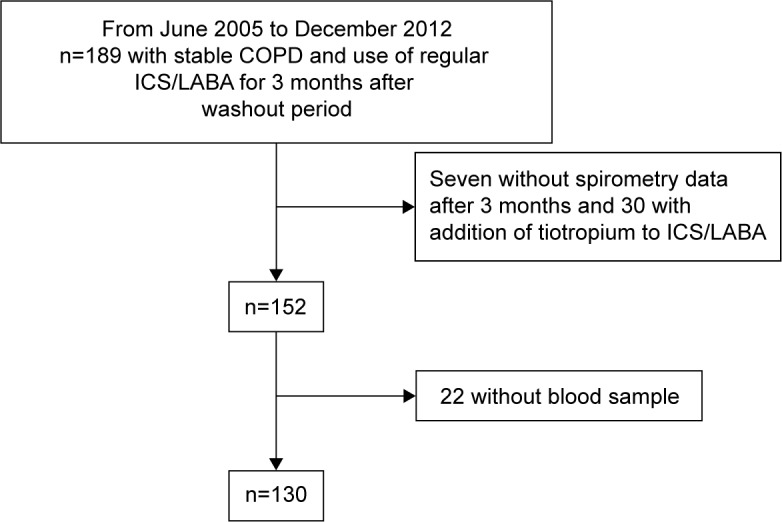
Blood eosinophils and plasma periostin levels were measured in 130 stable COPD subjects selected from the Korean Obstructive Lung Disease cohort. Subjects began a 3-month ICS/LABA treatment after washout period.
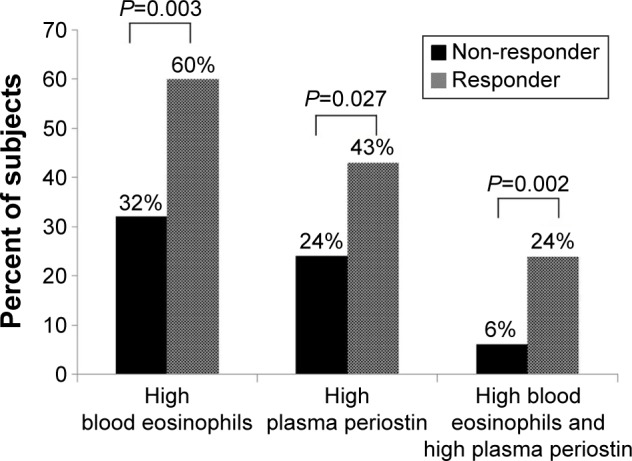
High blood eosinophils (>260/µL, adjusted odds ratio =3.52, P=0.009) and high plasma periostin (>23 ng/mL, adjusted odds ratio =3.52, P=0.013) were significantly associated with FEV1 responders (>12% and 200 mL increase in FEV1 from baseline after treatment). Moreover, the addition of high blood eosinophils to age, baseline positive bronchodilator response, and FEV1 <50% of the predicted value significantly increased the area under the curve for prediction of FEV1 responders (from 0.700 to 0.771; P=0.045).
High blood eosinophils and high plasma periostin were associated with improved lung function after 3-month ICS/LABA treatment. In particular, high blood eosinophils, in combination with age and baseline lung function parameters, might be a possible biomarker for identification of COPD patients with favorable FEV1 improvement in response to ICS/LABA treatment.
气道嗜酸性粒细胞炎症增加的慢性阻塞性肺疾病(COPD)患者对吸入性糖皮质激素(ICS)联合长效支气管扩张剂表现出良好反应。最近的研究表明,痰液嗜酸性粒细胞与血液嗜酸性粒细胞及骨膜蛋白之间存在显著相关性。我们调查了在稳定期COPD患者中,高血液嗜酸性粒细胞和血浆骨膜蛋白是否与ICS/长效β2受体激动剂(LABA)治疗3个月后1秒用力呼气容积(FEV1)的改善相关。
从韩国阻塞性肺病队列中选取130例稳定期COPD受试者,测量其血液嗜酸性粒细胞和血浆骨膜蛋白水平。受试者在洗脱期后开始为期3个月的ICS/LABA治疗。
高血液嗜酸性粒细胞(>260/µL,校正比值比=3.52,P=0.009)和高血浆骨膜蛋白(>23 ng/mL,校正比值比=3.52,P=0.013)与FEV1反应者(治疗后FEV1较基线增加>12%且增加200 mL)显著相关。此外,将高血液嗜酸性粒细胞加入年龄、基线支气管扩张剂阳性反应及FEV1<预测值的50%中,显著增加了预测FEV1反应者的曲线下面积(从0.700增至0.771;P=0.045)。
高血液嗜酸性粒细胞和高血浆骨膜蛋白与3个月ICS/LABA治疗后肺功能改善相关。特别是,高血液嗜酸性粒细胞与年龄及基线肺功能参数相结合,可能是识别对ICS/LABA治疗有良好FEV1改善的COPD患者的一种可能的生物标志物。