Oh Yeon-Mok, Lee Keu Sung, Hong Yoonki, Hwang Sung Chul, Kim Jae Yeol, Kim Deog Keom, Yoo Kwang Ha, Lee Ji-Hyun, Kim Tae-Hyung, Lim Seong Yong, Rhee Chin Kook, Yoon Hyoung Kyu, Lee Sang Yeub, Park Yong Bum, Jung Jin Hee, Kim Woo Jin, Lee Sang-Do, Park Joo Hun
Department of Pulmonary and Critical Care Medicine and Clinical Research Center for Chronic Obstructive Airway Diseases, Asan Medical Center, University of Ulsan College of Medicine, Seoul, Korea.
Department of Pulmonary and Critical Care Medicine, Ajou University School of Medicine, Suwon, Korea,
Int J Chron Obstruct Pulmon Dis. 2018 Oct 31;13:3589-3596. doi: 10.2147/COPD.S179734. eCollection 2018.
High blood eosinophil count is a predictive biomarker for response to inhaled corticosteroids in prevention of acute exacerbation of COPD, and low blood eosinophil count is associated with pneumonia risk in COPD patients taking inhaled corticosteroids. However, the prognostic role of blood eosinophil count remains underexplored. Therefore, we investigated the associated factors and mortality based on blood eosinophil count in COPD.
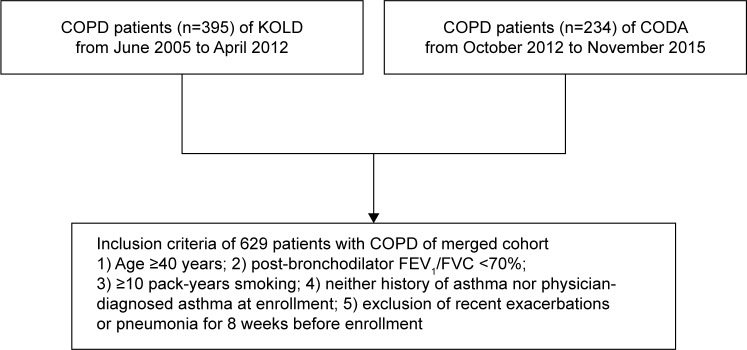
Patients with COPD were recruited from 16 hospitals of the Korean Obstructive Lung Disease cohort (n=395) and COPD in Dusty Area cohort (n=234) of Kangwon University Hospital. The two merged cohorts were divided based on blood eosinophil count into three groups: high (≥5%), middle (2%-5%), and low (<2%).
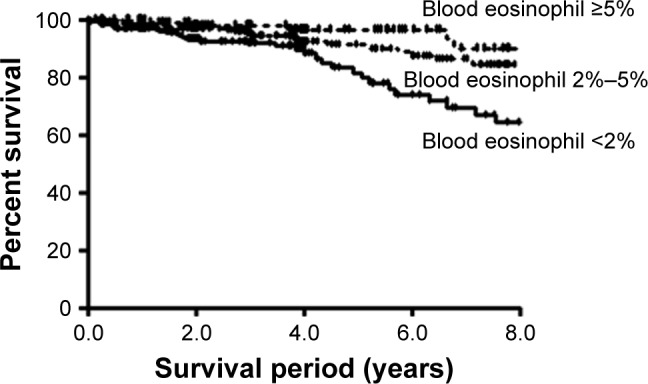
The high group had longer six-minute walk distance (high =445.8±81.4, middle =428.5±88.0, and low =414.7±86.3 m), higher body mass index (23.3±3.1, 23.1±3.1, and 22.5±3.2 kg/m), lower emphysema index (18.5±14.1, 22.2±15.3, and 23.7±16.3), and higher inspiratory capacity/total lung capacity ratio (32.6±7.4, 32.4±9.2, and 29.9% ± 8.9%) (<0.05). The survival period increased with increasing blood eosinophil count (high =9.52±0.23, middle =8.47±1.94, and low =7.42±0.27 years, <0.05). Multivariate linear regression analysis revealed that the emphysema index was independently and negatively correlated with blood eosinophil count (<0.05).
In COPD, the severity of emphysema was independently linked with low blood eosinophil count and the longer survival period was associated with increased blood eosinophil count, though it was not proven in the multivariate analysis.
高血嗜酸性粒细胞计数是预测慢性阻塞性肺疾病(COPD)患者吸入糖皮质激素预防急性加重反应的生物标志物,而低血嗜酸性粒细胞计数与使用吸入糖皮质激素的COPD患者的肺炎风险相关。然而,血嗜酸性粒细胞计数的预后作用仍未得到充分研究。因此,我们基于COPD患者的血嗜酸性粒细胞计数调查了相关因素和死亡率。
从韩国阻塞性肺疾病队列研究的16家医院招募COPD患者(n = 395)以及江原大学医院粉尘地区队列研究中的COPD患者(n = 234)。将这两个合并队列根据血嗜酸性粒细胞计数分为三组:高(≥5%)、中(2% - 5%)和低(<2%)。
高血嗜酸性粒细胞计数组的六分钟步行距离更长(高 = 445.8±81.4,中 = 428.5±88.0,低 = 414.7±86.3米),体重指数更高(23.3±3.1,23.1±3.1,22.5±3.2千克/平方米),肺气肿指数更低(18.5±14.1,22.2±15.3,23.7±16.3),吸气容量/肺总量比值更高(32.6±7.4,32.4±9.2,29.9%±8.9%)(P<0.05)。生存期随血嗜酸性粒细胞计数增加而延长(高 = 9.52±0.23,中 = 8.47±1.94,低 = 7.42±0.27年,P<0.05)。多变量线性回归分析显示,肺气肿指数与血嗜酸性粒细胞计数独立且呈负相关(P<0.05)。
在COPD中,肺气肿严重程度与低血嗜酸性粒细胞计数独立相关,生存期延长与血嗜酸性粒细胞计数增加相关,尽管在多变量分析中未得到证实。