Cooper Tim J, Garcia Valerie, Neale Matthew J
a Genome Damage and Stability Centre, School of Life Sciences, University of Sussex , Brighton , UK.
b Centre de Recherche en Cancérologie de Marseille , Marseille , France.
Cell Cycle. 2016;15(1):13-21. doi: 10.1080/15384101.2015.1093709.
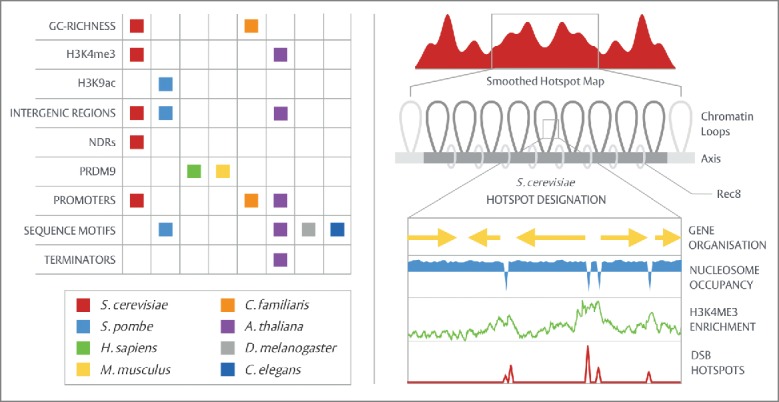
Meiosis is a specialized two-step cell division responsible for genome haploidization and the generation of genetic diversity during gametogenesis. An integral and distinctive feature of the meiotic program is the evolutionarily conserved initiation of homologous recombination (HR) by the developmentally programmed induction of DNA double-strand breaks (DSBs). The inherently dangerous but essential act of DSB formation is subject to multiple forms of stringent and self-corrective regulation that collectively ensure fruitful and appropriate levels of genetic exchange without risk to cellular survival. Within this article we focus upon an emerging element of this control--spatial regulation--detailing recent advances made in understanding how DSBs are evenly distributed across the genome, and present a unified view of the underlying patterning mechanisms employed.
减数分裂是一种特殊的两步细胞分裂过程,负责基因组单倍体化以及配子发生过程中遗传多样性的产生。减数分裂程序的一个不可或缺且独特的特征是通过发育程序诱导DNA双链断裂(DSB)引发进化上保守的同源重组(HR)。DSB形成这一本质上危险但又必不可少的行为受到多种严格且自我纠正的调控形式的制约,这些调控共同确保了富有成效且适度的基因交换水平,同时不会对细胞存活造成风险。在本文中,我们聚焦于这种调控的一个新要素——空间调控,详细阐述了在理解DSB如何在基因组中均匀分布方面取得的最新进展,并对所采用的潜在模式形成机制提出了统一观点。