Zhao Yihong, Castellanos F Xavier
Department of Child and Adolescent Psychiatry, The Child Study Center at NYU Langone Medical Center, New York, NY, USA.
Nathan S. Kline Institute for Psychiatric Research, Orangeburg, NY, USA.
J Child Psychol Psychiatry. 2016 Mar;57(3):421-39. doi: 10.1111/jcpp.12503. Epub 2016 Jan 6.
Psychiatric science remains descriptive, with a categorical nosology intended to enhance interobserver reliability. Increased awareness of the mismatch between categorical classifications and the complexity of biological systems drives the search for novel frameworks including discovery science in Big Data. In this review, we provide an overview of incipient approaches, primarily focused on classically categorical diagnoses such as schizophrenia (SZ), autism spectrum disorder (ASD), and attention-deficit/hyperactivity disorder (ADHD), but also reference convincing, if focal, advances in cancer biology, to describe the challenges of Big Data and discovery science, and outline approaches being formulated to overcome existing obstacles.
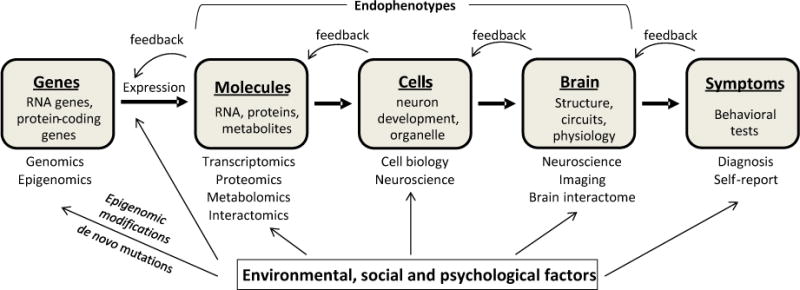
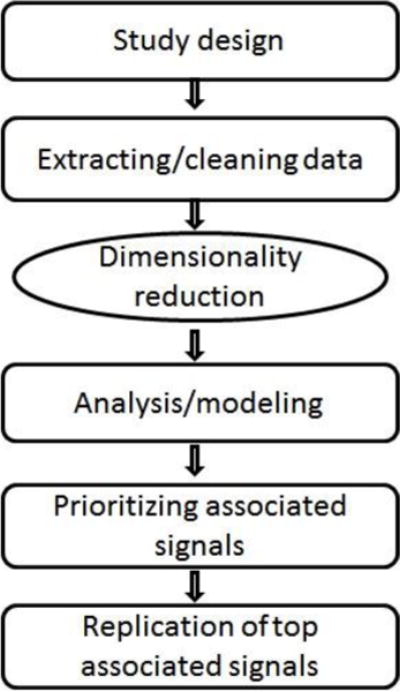
A paradigm shift from categorical diagnoses to a domain/structure-based nosology and from linear causal chains to complex causal network models of brain-behavior relationship is ongoing. This (r)evolution involves appreciating the complexity, dimensionality, and heterogeneity of neuropsychiatric data collected from multiple sources ('broad' data) along with data obtained at multiple levels of analysis, ranging from genes to molecules, cells, circuits, and behaviors ('deep' data). Both of these types of Big Data landscapes require the use and development of robust and powerful informatics and statistical approaches. Thus, we describe Big Data analysis pipelines and the promise and potential limitations in using Big Data approaches to study psychiatric disorders.
We highlight key resources available for psychopathological studies and call for the application and development of Big Data approaches to dissect the causes and mechanisms of neuropsychiatric disorders and identify corresponding biomarkers for early diagnosis.
精神病学仍处于描述性阶段,采用分类学方法以提高观察者间的可靠性。人们日益意识到分类诊断与生物系统复杂性之间的不匹配,这推动了对新框架的探索,包括大数据中的发现科学。在本综述中,我们概述了初步方法,主要关注经典的分类诊断,如精神分裂症(SZ)、自闭症谱系障碍(ASD)和注意力缺陷多动障碍(ADHD),同时也提及癌症生物学中虽不全面但令人信服的进展,以描述大数据和发现科学面临的挑战,并概述为克服现有障碍而制定的方法。
从分类诊断向基于领域/结构的分类学转变,以及从线性因果链向脑 - 行为关系的复杂因果网络模型的转变正在进行。这种(变革)演变涉及认识到从多个来源收集的神经精神数据(“广泛”数据)的复杂性、维度和异质性,以及从基因到分子、细胞、回路和行为等多个分析层面获得的数据(“深度”数据)。这两种类型的大数据格局都需要使用和开发强大的信息学和统计方法。因此,我们描述了大数据分析流程以及使用大数据方法研究精神疾病的前景和潜在局限性。
我们强调了可用于精神病理学研究的关键资源,并呼吁应用和开发大数据方法来剖析神经精神疾病的病因和机制,并确定早期诊断的相应生物标志物。