Rodriguez Mabel, Spaniel Filip, Konradova Lucie, Sedlakova Katerina, Dvorska Karolina, Prajsova Jitka, Kratochvilova Zuzana, Levcik David, Vlcek Kamil, Fajnerova Iveta
National IT System of Mental Health and Brain Monitoring, National Institute of Mental Health Klecany, Czech Republic.
National IT System of Mental Health and Brain Monitoring, National Institute of Mental HealthKlecany, Czech Republic; Department of Psychiatry and Medical Psychology, Third Faculty of Medicine, Charles University in PraguePrague, Czech Republic.
Front Behav Neurosci. 2015 Dec 18;9:322. doi: 10.3389/fnbeh.2015.00322. eCollection 2015.
Deficit in visuospatial functions can influence both simple and complex daily life activities. Despite the fact that visuospatial deficit was reported in schizophrenia, research on visuospatial functions as an independent entity is limited. Our study aims to elucidate the impact of visuospatial deficit in comparison with verbal deficit on global functioning and quality of life in the first psychotic episode of schizophrenia spectrum disorder (FES). The significance of clinical symptoms and antipsychotic medication was also studied.
Thirty-six FES patients and a matched group of healthy controls (HC group) were assessed with a neuropsychological battery focused on visuospatial (VIS) and verbal (VERB) functions. Using multiple regression analysis, we evaluated the cumulative effect of VERB and VIS functions, psychiatric symptoms (PANSS) and antipsychotic medication on global functioning (GAF) and quality of life (WHOQOL-BREF) in the FES group.
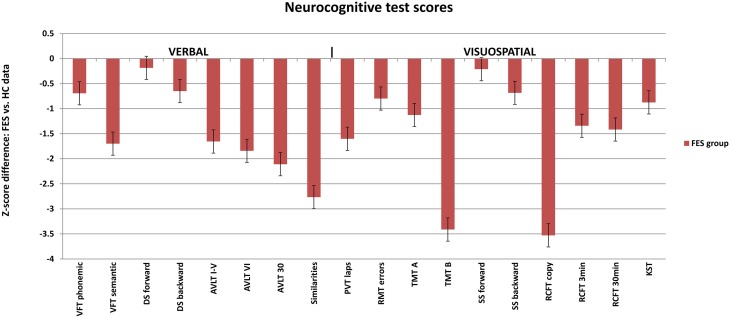
The FES group demonstrated significant impairment both in VIS and VERB cognitive abilities compared to the HC group. Antipsychotic medication did not significantly affect either VIS or VERB functioning. PANSS was not related to cognitive functioning, apart from the Trail Making Test B. In the FES group, the GAF score was significantly affected by the severity of positive symptoms and VERB functioning, explaining together 60% of GAF variability. The severity of negative and positive symptoms affected only the Physical health domain of WHOQOL-BREF. The degree of VERB deficit was associated with both Physical and Psychological health. Although we did not find any relation between VIS functioning, GAF, and WHOQOL-BREF, a paradoxical finding emerged in the Environment quality domain, where a worse quality of the environment was associated with better VIS functioning.
Our results suggest that the deficit in VIS functions is an integral part of cognitive deficit in schizophrenia spectrum disorders, rather than a side effect of symptomatology or antipsychotic medication. Moreover, VERB functioning was a better predictor of GAF and WHOQOL-BREF than VIS functioning. Given the findings of negative or missing effect of VIS deficit on WHOQOL-BREF and GAF, the accuracy of these measures in evaluating the impact of global cognitive deficit on everyday life in schizophrenia could be questioned.
视觉空间功能缺陷会影响简单和复杂的日常生活活动。尽管已有报道称精神分裂症存在视觉空间缺陷,但将视觉空间功能作为一个独立实体进行的研究有限。我们的研究旨在阐明在精神分裂症谱系障碍首次精神病发作(FES)中,与言语缺陷相比,视觉空间缺陷对整体功能和生活质量的影响。还研究了临床症状和抗精神病药物的意义。
对36名FES患者和一组匹配的健康对照者(HC组)进行了一项侧重于视觉空间(VIS)和言语(VERB)功能的神经心理测试。通过多元回归分析,我们评估了VERB和VIS功能、精神症状(PANSS)以及抗精神病药物对FES组整体功能(GAF)和生活质量(WHOQOL - BREF)的累积影响。
与HC组相比,FES组在VIS和VERB认知能力方面均表现出显著损害。抗精神病药物对VIS或VERB功能均无显著影响。除了连线测验B外,PANSS与认知功能无关。在FES组中,GAF评分受阳性症状严重程度和VERB功能的显著影响,二者共同解释了GAF变异性的60%。阴性和阳性症状的严重程度仅影响WHOQOL - BREF的身体健康领域。VERB缺陷程度与身体健康和心理健康均相关。虽然我们未发现VIS功能、GAF和WHOQOL - BREF之间存在任何关系,但在环境质量领域出现了一个矛盾的发现,即环境质量较差与更好的VIS功能相关。
我们的结果表明,VIS功能缺陷是精神分裂症谱系障碍认知缺陷的一个组成部分,而非症状学或抗精神病药物的副作用。此外,与VIS功能相比,VERB功能是GAF和WHOQOL - BREF更好的预测指标。鉴于VIS缺陷对WHOQOL - BREF和GAF的负面影响或无影响的结果,这些测量方法在评估精神分裂症中整体认知缺陷对日常生活影响的准确性可能受到质疑。