Homberg Uwe
Faculty of Biology, Animal Physiology, Philipps University Marburg, Germany.
Front Behav Neurosci. 2015 Dec 16;9:346. doi: 10.3389/fnbeh.2015.00346. eCollection 2015.
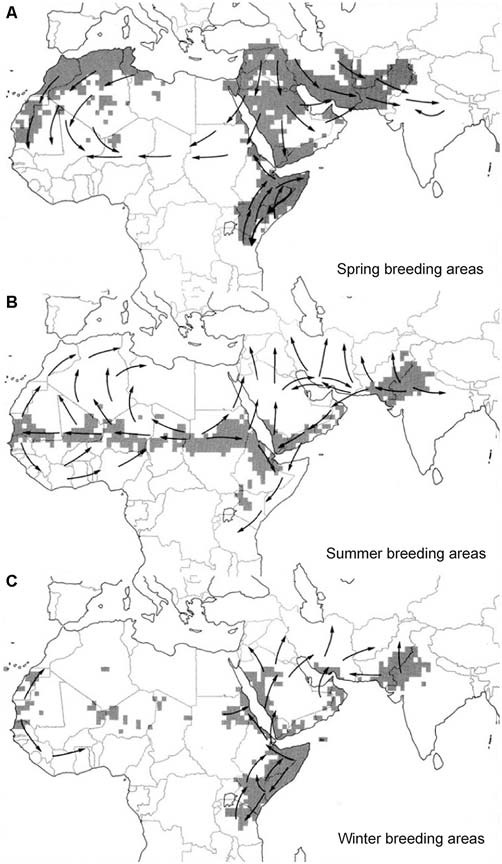
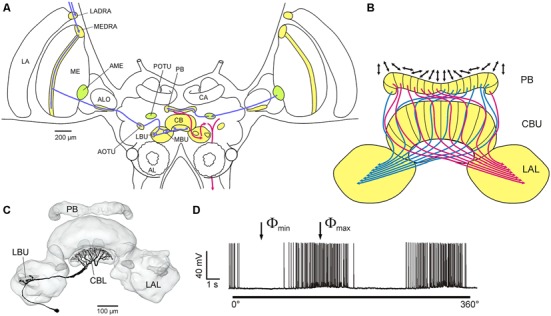
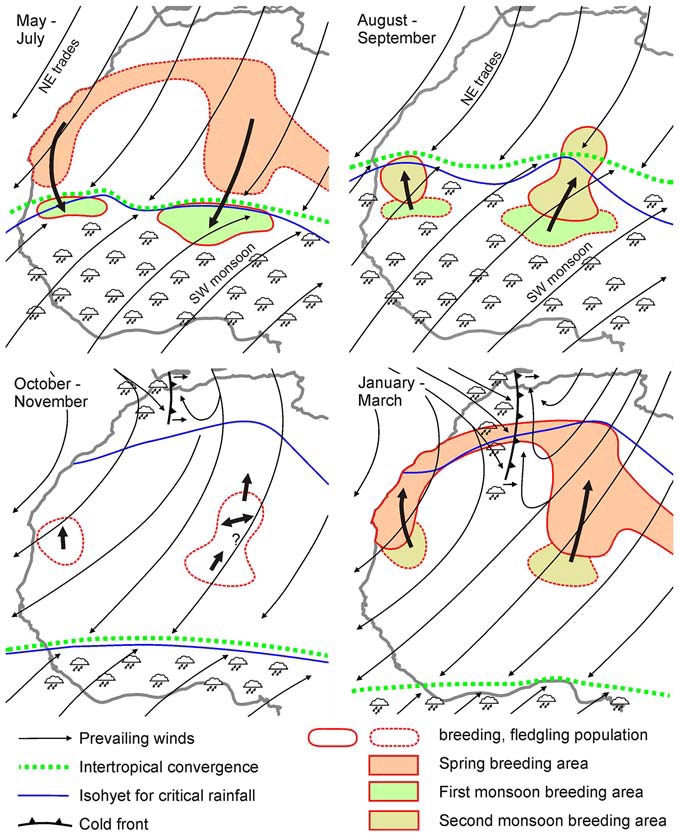
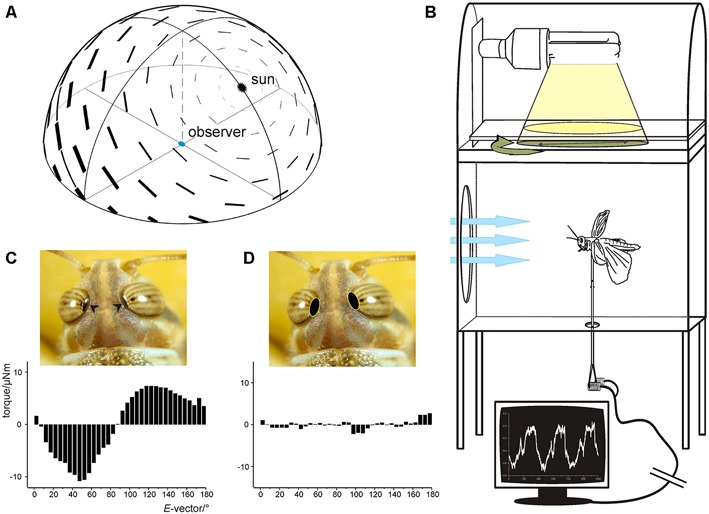
Locusts are long-range migratory insects. At high population density, immature animals form marching hopper bands while adults take off and form huge swarms of millions of animals. At low population densities animals are solitarious, but likewise migrate, mostly during the night. Numerous studies aimed at predicting locust infestations showed that migrations both as hopper bands and as adults are largely downwind following seasonal shifts of the tropical convergence zone taking the animals to areas of rainfall. Only a few studies provided evidence for active orientation mechanisms, including the involvement of a sun compass. This scarcity of evidence stands in contrast to recent neurobiological data showing sophisticated neuronal adaptations suited for sky compass navigation. These include a special dorsal eye region with photoreceptors suited to analyze the polarization pattern of the sky and a system of topographically arranged sky compass neurons in the central complex of the brain. Laboratory experiments, moreover, demonstrated polarotaxis in tethered flying animals. The discrepancy of these findings call for more rigorous field studies on active orientation mechanisms in locusts. It remains to be shown how locusts use their internal sky compass during mass migrations and what role it plays to guide solitarious locusts in their natural habitat.
蝗虫是远距离迁徙昆虫。在高密度种群情况下,未成熟的蝗虫会形成行军蝗带,而成虫则起飞并形成由数百万只蝗虫组成的巨大蝗群。在低密度种群情况下,蝗虫是独居的,但同样会迁徙,主要在夜间进行。众多旨在预测蝗虫侵扰的研究表明,无论是蝗带还是成虫的迁徙,在很大程度上都是顺着热带辐合带的季节性移动方向顺风飞行,将蝗虫带往有降雨的地区。只有少数研究提供了主动定向机制的证据,包括太阳罗盘的参与。这一证据的稀缺与最近的神经生物学数据形成对比,后者显示出适合天空罗盘导航的复杂神经元适应性。这些适应性包括一个特殊的背眼区域,其光感受器适合分析天空的偏振模式,以及大脑中央复合体中按地形排列的天空罗盘神经元系统。此外,实验室实验证明了系留飞行的动物存在极轴趋性。这些发现之间的差异需要对蝗虫的主动定向机制进行更严格的野外研究。蝗虫在大规模迁徙过程中如何利用其内部的天空罗盘,以及它在引导独居蝗虫在其自然栖息地中的作用还有待揭示。