Biocenter, Zoology II, University of Wuerzburg, Würzburg, Germany.
Department of Biology and Center for Biological Clocks Research, Texas A&M University, College Station, TX, United States.
Front Neural Circuits. 2022 Jun 30;16:862279. doi: 10.3389/fncir.2022.862279. eCollection 2022.
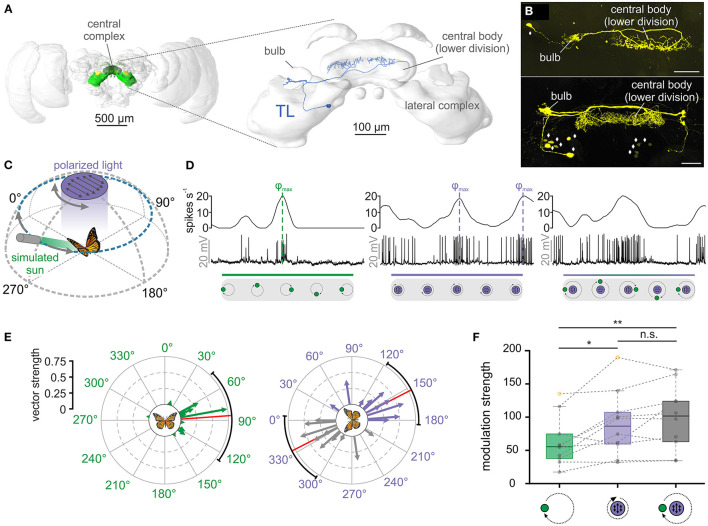
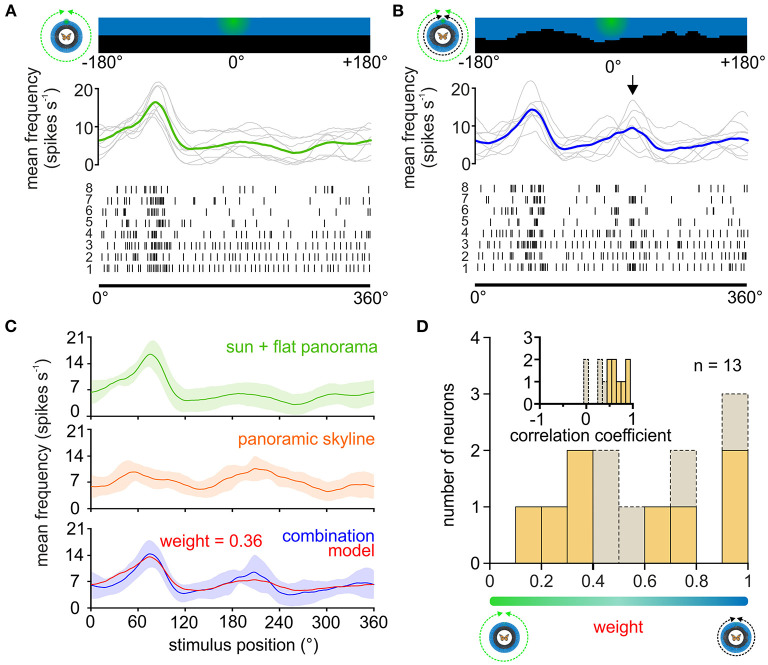
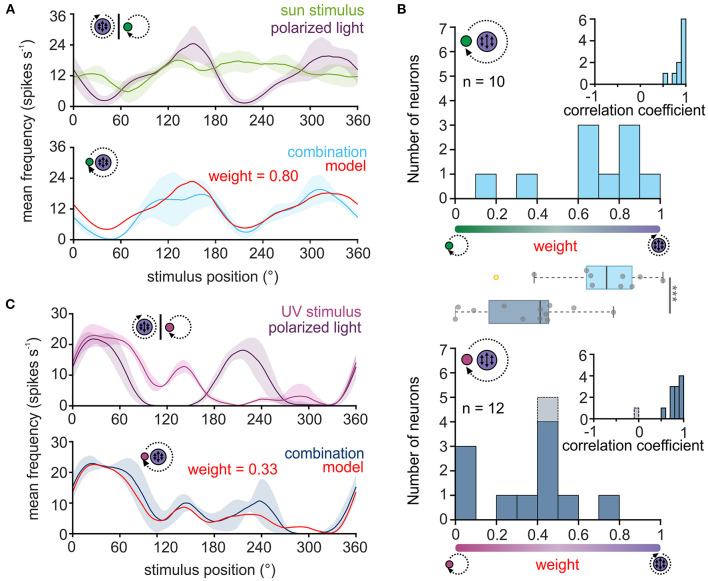
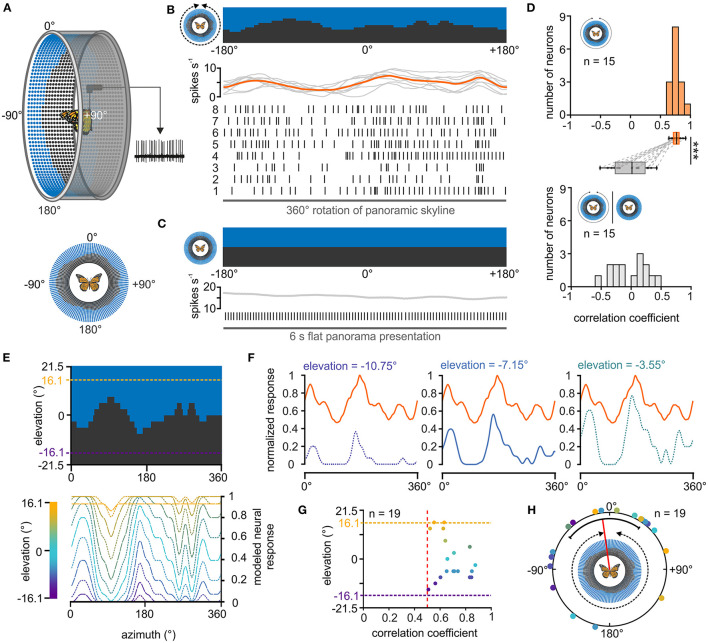
Monarch butterflies rely on external cues for orientation during their annual long-distance migration from Northern US and Canada to Central Mexico. These external cues can be celestial cues, such as the sun or polarized light, which are processed in a brain region termed the central complex (CX). Previous research typically focused on how individual simulated celestial cues are encoded in the butterfly's CX. However, in nature, the butterflies perceive several celestial cues at the same time and need to integrate them to effectively use the compound of all cues for orientation. In addition, a recent behavioral study revealed that monarch butterflies can rely on terrestrial cues, such as the panoramic skyline, for orientation and use them in combination with the sun to maintain a directed flight course. How the CX encodes a combination of celestial and terrestrial cues and how they are weighted in the butterfly's CX is still unknown. Here, we examined how input neurons of the CX, termed TL neurons, combine celestial and terrestrial information. While recording intracellularly from the neurons, we presented a sun stimulus and polarized light to the butterflies as well as a simulated sun and a panoramic scene simultaneously. Our results show that celestial cues are integrated linearly in these cells, while the combination of the sun and a panoramic skyline did not always follow a linear integration of action potential rates. Interestingly, while the sun and polarized light were invariantly weighted between individual neurons, the sun stimulus and panoramic skyline were dynamically weighted when both stimuli were simultaneously presented. Taken together, this dynamic weighting between celestial and terrestrial cues may allow the butterflies to flexibly set their cue preference during navigation.
黑脉金斑蝶在每年从美国北部和加拿大到墨西哥中部的长途迁徙过程中依靠外部线索进行定位。这些外部线索可以是天体线索,如太阳或偏振光,这些线索在一个被称为中央复合体(CX)的大脑区域中被处理。以前的研究通常集中在蝴蝶的 CX 中如何对单个模拟天体线索进行编码。然而,在自然界中,蝴蝶同时感知到几个天体线索,需要整合它们才能有效地利用所有线索的组合进行定向。此外,最近的一项行为研究表明,黑脉金斑蝶可以依靠陆地线索,如全景天际线,进行定向,并将它们与太阳结合使用以保持定向飞行路线。CX 如何编码天体和陆地线索的组合以及它们在蝴蝶的 CX 中是如何加权的仍然未知。在这里,我们研究了 CX 的输入神经元,称为 TL 神经元,如何组合天体和陆地信息。在对神经元进行细胞内记录的同时,我们向蝴蝶呈现太阳刺激和偏振光,以及同时模拟太阳和全景场景。我们的结果表明,这些细胞中天体线索是线性整合的,而太阳和全景天际线的组合并不总是遵循动作电位率的线性整合。有趣的是,虽然太阳和偏振光在单个神经元之间的权重不变,但当同时呈现两个刺激时,太阳刺激和全景天际线的权重是动态变化的。总之,这种天体和陆地线索之间的动态权重可能使蝴蝶在导航过程中能够灵活地设置线索偏好。