Montero-Marin Jesús, Tops Mattie, Manzanera Rick, Piva Demarzo Marcelo M, Álvarez de Mon Melchor, García-Campayo Javier
Faculty of Health and Sport Sciences, University of ZaragozaHuesca, Spain; Miguel Servet University Hospital, University of ZaragozaZaragoza, Spain.
Department of Clinical Psychology, VU University Amsterdam Amsterdam, Netherlands.
Front Psychol. 2015 Dec 17;6:1895. doi: 10.3389/fpsyg.2015.01895. eCollection 2015.
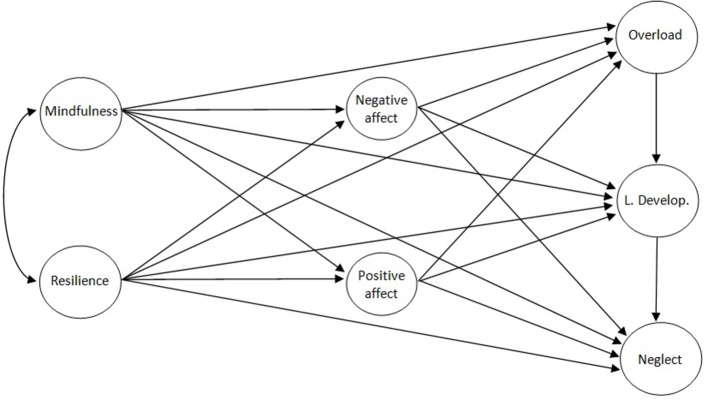
Primary care health professionals suffer from high levels of burnout. The aim of the present study was to evaluate the associations of mindfulness and resilience with the features of the burnout types (overload, lack of development, neglect) in primary care physicians, taking into account the potential mediating role of negative and positive affect.
A cross-sectional design was used. Six hundred and twenty-two Spanish primary care physicians were recruited from an online survey. The Mindful Attention Awareness Scale (MAAS), Connor-Davidson Resilience Scale (CD-RISC), Positive and Negative Affect Schedule (PANAS), and Burnout Clinical Subtype Questionnaire (BCSQ-12) questionnaires were administered. Polychoric correlation matrices were calculated. The unweighted least squares (ULS) method was used for developing structural equation modeling.
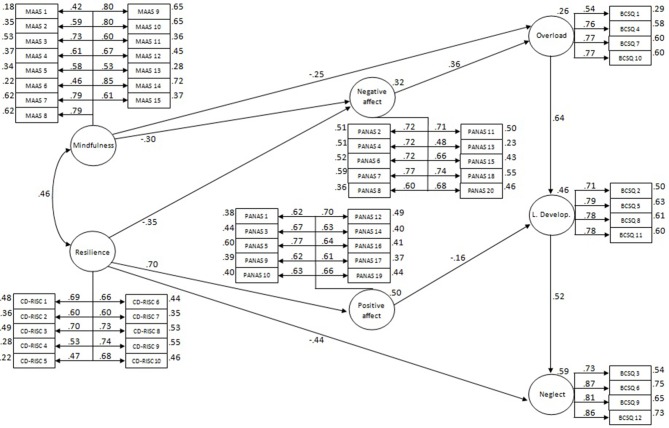
Mindfulness and resilience presented moderately high associations (φ = 0.46). Links were found between mindfulness and overload (γ = -0.25); resilience and neglect (γ = -0.44); mindfulness and resilience, and negative affect (γ = -0.30 and γ = -0.35, respectively); resilience and positive affect (γ = 0.70); negative affect and overload (β = 0.36); positive affect and lack of development (β = -0.16). The links between the burnout types reached high and positive values between overload and lack of development (β = 0.64), and lack of development and neglect (β = 0.52). The model was a very good fit to the data (GFI = 0.96; AGFI = 0.96; RMSR = 0.06; NFI = 0.95; RFI = 0.95; PRATIO = 0.96).
Interventions addressing both mindfulness and resilience can influence burnout subtypes, but their impact may occur in different ways, potentially mediated by positive and negative affect. Both sorts of trainings could constitute possible tools against burnout; however, while mindfulness seems a suitable intervention for preventing its initial stages, resilience may be more effective for treating its advanced stages.
基层医疗保健专业人员面临着高度的职业倦怠。本研究的目的是评估正念和心理韧性与基层医疗医生职业倦怠类型(工作负荷过重、缺乏职业发展、忽视)特征之间的关联,并考虑消极和积极情绪的潜在中介作用。
采用横断面设计。通过在线调查招募了622名西班牙基层医疗医生。使用了正念注意觉知量表(MAAS)、康纳-戴维森心理韧性量表(CD-RISC)、正负性情绪量表(PANAS)和职业倦怠临床亚型问卷(BCSQ-12)进行问卷调查。计算了多列相关矩阵。采用非加权最小二乘法(ULS)构建结构方程模型。
正念和心理韧性呈现出中等偏高的相关性(φ = 0.46)。发现正念与工作负荷过重之间存在联系(γ = -0.25);心理韧性与忽视之间存在联系(γ = -0.44);正念和心理韧性与消极情绪之间存在联系(分别为γ = -0.30和γ = -0.35);心理韧性与积极情绪之间存在联系(γ = 0.70);消极情绪与工作负荷过重之间存在联系(β = 0.36);积极情绪与缺乏职业发展之间存在联系(β = -0.16)。职业倦怠类型之间的联系在工作负荷过重与缺乏职业发展之间(β = 0.64)以及缺乏职业发展与忽视之间(β = 0.52)达到了较高的正值。该模型与数据拟合度非常好(GFI = 0.96;AGFI = 0.96;RMSR = 0.06;NFI = 0.95;RFI = 0.95;PRATIO = 0.96)。
针对正念和心理韧性的干预措施可以影响职业倦怠亚型,但其影响可能以不同方式发生,可能由积极和消极情绪介导。这两种培训都可能构成对抗职业倦怠的可能工具;然而,虽然正念似乎是预防职业倦怠初始阶段的合适干预措施,但心理韧性可能对治疗其晚期阶段更有效。