Pérez-Aranda Adrián, García-Campayo Javier, Gude Francisco, Luciano Juan V, Feliu-Soler Albert, González-Quintela Arturo, López-Del-Hoyo Yolanda, Montero-Marin Jesus
Aragon Institute for Health Research (IIS Aragón), Miguel Servet University Hospital, Spain.
Faculty of Psychology, Universitat Autònoma de Barcelona, Spain.
Int J Clin Health Psychol. 2021 May-Aug;21(2):100229. doi: 10.1016/j.ijchp.2021.100229. Epub 2021 Mar 11.
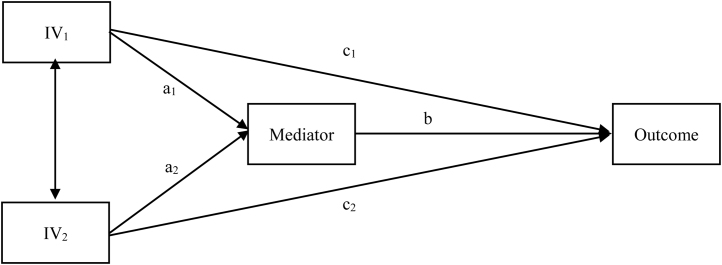
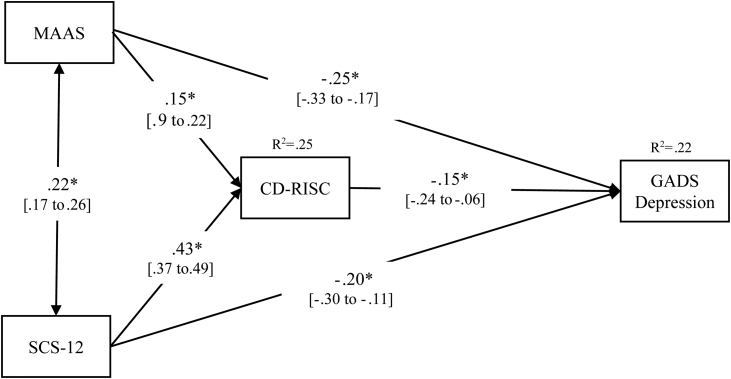
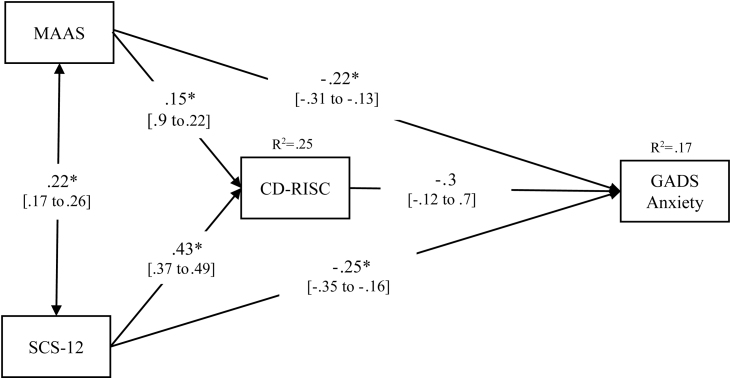
'Third-wave' psychotherapies have shown effectiveness for treating psychopathological symptoms such as anxiety and depression. There is burgeoning interest in examining how these therapies' core constructs produce their therapeutic benefits. This study explores the hypothetical mediating effect of resilience in the impact of mindfulness and self-compassion on anxiety and depressive symptoms. : Cross-sectional study design. The sample consisted of 860 Spanish general population participants. The measures included the Mindful Attention Awareness Scale (MAAS), the Self-Compassion Scale (SCS-12), the Connor-Davidson Resilience Scale (CD-RISC) and the Goldberg Anxiety and Depression Scale (GADS). Bivariate correlations were calculated, and path analysis models were performed. : Significant correlations were found between the study variables, always in the expected direction (all values <.001). The path analysis models showed significant direct effects of mindfulness and self-compassion on anxiety and depression symptoms, but the only significant indirect effects through resilience were found on depression (MAAS: β = -.05, 95% CI = -.11 to -.02; SCS-12: β = -.06, 95% CI = -.33 to -.07). : Resilience might partially mediate the effect of mindfulness and self-compassion on depression, but not on anxiety.
“第三波”心理疗法已显示出对治疗焦虑和抑郁等精神病理症状的有效性。人们对研究这些疗法的核心构念如何产生治疗效果的兴趣与日俱增。本研究探讨了心理韧性在正念和自我同情对焦虑和抑郁症状影响中的假设中介作用。:横断面研究设计。样本包括860名西班牙普通人群参与者。测量工具包括正念注意觉知量表(MAAS)、自我同情量表(SCS - 12)、康纳 - 戴维森心理韧性量表(CD - RISC)和戈德堡焦虑抑郁量表(GADS)。计算了双变量相关性,并进行了路径分析模型。:研究变量之间发现了显著相关性,且均符合预期方向(所有p值 <.001)。路径分析模型显示正念和自我同情对焦虑和抑郁症状有显著直接效应,但通过心理韧性发现的唯一显著间接效应仅在抑郁方面(MAAS:β = -.05,95% CI = -.11至 -.02;SCS - 12:β = -.06,95% CI = -.33至 -.07)。:心理韧性可能部分中介正念和自我同情对抑郁的影响,但对焦虑无此作用。