Van Rossum Thea, Peabody Michael A, Uyaguari-Diaz Miguel I, Cronin Kirby I, Chan Michael, Slobodan Jared R, Nesbitt Matthew J, Suttle Curtis A, Hsiao William W L, Tang Patrick K C, Prystajecky Natalie A, Brinkman Fiona S L
Department of Molecular Biology and Biochemistry, Simon Fraser University Burnaby, BC, Canada.
Department of Pathology and Laboratory Medicine, University of British Columbia Vancouver, BC, Canada.
Front Microbiol. 2015 Dec 16;6:1405. doi: 10.3389/fmicb.2015.01405. eCollection 2015.
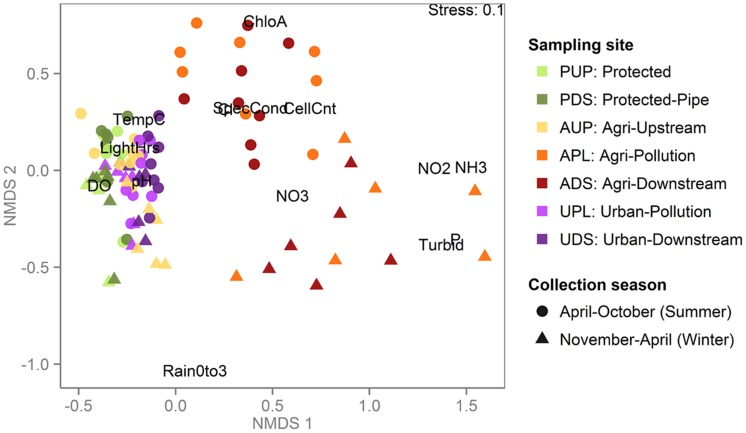
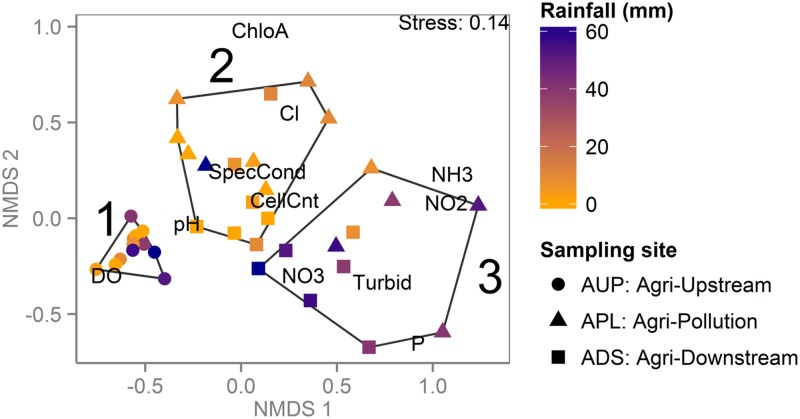
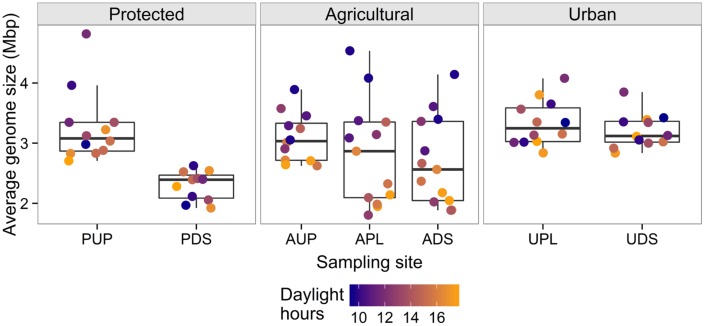
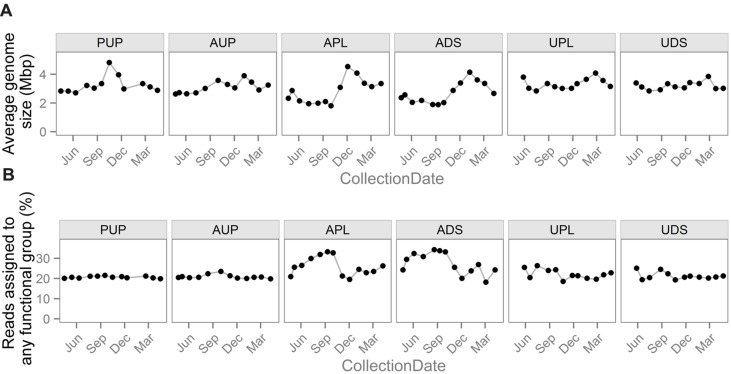
Select bacteria, such as Escherichia coli or coliforms, have been widely used as sentinels of low water quality; however, there are concerns regarding their predictive accuracy for the protection of human and environmental health. To develop improved monitoring systems, a greater understanding of bacterial community structure, function, and variability across time is required in the context of different pollution types, such as agricultural and urban contamination. Here, we present a year-long survey of free-living bacterial DNA collected from seven sites along rivers in three watersheds with varying land use in Southwestern Canada. This is the first study to examine the bacterial metagenome in flowing freshwater (lotic) environments over such a time span, providing an opportunity to describe bacterial community variability as a function of land use and environmental conditions. Characteristics of the metagenomic data, such as sequence composition and average genome size (AGS), vary with sampling site, environmental conditions, and water chemistry. For example, AGS was correlated with hours of daylight in the agricultural watershed and, across the agriculturally and urban-affected sites, k-mer composition clustering corresponded to nutrient concentrations. In addition to indicating a community shift, this change in AGS has implications in terms of the normalization strategies required, and considerations surrounding such strategies in general are discussed. When comparing abundances of gene functional groups between high- and low-quality water samples collected from an agricultural area, the latter had a higher abundance of nutrient metabolism and bacteriophage groups, possibly reflecting an increase in agricultural runoff. This work presents a valuable dataset representing a year of monthly sampling across watersheds and an analysis targeted at establishing a foundational understanding of how bacterial lotic communities vary across time and land use. The results provide important context for future studies, including further analyses of watershed ecosystem health, and the identification and development of biomarkers for improved water quality monitoring systems.
某些特定细菌,如大肠杆菌或大肠菌群,已被广泛用作低水质的指示生物;然而,人们对它们在保护人类和环境健康方面的预测准确性存在担忧。为了开发更完善的监测系统,需要在不同污染类型(如农业和城市污染)的背景下,更深入地了解细菌群落结构、功能以及随时间的变化情况。在此,我们展示了一项为期一年的调查,该调查采集了加拿大西南部三个流域七条河流沿线七个地点的自由生活细菌DNA。这是首次在如此长的时间跨度内对流动淡水(流水)环境中的细菌宏基因组进行研究,为描述细菌群落随土地利用和环境条件的变化提供了契机。宏基因组数据的特征,如序列组成和平均基因组大小(AGS),会因采样地点、环境条件和水化学性质的不同而有所变化。例如,在农业流域,AGS与日照时长相关,并且在受农业和城市影响的所有地点,k-mer组成聚类与养分浓度相对应。AGS的这种变化除了表明群落发生了转变外,还对所需的标准化策略有影响,并且本文还讨论了一般情况下围绕此类策略的相关考量。在比较从农业区域采集的高质量和低质量水样之间基因功能组的丰度时,后者的养分代谢和噬菌体组丰度更高,这可能反映了农业径流的增加。这项工作提供了一个有价值的数据集,该数据集代表了对各流域进行的为期一年的月度采样,并且进行了一项分析,旨在建立对流水细菌群落如何随时间和土地利用而变化的基本理解。研究结果为未来的研究提供了重要背景,包括对流域生态系统健康的进一步分析,以及为改进水质监测系统而进行的生物标志物的识别和开发。