Hanly Elyse K, Tuli Neha Y, Bednarczyk Robert B, Suriano Robert, Geliebter Jan, Moscatello Augustine L, Darzynkiewicz Zbigniew, Tiwari Raj K
Department of Microbiology and Immunology, New York Medical College, Valhalla, NY 10595, USA.
Division of Natural Sciences, College of Mount Saint Vincent, Bronx, NY 10471, USA.
Oncotarget. 2016 Feb 23;7(8):8676-87. doi: 10.18632/oncotarget.6779.
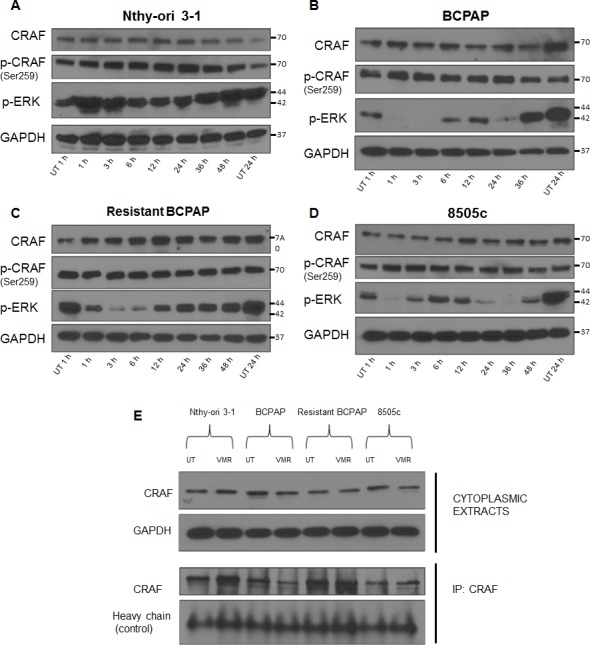
Clinical studies evaluating targeted BRAFV600E inhibitors in advanced thyroid cancer patients are currently underway. Vemurafenib (BRAFV600E inhibitor) monotherapy has shown promising results thus far, although development of resistance is a clinical challenge. The objective of this study was to characterize development of resistance to BRAFV600E inhibition and to identify targets for effective combination therapy. We created a line of BCPAP papillary thyroid cancer cells resistant to vemurafenib by treating with increasing concentrations of the drug. The resistant BCPAP line was characterized and compared to its sensitive counterpart with respect to signaling molecules thought to be directly related to resistance. Expression and phosphorylation of several critical proteins were analyzed by Western blotting and dimerization was evaluated by immunoprecipitation. Resistance to vemurafenib in BCPAP appeared to be mediated by constitutive overexpression of phospho-ERK and by resistance to inhibition of both phospho-mTOR and phospho-S6 ribosomal protein after vemurafenib treatment. Expression of potential alternative signaling molecule, CRAF, was not increased in the resistant line, although formation of CRAF dimers appeared increased. Expression of membrane receptors HER2 and HER3 was greatly amplified in the resistant cancer cells. Papillary thyroid cancer cells were capable of overcoming targeted BRAFV600E inhibition by rewiring of cell signal pathways in response to prolonged vemurafenib therapy. Our study suggests that in vitro culture of cancer cells may be useful in assessing molecular resistance pathways. Potential therapies in advanced thyroid cancer patients may combine vemurafenib with inhibitors of CRAF, HER2/HER3, ERK, and/or mTOR to delay or abort development of resistance.
目前正在进行评估针对晚期甲状腺癌患者的BRAFV600E靶向抑制剂的临床研究。维莫非尼(BRAFV600E抑制剂)单药治疗迄今为止已显示出有前景的结果,尽管耐药性的产生是一项临床挑战。本研究的目的是表征对BRAFV600E抑制的耐药性发展,并确定有效联合治疗的靶点。我们通过用浓度递增的该药物处理,创建了一株对维莫非尼耐药的BCPAP甲状腺乳头状癌细胞系。对耐药的BCPAP细胞系进行了表征,并就被认为与耐药性直接相关的信号分子,将其与其敏感对应物进行了比较。通过蛋白质印迹法分析了几种关键蛋白的表达和磷酸化情况,并通过免疫沉淀法评估了二聚化情况。BCPAP细胞对维莫非尼的耐药性似乎是由磷酸化ERK的组成型过表达以及维莫非尼治疗后对磷酸化mTOR和磷酸化S6核糖体蛋白抑制的耐药性介导的。潜在替代信号分子CRAF的表达在耐药细胞系中并未增加,尽管CRAF二聚体的形成似乎有所增加。耐药癌细胞中膜受体HER2和HER3的表达大幅扩增。甲状腺乳头状癌细胞能够通过重新布线细胞信号通路来克服针对BRAFV600E的抑制,以应对长期的维莫非尼治疗。我们的研究表明,癌细胞的体外培养可能有助于评估分子耐药途径。晚期甲状腺癌患者的潜在治疗方法可能是将维莫非尼与CRAF、HER2/HER3、ERK和/或mTOR的抑制剂联合使用,以延迟或阻止耐药性的发展。