Lai Ching-Yuan, Huang Yu-Wei, Tseng Chun-Hung, Lin Cheng-Li, Sung Fung-Chang, Kao Chia-Hung
From the Department of Emergency Medicine, China Medical University Hospital, Taichung (C-YL); Department of Critical Care Medicine, E-DA Hospital, Department of Community Medicine, E-DA Hospital and I-Shou University Kaohsiung (Y-WH), Department of Neurology, China Medical University Hospital (C-HT), Management Office for Health Data China Medical University Hospital (C-LL), College of Medicine (C-LL), Graduate Institute of Clinical Medical Science and School of Medicine, College of Medicine (C-HK), Department of Health Services Administration (F-CS); and Department of Nuclear Medicine and PET Center, China Medical University Hospital, Taichung, Taiwan (C-HK).
Medicine (Baltimore). 2016 Jan;95(1):e2418. doi: 10.1097/MD.0000000000002418.
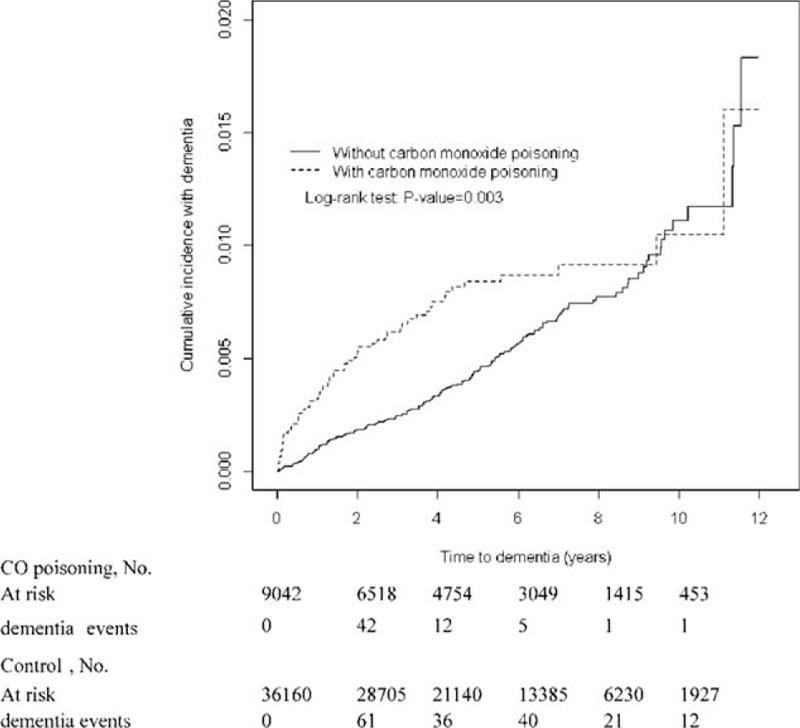
The present study evaluated the dementia risk after carbon monoxide poisoning (CO poisoning). Using the National Health Insurance Research Database of Taiwan, a total of 9041 adults newly diagnosed with CO poisoning from 2000 to 2011 were identified as the CO poisoning cohort. Four-fold (N = 36,160) of non-CO poisoning insured people were randomly selected as controls, frequency-matched by age, sex, and hospitalization year. Incidence and hazard ratio (HR) of dementia were measured by the end 2011. The dementia incidence was 1.6-fold higher in the CO exposed cohort than in the non-exposed cohort (15.2 vs 9.76 per 10,000 person-years; n = 62 vs 174) with an adjusted HR of 1.50 (95% CI = 1.11-2.04). The sex- and age-specific hazards were higher in male patients (adjusted HR = 1.74, 95% CI = 1.20-2.54), and those aged <= 49 years (adjusted HR = 2.62, 95% CI = 1.38-4.99). CO exposed patients with 7-day or longer hospital stay had an adjusted HR of 2.18 (95% CI = 1.42, 3.36). The CO poisoning patients on hyperbaric oxygen (HBO2) therapy had an adjusted HR of 1.80 (95% CI = 0.96-3.37). This study suggests that CO poisoning may have association with the risk of developing dementia, which is significant for severe cases. The effectiveness of HBO2 therapy remains unclear in preventing dementia. Patients with CO poisoning are more prevalent with depression.
本研究评估了一氧化碳中毒(CO中毒)后的痴呆风险。利用台湾地区国民健康保险研究数据库,共识别出9041名在2000年至2011年期间新诊断为CO中毒的成年人作为CO中毒队列。随机选取四倍数量(N = 36,160)的未患CO中毒的参保人员作为对照,按年龄、性别和住院年份进行频数匹配。到2011年底时测量痴呆的发病率及风险比(HR)。CO暴露队列中的痴呆发病率比未暴露队列高1.6倍(每10,000人年分别为15.2例和9.76例;n = 62例对174例),校正后的HR为1.50(95%置信区间 = 1.11 - 2.04)。男性患者(校正后的HR = 1.74,95%置信区间 = 1.20 - 2.54)以及年龄≤49岁的患者(校正后的HR = 2.62,95%置信区间 = 1.38 - 4.99)的性别和年龄特异性风险更高。住院7天或更长时间的CO暴露患者校正后的HR为2.18(95%置信区间 = 1.42, 3.36)。接受高压氧(HBO2)治疗的CO中毒患者校正后的HR为1.80(95%置信区间 = 0.96 - 3.37)。本研究表明,CO中毒可能与患痴呆症的风险有关,这在严重病例中很显著。HBO2治疗在预防痴呆方面的有效性仍不明确。CO中毒患者中抑郁症更为普遍。