Department of Psychiatry, Tri-Service General Hospital, National Defense Medical Center, Taipei, Taiwan, ROC.
Student Counseling Center, National Defense Medical Center, Taipei, Taiwan, ROC.
Ann Clin Transl Neurol. 2020 Aug;7(8):1284-1295. doi: 10.1002/acn3.51113. Epub 2020 Jun 30.
We have conducted a study to clarify the association between amphetamine-related disorders (ARD) and the risk of developing dementia.
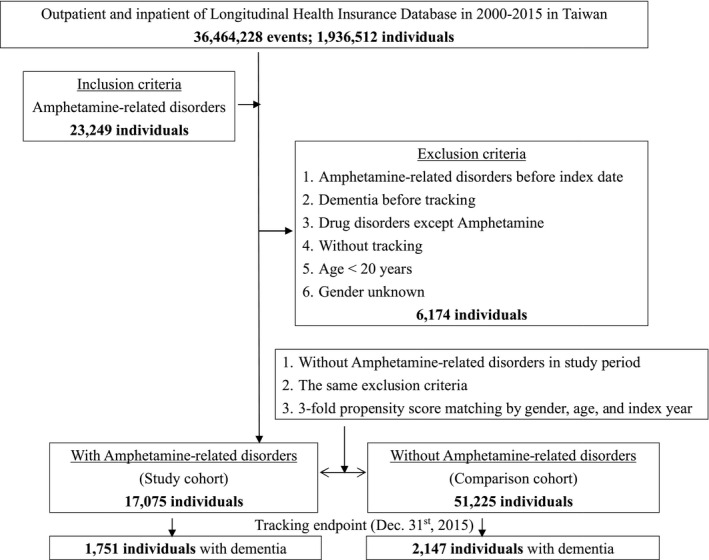
This study used a retrospective cohort design by using Taiwan's National Health Research Institute Database. A random sample of 68,300 subjects between January 1, 2000, and December 31, 2015, was obtained, comprising of 17,075 patients with ARD, and 51,225 controls without ARD (1:3), matched for gender and age group. After adjusting for covariates, a Fine and Gray's survival analysis (competing with mortality) was used to compare the risk of dementia during a 15-year follow-up period.
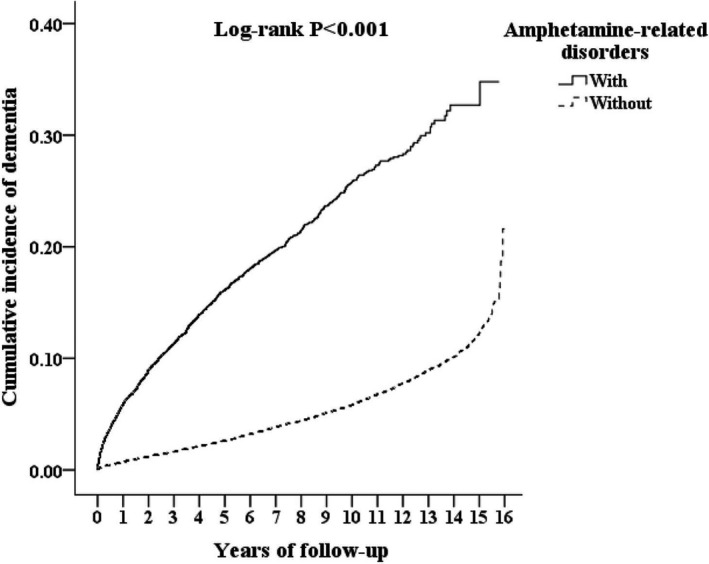
In the present study, 1,751 of 17,075 patients with ARD and 2,147 of 51,225 in the control group without ARD (883.10 vs 342.83 per 100,000 person-years) developed dementia. ARD cohort was more likely to develop dementia (hazard ratio = 4.936 [95% CI: 4.609-5.285, P < 0.001). After adjusting for gender, age groups, education, monthly insured premiums, urbanization level, geographic region, comorbidities, the hazard ratio for ARD patients was 5.034 (95% CI: 4.701-5.391, P < 0.001). ARD has been associated with overall dementia, Alzheimer dementia, vascular dementia, and other dementia. Both the amphetamine use disorder and amphetamine-induced psychotic disorders were associated with the risk of overall dementia, Alzheimer dementia, vascular dementia, and other dementia.
This study shows that patients with ARD, both the amphetamine use disorder and the amphetamine-induced psychotic disorder, may have a nearly fivefold risk of developing dementia, including Alzheimer dementia and other types of dementia.
我们开展了一项研究,旨在阐明安非他命相关障碍(ARD)与痴呆发病风险之间的关联。
本研究采用回顾性队列设计,利用台湾国家健康研究数据库。我们获得了 2000 年 1 月 1 日至 2015 年 12 月 31 日期间的一个随机样本,共 68300 名受试者,其中 17075 名为 ARD 患者,51225 名为无 ARD 患者(1:3),按性别和年龄组匹配。在调整协变量后,采用 Fine 和 Gray 生存分析(与死亡率竞争)比较了 15 年随访期间的痴呆发病风险。
在本研究中,17075 名 ARD 患者中有 1751 名(883.10/100000 人年)和 51225 名对照组无 ARD 患者中有 2147 名(342.83/100000 人年)发展为痴呆。ARD 队列发生痴呆的风险更高(风险比=4.936[95%CI:4.609-5.285,P<0.001)。在调整性别、年龄组、教育程度、月投保金额、城市化水平、地理区域、合并症后,ARD 患者的风险比为 5.034(95%CI:4.701-5.391,P<0.001)。ARD 与总体痴呆、阿尔茨海默病痴呆、血管性痴呆和其他痴呆有关。安非他命使用障碍和安非他命引起的精神病性障碍均与总体痴呆、阿尔茨海默病痴呆、血管性痴呆和其他痴呆的发病风险相关。
本研究表明,ARD 患者,包括安非他命使用障碍和安非他命引起的精神病性障碍,发生痴呆的风险可能增加近五倍,包括阿尔茨海默病痴呆和其他类型的痴呆。