Jiang Bin, He Yao, Zuo Fang, Wu Lei, Liu Qing-Hui, Zhang Li, Zhou Chang-Xi, Cheng K K, Chan Sophia S C, Lam Tai Hing
Nanlou Faculty of Clinical Medicine, Department of Traditional Chinese Medicine and Acupuncture, Chinese People's Liberation Army General Hospital, Beijing, China.
Department of Epidemiology, Institute of Geriatrics, Beijing key laboratory of Aging and Geriatrics, Chinese People's Liberation Army General Hospital, Beijing, China.
BMJ Open. 2016 Jan 6;6(1):e009381. doi: 10.1136/bmjopen-2015-009381.
To evaluate the effectiveness of varenicline for smoking cessation in Chinese smokers in a real world cessation clinic practice.
A prospective observational study.
Beijing, China.
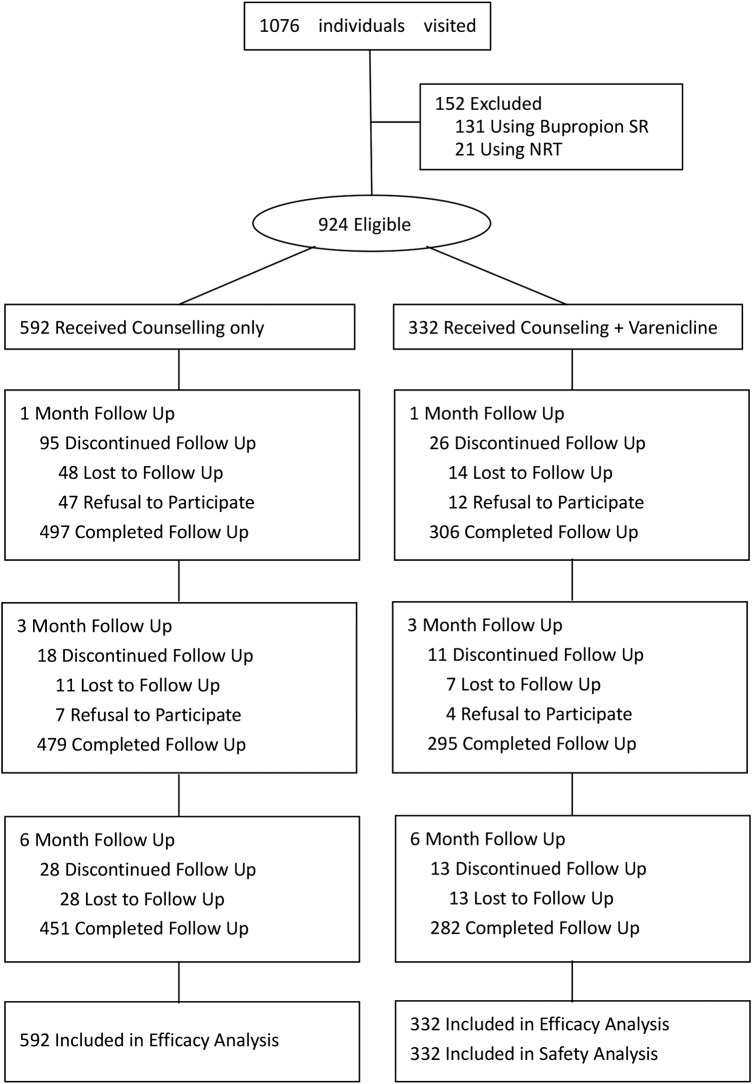
A total of 924 smokers (883 men and 41 women) who attended a smoking cessation clinic of a large general hospital were assessed with data from structured questionnaires at baseline and follow-up at 1, 3 and 6 months. Trained physician counsellors provided free individual counselling for all subjects and follow-up interviews with brief counselling. 332 subjects additionally prescribed varenicline according to their own choice were compared with those without varenicline.
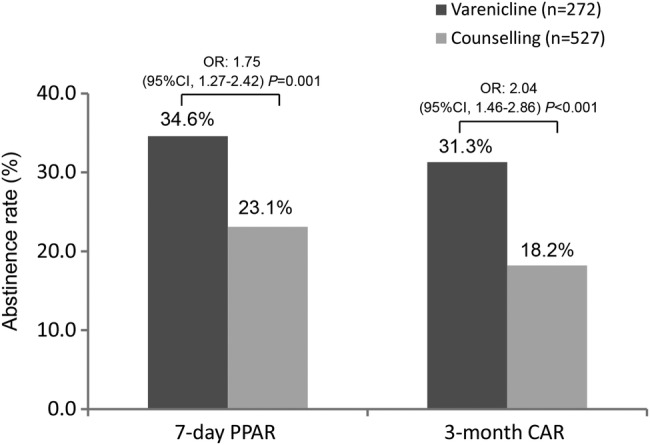
Primary outcomes were self-reported 7-day point prevalence abstinence rate and 3-month continuous abstinence rate at 6-month follow-up. Secondary outcomes were 7-day point prevalence abstinence rates at 1 and 3-month follow-up, and 1-month continuous abstinence rate at 3-month follow-up.
By intention-to-treat, the 7-day point prevalence abstinence rate with varenicline and counselling at 6 months was significantly higher than counselling only (37.0% vs 23.1%; OR, 1.75; 95% CI 1.46 to 2.62; p=0.001). The 3-month continuous abstinence rate at 6 months was higher with varenicline (33.1% vs 18.4%; OR, 2.04; 95% CI 1.61 to 2.99; p<0.001). Varenicline also showed better secondary outcomes.
Varenicline prescription in the smoking cessation clinic appeared to be effective with doubling of quit rates in Chinese smokers in a real world cessation clinic practice.
NCT01935505; Results.
在现实世界的戒烟门诊实践中,评估伐尼克兰对中国吸烟者戒烟的有效性。
一项前瞻性观察性研究。
中国北京。
共有924名吸烟者(883名男性和41名女性),他们前往一家大型综合医院的戒烟门诊就诊,并在基线时以及1、3和6个月的随访时通过结构化问卷进行数据评估。训练有素的医生顾问为所有受试者提供免费的个人咨询,并进行简短咨询的随访访谈。另外332名根据自身选择开具伐尼克兰处方的受试者与未使用伐尼克兰的受试者进行比较。
主要结局为6个月随访时自我报告的7日点患病率戒烟率和3个月持续戒烟率。次要结局为1个月和3个月随访时的7日点患病率戒烟率,以及3个月随访时的1个月持续戒烟率。
意向性分析显示,6个月时使用伐尼克兰并接受咨询的7日点患病率戒烟率显著高于仅接受咨询的情况(37.0%对23.1%;OR,1.75;95%CI 1.46至2.62;p=0.001)。6个月时使用伐尼克兰的3个月持续戒烟率更高(33.1%对18.4%;OR,2.04;95%CI 1.61至2.99;p<0.001)。伐尼克兰在次要结局方面也表现更好。
在现实世界的戒烟门诊实践中,戒烟门诊开具伐尼克兰处方对中国吸烟者似乎有效,戒烟率提高了一倍。
NCT01935505;结果。