School of Health Sciences, Liverpool Hope University, Liverpool, UK.
Musculoskeletal Science Research Group, Institute of Translational Medicine, University of Liverpool, Liverpool, UK.
Orthop J Sports Med. 2015 Nov 4;3(11):2325967115613988. doi: 10.1177/2325967115613988. eCollection 2015 Nov.
Implementation of overhead activity, a key component of many professional sports, requires an effective and balanced activation of the shoulder girdle muscles, particularly during forceful external rotation (ER) motions.
To identify activation strategies of 16 shoulder girdle muscles/muscle segments during common shoulder ER exercises.
Descriptive laboratory study.
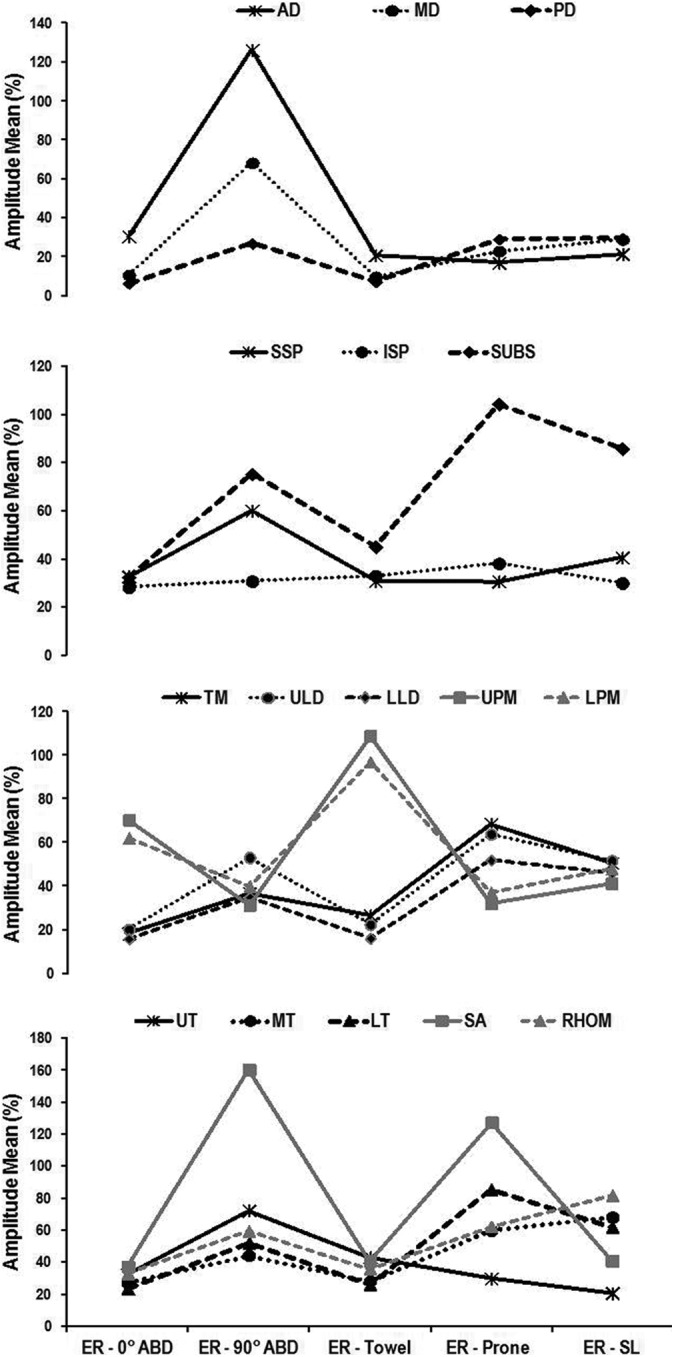
Thirty healthy subjects were included in this study, and 16 shoulder girdle muscles/muscle segments were investigated (surface electrode: anterior, middle, and posterior deltoid; upper, middle, and lower trapezius; serratus anterior; teres major; upper and lower latissimus dorsi; and upper and lower pectoralis major; fine wire electrodes: supraspinatus, infraspinatus, subscapularis, and rhomboid major) using a telemetric electromyography (EMG) system. Five ER exercises (standing ER at 0° and 90° of abduction, with underarm towel roll, prone ER at 90° of abduction, side-lying ER with underarm towel) were studied. Exercise EMG amplitudes were normalized to EMG at maximum ER force in a standard position. Univariate analysis of variance and post hoc analysis applied on EMG activity of each muscle were used to assess the main effect of the exercise condition.
Muscular activity differed significantly among the ER exercises (P < .05 to P < .001). The greatest activation for anterior and middle deltoid, supraspinatus, upper trapezius, and serratus anterior occurred during standing ER at 90° of abduction; for posterior deltoid, middle trapezius, and rhomboid during side-lying ER with underarm towel; for lower trapezius, upper and lower latissimus dorsi, subscapularis, and teres major during prone ER at 90° of abduction; and for the clavicular and sternal part of the pectoralis major during standing ER with underarm towel.
Key glenohumeral and scapular muscles can be optimally activated during specific ER exercises, particularly in positions that stimulate athletic overhead motions.
These results enable sports medicine professionals to target specific muscles during shoulder rehabilitation protocols while minimizing the effect of others, providing a foundation for optimal evidence-based exercise prescription. They also provide information for tailored muscle training and injury prevention in overhead sports.
许多专业运动的关键组成部分是上肢活动的实施,这需要有效地平衡肩部肌肉的活动,尤其是在强力外旋(ER)运动期间。
确定常见肩部 ER 运动中 16 个肩部肌肉/肌肉段的激活策略。
描述性实验室研究。
本研究纳入了 30 名健康受试者,研究了 16 个肩部肌肉/肌肉段(表面电极:前、中、后三角肌;上、中、下斜方肌;前锯肌;大圆肌;上、下背阔肌;上、下胸大肌;细钢丝电极:冈上肌、冈下肌、肩胛下肌和菱形肌),使用遥测肌电图(EMG)系统。研究了 5 种 ER 运动(站立 ER 在 0°和 90°外展,腋窝下毛巾卷,俯卧 ER 在 90°外展,侧卧 ER 腋窝下毛巾)。将 ER 力最大时的 EMG 幅度标准化为每个肌肉的 EMG 幅度。对每个肌肉的 EMG 活动进行单因素方差分析和事后分析,以评估运动条件的主要影响。
ER 运动之间的肌肉活动差异显著(P<0.05 至 P<0.001)。最大的前三角肌和中三角肌、冈上肌、上斜方肌和前锯肌的激活发生在站立 ER 在 90°外展时;侧卧位 ER 腋窝下毛巾时的后三角肌、中斜方肌和菱形肌;俯卧 ER 在 90°外展时的下斜方肌、上、下背阔肌、肩胛下肌和大圆肌;站立 ER 腋窝下毛巾时的胸大肌锁骨和胸骨部分。
特定的 ER 运动可以最佳地激活关键的盂肱和肩胛带肌肉,特别是在刺激运动性上肢活动的位置。
这些结果使运动医学专业人员能够在肩部康复方案中针对特定肌肉,同时最大限度地减少其他肌肉的影响,为最佳基于证据的运动处方提供基础。它们还为上肢运动中的针对性肌肉训练和损伤预防提供了信息。