Razmjou Helen, van Osnabrugge Varda, Anunciacion Mark, Nunn Andrea, Drosdowech Darren, Roszkowski Ania, Szafirowicz Analia, Boljanovic Dragana, Wainwright Amy, Nam Diane
Holland Bone and Joint Program, Holland Orthoapaedic & Arthritic Centre, Sunnybrook Health Sciences Centre, Toronto, Ontario, Canada.
Department of Physical Therapy, Faculty of Medicine, University of Toronto, Toronto, Ontario, Canada.
J Shoulder Elb Arthroplast. 2021 Jul 1;5:24715492211023302. doi: 10.1177/24715492211023302. eCollection 2021.
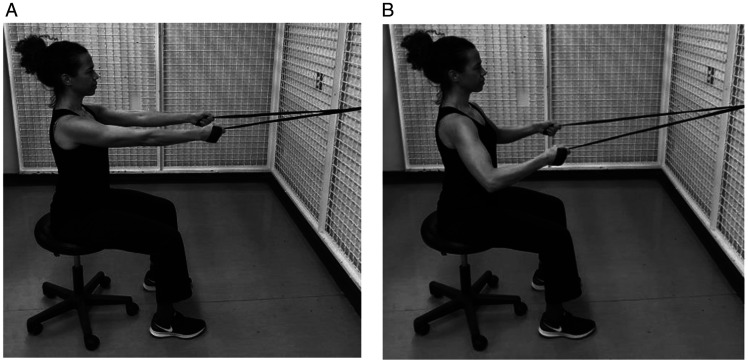
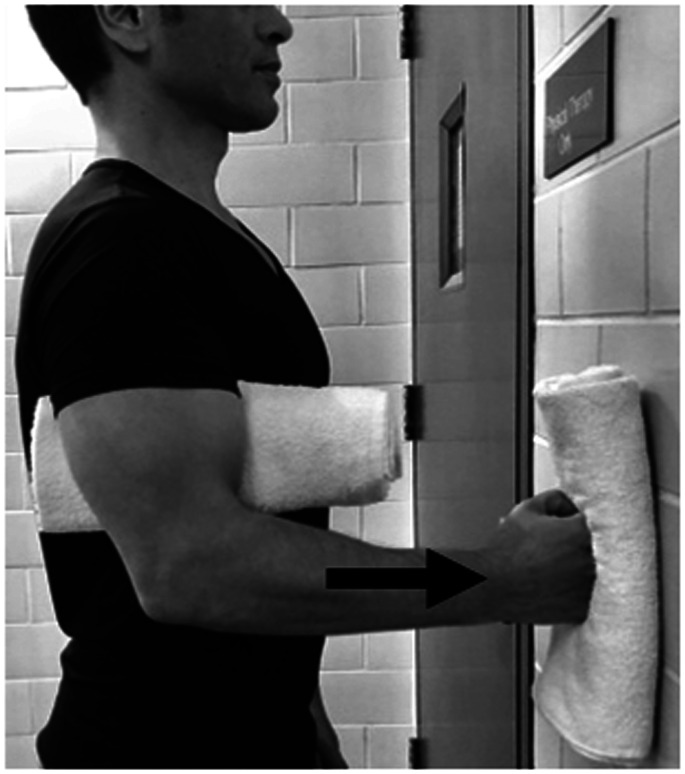
The purpose of this review is to describe the role of altered joint biomechanics in reverse shoulder arthroplasty and to propose a rehabilitation protocol for a cuff-deficient glenohumeral joint based on the current evidence. The proposed rehabilitation incorporates the principles of pertinent muscle loading while considering risk factors and surgical complications.
In light of altered function of shoulder muscles in reverse arthroplasty, scapular plane abduction should be more often utilized as it better activates deltoid, teres minor, upper trapezius, and serratus anterior. Given the absence of supraspinatus and infraspinatus and reduction of external rotation moment arm of the deltoid in reverse arthroplasty, significant recovery of external rotation may not occur, although an intact teres minor may assist external rotation in the elevated position.
Improving the efficiency of deltoid function before and after reverse shoulder arthroplasty is a key factor in the rehabilitation of the cuff deficient shoulders. Performing exercises in scapular plane and higher abduction angles activates deltoid and other important muscles more efficiently and optimizes surgical outcomes.
本综述的目的是描述改变的关节生物力学在反式肩关节置换术中的作用,并根据现有证据为肩袖缺损的盂肱关节提出一种康复方案。所提出的康复方案纳入了相关肌肉负荷的原则,同时考虑了风险因素和手术并发症。
鉴于反式肩关节置换术中肩部肌肉功能的改变,肩胛平面外展应更常被采用,因为它能更好地激活三角肌、小圆肌、斜方肌上束和前锯肌。由于反式肩关节置换术中冈上肌和冈下肌缺失以及三角肌外旋力矩臂减小,外旋可能无法显著恢复,尽管完整的小圆肌可能在抬高位置辅助外旋。
提高反式肩关节置换术前和术后三角肌功能的效率是肩袖缺损肩部康复的关键因素。在肩胛平面和更大外展角度进行锻炼能更有效地激活三角肌和其他重要肌肉,并优化手术效果。