Rajput Charu, Tauseef Mohammad, Farazuddin Mohammad, Yazbeck Pascal, Amin Md-Ruhul, Avin Br Vijay, Sharma Tiffany, Mehta Dolly
From the Department of Pharmacology and Center for Lung and Vascular Biology, University of Illinois at Chicago.
Arterioscler Thromb Vasc Biol. 2016 Feb;36(2):380-8. doi: 10.1161/ATVBAHA.115.306997. Epub 2016 Jan 7.
Increased vascular permeability is a hallmark of sepsis and acute respiratory distress syndrome. Angiopoietin (Ang2) induces vascular leak, and excess Ang2 generation is associated with patient mortality from these diseases. However, mechanisms dampening Ang2 generation during injury remain unclear. Interestingly, microRNA (miR)-150 levels were decreased in septic patients. miR regulate signaling networks by silencing mRNAs containing complementary sequences. Thus, we hypothesized that miR-150 suppresses Ang2 generation and thereby resolves vascular injury.
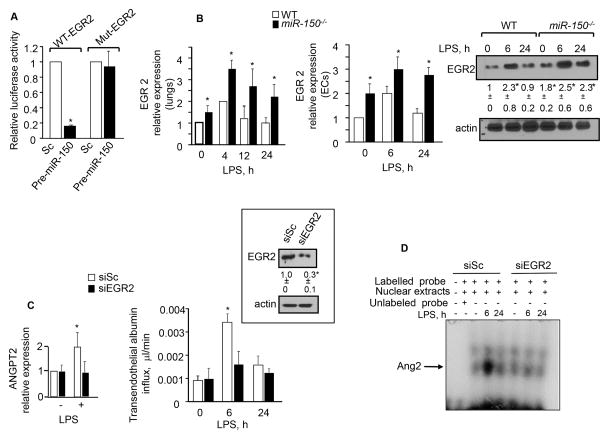
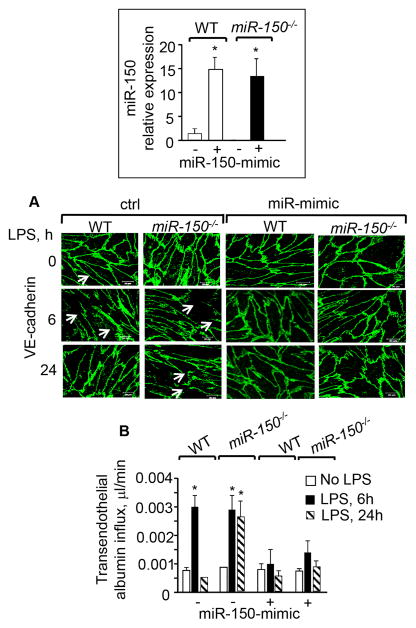
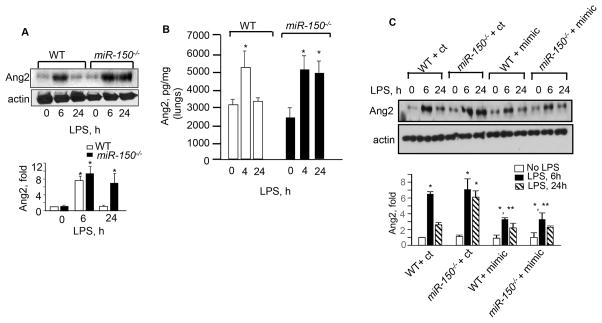
Wild-type or miR-150(-/-) mice or endothelial cells were exposed to lipopolysaccharide or sepsis, and Ang2 levels, adherens junction reannealing, endothelial barrier function, and mortality were determined. Although Ang2 transiently increased during lipopolysaccharide-induced injury in wild-type endothelial cells and lungs, miR-150 expression was elevated only during recovery from injury. Deletion of miR-150 caused a persistent increase in Ang2 levels and impaired adherens junctions reannealing after injury, resulting thereby in an irreversible increase in vascular permeability. Also, miR-150(-/-) mice died rapidly after sepsis. Rescuing miR-150 expression in endothelial cells prevented Ang2 generation, thereby restoring vascular barrier function in miR-150(-/-) mice. miR-150 terminated Ang2 generation by targeting the transcription factor, early growth response 2. Thus, early growth response 2 or Ang2 depletion in miR-150(-/-) endothelial cells restored junctional reannealing and reinstated barrier function. Importantly, upregulating miR-150 expression by injecting a chemically synthesized miR-150 mimic into wild-type mice vasculature decreased early growth response 2 and Ang2 levels and hence mortality from sepsis.
miR-150 is a novel suppressor of Ang2 generation with a key role in resolving vascular injury and reducing mortality resulting from sepsis.
血管通透性增加是脓毒症和急性呼吸窘迫综合征的一个标志。血管生成素(Ang2)可诱导血管渗漏,并且Ang2生成过多与这些疾病导致的患者死亡相关。然而,损伤期间抑制Ang2生成的机制仍不清楚。有趣的是,脓毒症患者体内的微小RNA(miR)-150水平降低。miR通过使含有互补序列的mRNA沉默来调节信号网络。因此,我们推测miR-150可抑制Ang2生成,从而解决血管损伤问题。
将野生型或miR-150基因敲除(-/-)小鼠或内皮细胞暴露于脂多糖或脓毒症中,然后测定Ang2水平、黏附连接重新退火、内皮屏障功能和死亡率。尽管在野生型内皮细胞和肺中,脂多糖诱导损伤期间Ang2会短暂增加,但miR-150表达仅在损伤恢复期间升高。miR-150缺失导致损伤后Ang2水平持续升高,并损害黏附连接重新退火,从而导致血管通透性不可逆增加。此外,miR-150(-/-)小鼠在脓毒症后迅速死亡。在内皮细胞中恢复miR-150表达可阻止Ang2生成,从而恢复miR-150(-/-)小鼠的血管屏障功能。miR-150通过靶向转录因子早期生长反应2来终止Ang2生成。因此,在miR-150(-/-)内皮细胞中敲低早期生长反应2或Ang2可恢复连接重新退火并恢复屏障功能。重要的是,通过向野生型小鼠脉管系统注射化学合成的miR-150模拟物来上调miR-150表达,可降低早期生长反应2和Ang2水平,从而降低脓毒症导致的死亡率。
miR-150是一种新型的Ang2生成抑制剂,在解决血管损伤和降低脓毒症导致的死亡率方面起关键作用。