Bruse Shannon, Moreau Michael, Bromberg Yana, Jang Jun-Ho, Wang Nan, Ha Hongseok, Picchi Maria, Lin Yong, Langley Raymond J, Qualls Clifford, Klensney-Tait Julia, Zabner Joseph, Leng Shuguang, Mao Jenny, Belinsky Steven A, Xing Jinchuan, Nyunoya Toru
Lovelace Respiratory Research Institute, 2425 Ridgecrest Drive SE, Albuquerque, NM, 87108, USA.
Department of Genetics, Rutgers, The State University of New Jersey, 145 Bevier Road, Piscataway, NJ, 08854, USA.
Hum Genomics. 2016 Jan 7;10:1. doi: 10.1186/s40246-015-0058-7.
Chronic obstructive pulmonary disease (COPD) is characterized by an irreversible airflow limitation in response to inhalation of noxious stimuli, such as cigarette smoke. However, only 15-20 % smokers manifest COPD, suggesting a role for genetic predisposition. Although genome-wide association studies have identified common genetic variants that are associated with susceptibility to COPD, effect sizes of the identified variants are modest, as is the total heritability accounted for by these variants. In this study, an extreme phenotype exome sequencing study was combined with in vitro modeling to identify COPD candidate genes.
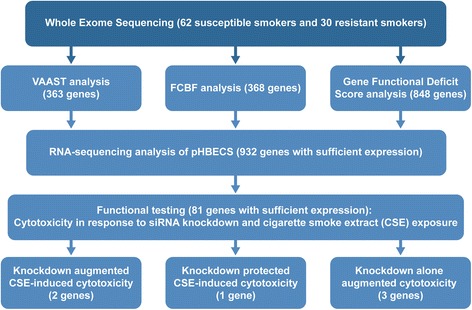
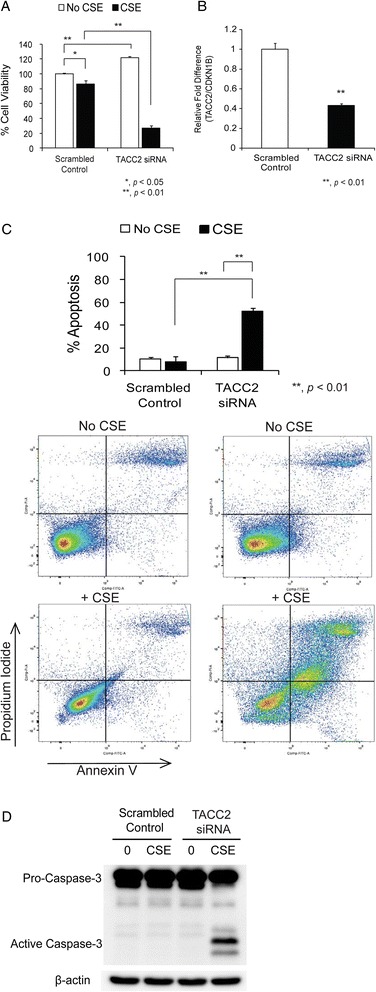
We performed whole exome sequencing of 62 highly susceptible smokers and 30 exceptionally resistant smokers to identify rare variants that may contribute to disease risk or resistance to COPD. This was a cross-sectional case-control study without therapeutic intervention or longitudinal follow-up information. We identified candidate genes based on rare variant analyses and evaluated exonic variants to pinpoint individual genes whose function was computationally established to be significantly different between susceptible and resistant smokers. Top scoring candidate genes from these analyses were further filtered by requiring that each gene be expressed in human bronchial epithelial cells (HBECs). A total of 81 candidate genes were thus selected for in vitro functional testing in cigarette smoke extract (CSE)-exposed HBECs. Using small interfering RNA (siRNA)-mediated gene silencing experiments, we showed that silencing of several candidate genes augmented CSE-induced cytotoxicity in vitro.
Our integrative analysis through both genetic and functional approaches identified two candidate genes (TACC2 and MYO1E) that augment cigarette smoke (CS)-induced cytotoxicity and, potentially, COPD susceptibility.
慢性阻塞性肺疾病(COPD)的特征是对诸如香烟烟雾等有害刺激物吸入产生不可逆的气流受限。然而,只有15 - 20%的吸烟者会患COPD,这表明遗传易感性起到了一定作用。尽管全基因组关联研究已经确定了与COPD易感性相关的常见基因变异,但所确定变异的效应大小适中,这些变异所解释的总遗传度也是如此。在本研究中,将极端表型外显子测序研究与体外模型相结合以鉴定COPD候选基因。
我们对62名高度易感吸烟者和30名异常耐受吸烟者进行了全外显子测序,以鉴定可能导致疾病风险或对COPD耐受的罕见变异。这是一项无治疗干预或纵向随访信息的横断面病例对照研究。我们基于罕见变异分析确定了候选基因,并评估外显子变异以确定在易感和耐受吸烟者之间其功能经计算确定有显著差异的单个基因。通过要求每个基因在人支气管上皮细胞(HBECs)中表达,对这些分析中得分最高的候选基因进行了进一步筛选。总共选择了81个候选基因在暴露于香烟烟雾提取物(CSE)的HBECs中进行体外功能测试。使用小干扰RNA(siRNA)介导的基因沉默实验,我们表明沉默几个候选基因会增强体外CSE诱导的细胞毒性。
我们通过遗传和功能方法的综合分析确定了两个候选基因(TACC2和MYO1E),它们增强了香烟烟雾(CS)诱导的细胞毒性,并可能增强COPD易感性。