Abbasian Ahmad, Feiz Disfani Hamideh, Afzalimoghaddam Mohammad, Talebian Mohammad Taghi, Masoumi Babak, Nasr-Esfahani Mohammad
Department of Emergency Medicine, Pre-Hospital Emergency Research Center, Imam Khomeini Hospital , Tehran University of Medical Sciences, Tehran, IR Iran.
Department of Emergency Medicine, Hasheminejad Hospital, Faculty of Medicine, Mashhad University of Medical Sciences, Mashhad, IR Iran.
Iran Red Crescent Med J. 2015 Dec 24;17(12):e19403. doi: 10.5812/ircmj.19403. eCollection 2015 Dec.
In order to assessment of intravascular fluid measurement of central venous pressure (CVP) is used via central venous catheterization (CVC). This procedure is highly invasive and may cause serious complications such as pneumothorax, infection, hematoma and etc. It is so valuable procedure if we can uses a less invasive or noninvasive procedure to assess patients intravascular fluid in critical positions.
In this study, the ultrasound was used to measure the central venous pressure (CVP).
In this study, patients with Central venous catheterization were selected using simple random sampling. The largest diameter of longitudinal, transverse views and the cross-section of inferior vena cava (IVC) and internal jugular vein (IJV) were measured using the ultrasound in the bedside of the patients. Central venous pressure was measured using routine methods. Correlations between variables were analyzed using SPSS and linear regression.
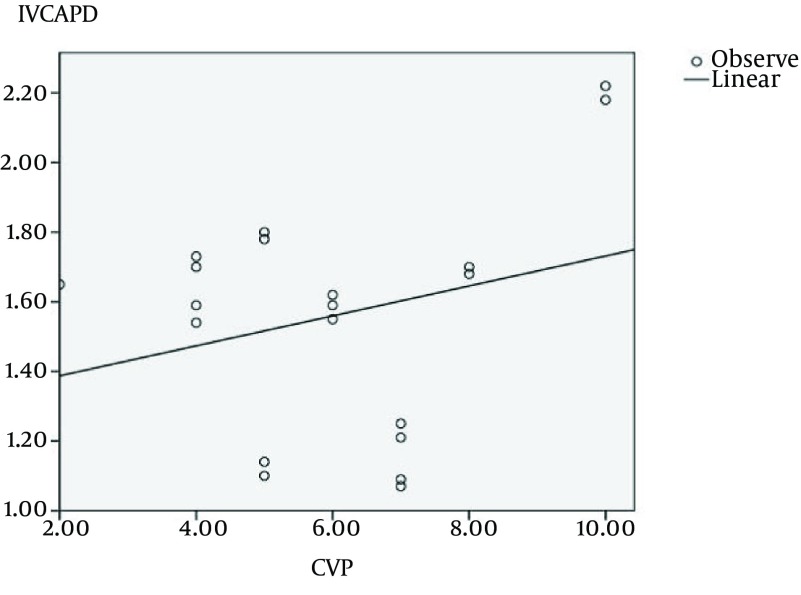
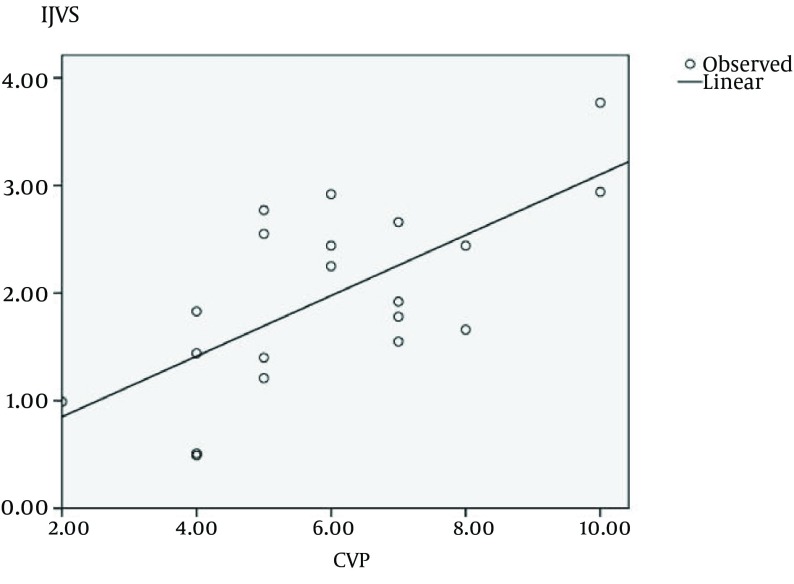
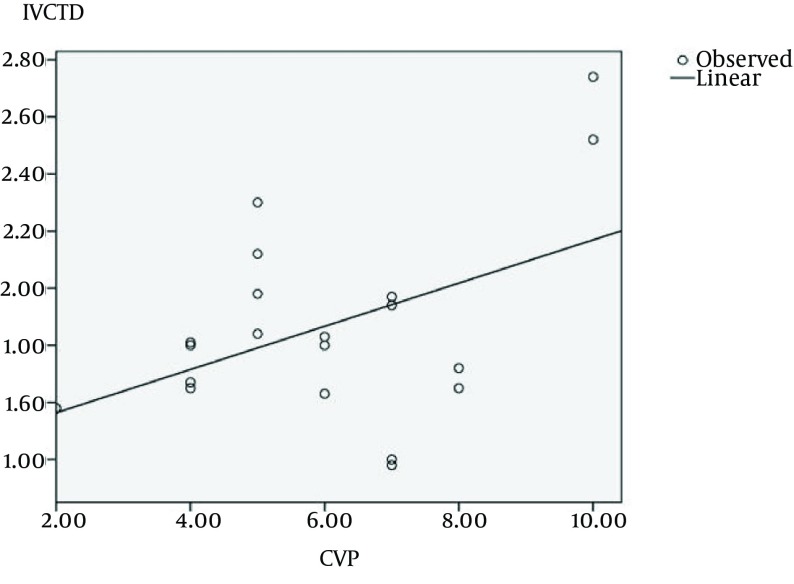
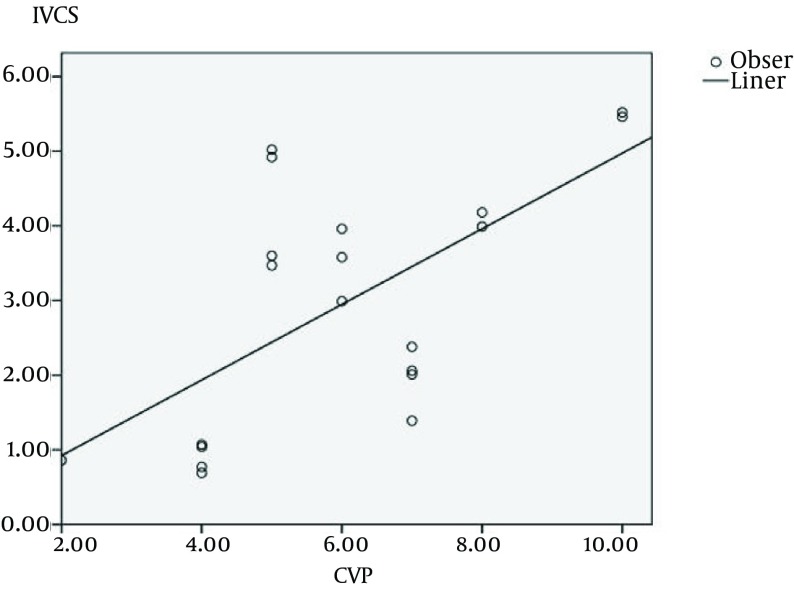
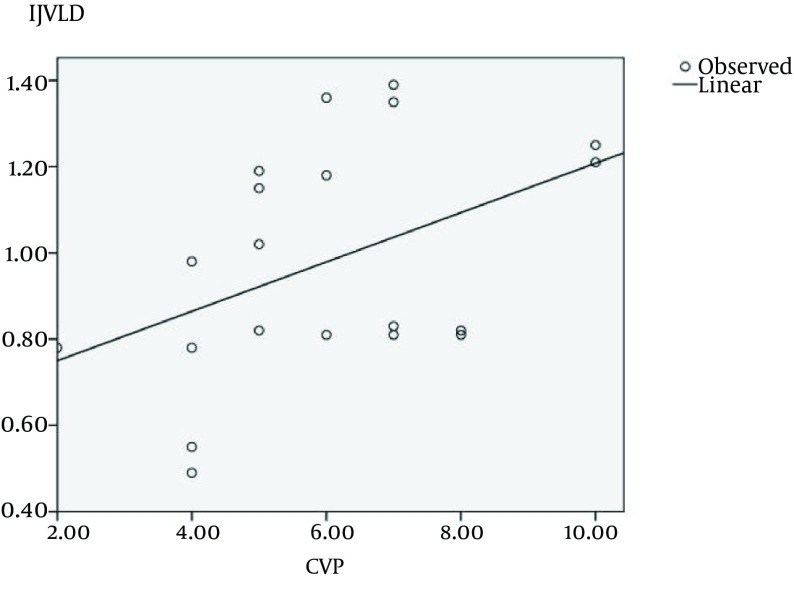
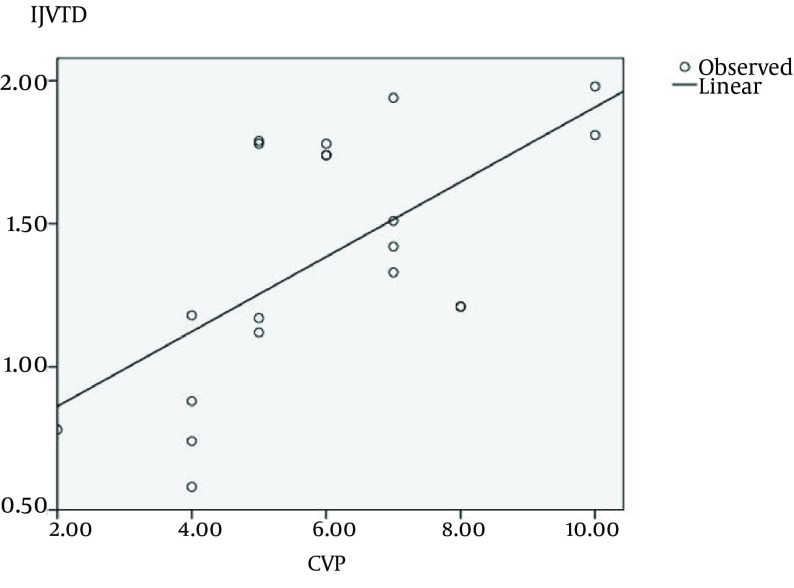
Twenty patients with the mean age of 60.3 were studied. The main reason for cardiac catheterization was shock. There are no relationship between anterior posterior diameter of inferior vena cava and CVP of patients (P = 0.257). The longest diameter of IVC in ultrasonographic transverse view had significant association with CVP of patients (P = 0.045) but in patients with BMI > 25 it was not significant. Cross section of internal jugular vein had significant association with CVP of patients (P = 0.003). Longitudinal diameter of internal jugular vein had no significant association with CVP of patients (P = 0.052), but transverse diameter of internal jugular generally had significant association with CVP of patients (P = 0.003). Cross section of internal jugular had significant association with CVP (P = 0.001).
Noninvasive assessment of the patient hydration condition using the ultrasound is a simple and practicable measure in emergency. With regard to the considerations, it is possible to estimate CVP via diameter measurement and cross-section of the central veins.
为评估血管内液体量,可通过中心静脉置管(CVC)测量中心静脉压(CVP)。此操作具有高度侵入性,可能引发严重并发症,如气胸、感染、血肿等。若能采用侵入性较小或非侵入性的方法来评估处于危急状态患者的血管内液体量,那将是非常有价值的做法。
本研究采用超声测量中心静脉压(CVP)。
本研究通过简单随机抽样选取行中心静脉置管的患者。在患者床边使用超声测量下腔静脉(IVC)和颈内静脉(IJV)的纵切面、横切面的最大直径以及横截面。采用常规方法测量中心静脉压。使用SPSS和线性回归分析变量之间的相关性。
研究了20例平均年龄为60.3岁的患者。进行心脏导管插入术的主要原因是休克。患者下腔静脉前后径与CVP之间无相关性(P = 0.257)。超声横切面上IVC的最长直径与患者CVP有显著相关性(P = 0.045),但在BMI>25的患者中不显著。颈内静脉横截面与患者CVP有显著相关性(P = 0.003)。颈内静脉纵径与患者CVP无显著相关性(P = 0.052),但颈内静脉横径一般与患者CVP有显著相关性(P = 0.003)。颈内静脉横截面与CVP有显著相关性(P = 0.001)。
在急诊中,使用超声对患者水化状况进行非侵入性评估是一种简单可行的措施。考虑到这些因素,通过测量中心静脉的直径和横截面来估计CVP是可行的。