Stevens Judy A, Mahoney Jane E, Ehrenreich Heidi
4770 Buford Highway NE, Mailstop F-62, Atlanta, GA 30341, USA.
Department of Medicine, University of Wisconsin School of Medicine and Public Health, Madison, WI 53705, USA.
Inj Epidemiol. 2014 Mar 20;1(5). doi: 10.1186/2197-1714-1-5.
For older adults, falls threaten their health, independence, and quality of life. Knowing the circumstances surrounding falls is essential for understanding how behavioral and environmental factors interact in fall events. It is also important for developing and implementing interventions that are effective and acceptable to older adults. This study investigated the circumstances and injury outcomes of falls among community-dwelling older adults at high risk of falling.
In this secondary analysis, we examined the circumstances and outcomes of falls experienced by 328 participants in the Dane County (Wisconsin) Safety Assessment for Elders (SAFE) Research Study. SAFE was a randomized controlled trial of a community-based multifactorial falls intervention for older adults at high risk for falls, conducted from October 2002 to December 2007. Participants were community-dwelling adults aged ≥65 years who reported at least one fall during the year after study enrollment. Falls were collected prospectively using monthly calendars. Everyone who reported a fall was contacted by telephone to determine the circumstances surrounding the event. Injury outcomes were defined as none, mild (injury reported but no treatment sought), moderate (treatment for any injury except head injury or fracture), and severe (treatment for head injury or fracture).
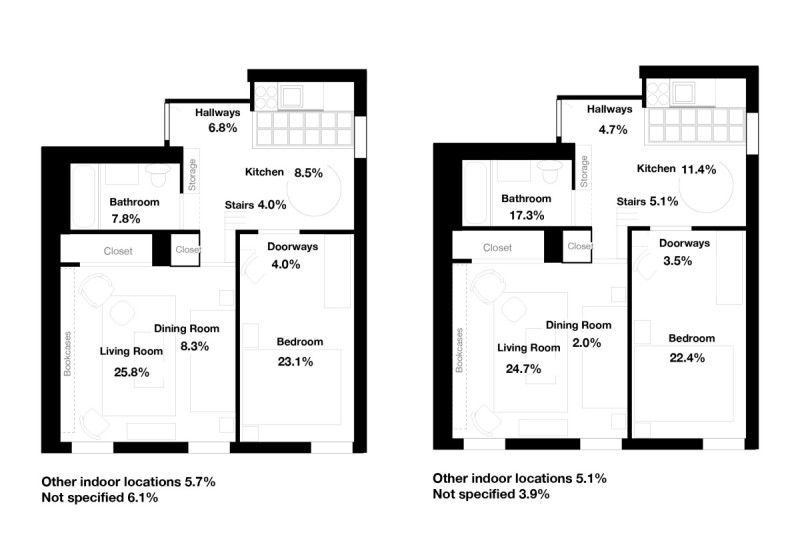
Data were available for 1,172 falls. A generalized linear mixed model analysis showed that being age ≥85 (OR = 2.1, 95% confidence interval [CI] = 1.2-3.9), female (OR = 2.1, 95% CI = 1.3-3.4), falling backward and landing flat (OR = 5.6, 95% CI = 2.9-10.5), sideways (OR = 4.6, 95% CI = 2.6-8.0) and forward (OR = 3.3, 95% CI = 2.0-5.7) were significantly associated with the likelihood of injury. Of 783 falls inside the home, falls in the bathroom were more than twice as likely to result in an injury compared to falls in the living room (OR = 2.4, 95% CI = 1.2-4.9).
Most falls among these high risk older adults occurred inside the home. The likelihood of injury in the bathroom supports the need for safety modifications such as grab bars, and may indicate a need for assistance with bathing. These findings will help clinicians tailor fall prevention for their patients and have practical implications for retirement and assisted living communities and community-based fall prevention programs.
对于老年人而言,跌倒会威胁他们的健康、独立性和生活质量。了解跌倒发生时的具体情况对于理解行为因素和环境因素在跌倒事件中如何相互作用至关重要。这对于制定和实施对老年人有效且可接受的干预措施也很重要。本研究调查了社区中具有高跌倒风险的老年人跌倒的情况及损伤后果。
在这项二次分析中,我们研究了参与威斯康星州戴恩县老年人安全评估(SAFE)研究的328名参与者跌倒的情况及后果。SAFE是一项针对高跌倒风险老年人的基于社区的多因素跌倒干预随机对照试验,于2002年10月至2007年12月进行。参与者为年龄≥65岁的社区居住成年人,他们在研究入组后的一年内报告至少发生过一次跌倒。跌倒情况通过每月日历前瞻性收集。对于每一位报告跌倒的人,通过电话联系以确定事件发生时的具体情况。损伤后果定义为无、轻度(报告有损伤但未寻求治疗)、中度(因任何损伤接受治疗,但不包括头部损伤或骨折)和重度(因头部损伤或骨折接受治疗)。
共获得1172次跌倒的数据。广义线性混合模型分析显示,年龄≥85岁(比值比[OR]=2.1,95%置信区间[CI]=1.2 - 3.9)、女性(OR = 2.1,95% CI = 1.3 - 3.4)、向后跌倒且平躺在地(OR = 5.6,95% CI = 2.9 - 10.5)、向侧面跌倒(OR = 4.6,95% CI = 2.6 - 8.0)和向前跌倒(OR = 3.3,95% CI = 2.0 - 5.7)与受伤可能性显著相关。在783次家中跌倒事件中,浴室跌倒导致受伤的可能性是客厅跌倒的两倍多(OR = 2.4,95% CI = 1.2 - 4.9)。
这些高风险老年人中的大多数跌倒发生在家中。浴室中跌倒受伤的可能性表明需要进行安全改造,如安装扶手,也可能表明在洗澡时需要协助。这些发现将有助于临床医生为患者量身定制跌倒预防措施,并对退休社区、辅助生活社区以及基于社区的跌倒预防项目具有实际意义。