Chiu Hsien-Yi, Hsieh Chi-Feng, Chiang Yi-Ting, Tsai Yi-Wen, Huang Weng-Foung, Li Cheng-Yuan, Wang Ting-Shun, Tsai Tsen-Fang
Institute of Biomedical Engineering, College of Medicine and College of Engineering, National Taiwan University, Taipei, Taiwan.
Department of Dermatology, National Taiwan University Hospital Hsin-Chu Branch, Hsinchu, Taiwan.
PLoS One. 2016 Jan 8;11(1):e0146462. doi: 10.1371/journal.pone.0146462. eCollection 2016.
The increased rates of cardiovascular morbidity and mortality in patients with psoriasis are not adequately explained by traditional risk factors. Whether concomitant sleep disorders (SDs) modify the risk of cardiovascular disease (CVD) in patients with psoriasis remains unknown.
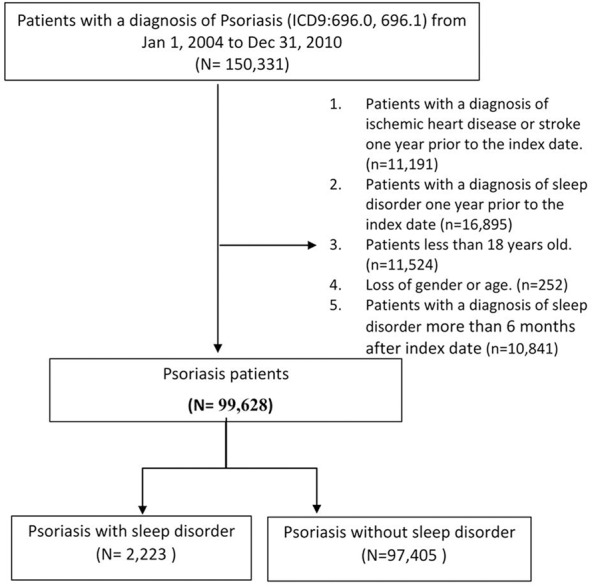
Using the Taiwan National Health Insurance Research Database (NHIRD), we conducted a cohort study to investigate the association between concomitant SDs and CVD risk in patients with psoriasis. Data from 99,628 adults who received a psoriasis diagnosis during the period from 2004 to 2010 were analyzed. Cox proportional hazards regression analysis models were used to compare the risks of ischemic heart disease (IHD) and stroke between patients with and without SDs.
Psoriasis patients with a concomitant SD had significantly higher risks of IHD (adjusted hazard ratio [aHR], 1.25; 95% confidence interval [CI], 1.22-1.28) and stroke (aHR, 1.24; 95% CI, 1.16-1.33) as compared with psoriasis patients without SDs. All psoriasis patient subgroups, including those with mild and severe psoriasis and those with and without arthritis, had increased HRs for IHD and stroke. The increases in IHD and stroke risks conferred by SDs were proportional to the dose of hypnotics used. The effect of SDs on the risks of IHD and stroke was greater in young adults than in middle-aged and older adults.
The risks of IHD and stroke were higher for psoriasis patients with SDs than for those without SDs. Clinicians should carefully evaluate CVD risk, particularly in young patients with psoriasis.
银屑病患者心血管疾病发病率和死亡率的上升不能完全用传统危险因素来解释。银屑病患者中,伴发的睡眠障碍(SDs)是否会改变心血管疾病(CVD)风险尚不清楚。
利用台湾国民健康保险研究数据库(NHIRD),我们进行了一项队列研究,以调查银屑病患者中伴发的SDs与CVD风险之间的关联。分析了2004年至2010年期间99628例被诊断为银屑病的成年人的数据。采用Cox比例风险回归分析模型比较有和没有SDs的患者患缺血性心脏病(IHD)和中风的风险。
与没有SDs的银屑病患者相比,伴有SDs的银屑病患者患IHD(调整后风险比[aHR],1.25;95%置信区间[CI],1.22 - 1.28)和中风(aHR,1.24;95%CI,1.16 - 1.33)的风险显著更高。所有银屑病患者亚组,包括轻度和重度银屑病患者以及有和没有关节炎的患者,患IHD和中风的风险比均升高。SDs导致的IHD和中风风险增加与使用的催眠药剂量成正比。SDs对IHD和中风风险的影响在年轻人中比在中年人和老年人中更大。
有SDs的银屑病患者患IHD和中风的风险高于没有SDs的患者。临床医生应仔细评估CVD风险,尤其是年轻的银屑病患者。