Waters Michael F, Hoh Brian L, Lynn Michael J, Kwon Hyung-Min, Turan Tanya N, Derdeyn Colin P, Fiorella David, Khanna Anna, Sheehan Tiffany O, Lane Bethany F, Janis Scott, Montgomery Jean, Chimowitz Marc I
Department of Neurology, McKnight Brain Institute, University of Florida College of Medicine, Gainesville2Department of Neuroscience, McKnight Brain Institute, University of Florida College of Medicine, Gainesville.
Department of Neurosurgery, McKnight Brain Institute, University of Florida College of Medicine, Gainesville.
JAMA Neurol. 2016 Mar;73(3):308-15. doi: 10.1001/jamaneurol.2015.4315.
The Stenting and Aggressive Medical Management for Preventing Recurrent Stroke in Intracranial Stenosis (SAMMPRIS) Trial showed that aggressive medical therapy was more effective than stenting for preventing stroke in patients with symptomatic intracranial stenosis. However, 15% of patients in the medical group still experienced a primary end point during a median follow-up of 32.7 months.
To determine baseline features that were associated with a high rate of a primary end point in the medical arm of the SAMMPRIS Trial.
DESIGN, SETTING, AND PARTICIPANTS: A post hoc analysis of patients in the medical arm only of the SAMMPRIS trial. Enrollment occurred between October 2008 and April 2013 and included 227 patients randomized to medical management alone. Baseline demographic features, vascular risk factors, qualifying event, brain imaging, and angiographic features were analyzed. Bivariate and multivariable proportional hazard regression modeling was performed to relate baseline features to the time until a primary end point. The post hoc analysis was conducted from November 2014 to June 2015.
The SAMMPRIS Trial compared stenting with aggressive medical management in patients with a stroke or transient ischemic attack attributed to 70% to 99% stenosis of a major intracranial artery.
The primary outcome was any of the following: stroke or death within 30 days of enrollment, ischemic stroke in the territory of the symptomatic intracranial artery beyond 30 days after enrollment, or any stroke or death within 30 days after stenting a patient in the medical group during follow-up.
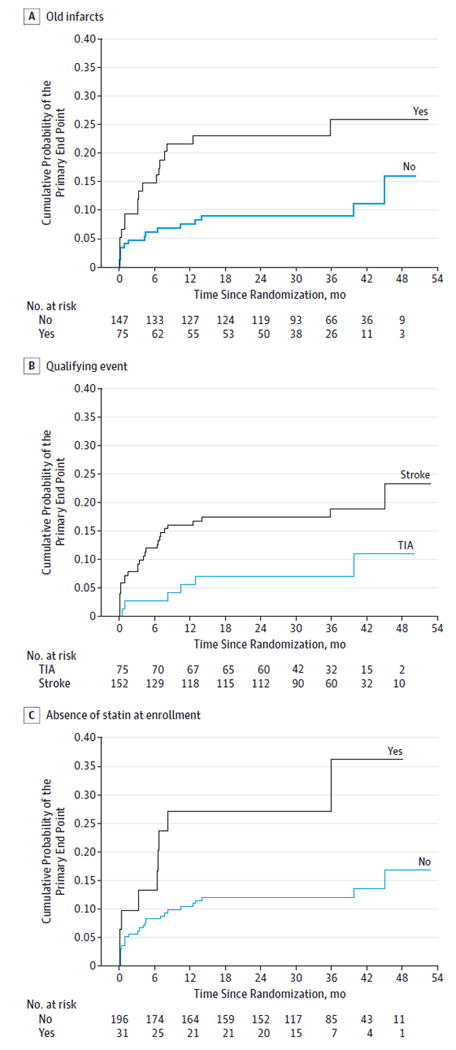
A total of 227 patients were included in the study, 82 of whom were female, and the mean (SD) age was 59.5 (11.8) years. Being female (hazard ratio [HR], 1.9; 95% CI, 0.96-3.7), having diabetes mellitus (HR, 1.8; 95% CI, 0.9-3.5), not taking a statin at enrollment (HR, 2.6; 95% CI, 1.2-5.7), stroke as the qualifying event (HR, 2.5; 95% CI, 1.03-6.0), Rankin grade of 1 or greater (HR, 2.3; 95% CI, 0.9-5.5), old infarct in the territory of the stenotic artery (HR, 2.6; 95% CI, 1.3-5.1), and greater than 80% stenosis (HR, 1.9; 95% CI, 0.9-3.7) were associated (P < .10) with higher risk on bivariate analysis. Factors that were significantly associated with a primary end point on multivariable analyses were old infarct in the territory (HR, 2.6; 95% CI, 1.3-5.3; P = .006), stroke as the qualifying event (HR, 3.0; 95% CI, 1.1-7.7; P = .03), and no statin use at enrollment (HR, 2.4; 95% CI, 1.1-5.2; P = .03).
Old infarct in the territory of the stenosis, new stroke presentation, and absence of statin use at enrollment were independently associated with high rates of the primary end point in the medical group in the SAMMPRIS Trial. These features may be useful for selecting high-risk patients for future clinical trials evaluating alternative therapies for intracranial stenosis.
clinicaltrials.gov Identifier: NCT00576693.
颅内狭窄预防复发性卒中的支架置入与积极药物治疗(SAMMPRIS)试验表明,对于有症状的颅内狭窄患者,积极药物治疗在预防卒中方面比支架置入更有效。然而,在中位随访32.7个月期间,药物治疗组有15%的患者仍出现主要终点事件。
确定与SAMMPRIS试验药物治疗组主要终点事件高发生率相关的基线特征。
设计、地点和参与者:仅对SAMMPRIS试验药物治疗组患者进行的事后分析。研究对象于2008年10月至2013年4月入组,包括227例随机接受单纯药物治疗的患者。分析了基线人口统计学特征、血管危险因素、入选事件、脑成像和血管造影特征。采用双变量和多变量比例风险回归模型,将基线特征与至主要终点事件的时间相关联。事后分析于2014年11月至2015年6月进行。
SAMMPRIS试验比较了对主要颅内动脉狭窄70%至99%所致卒中或短暂性脑缺血发作患者进行支架置入与积极药物治疗的效果。
主要结局为以下任何一种情况:入组后30天内发生卒中或死亡、入组30天后在有症状颅内动脉供血区域发生缺血性卒中、或在随访期间对药物治疗组患者进行支架置入后30天内发生任何卒中或死亡。
本研究共纳入227例患者,其中82例为女性,平均(标准差)年龄为59.5(11.8)岁。双变量分析显示,女性(风险比[HR],1.9;95%置信区间[CI],0.96 - 3.7)、患有糖尿病(HR,1.8;95% CI,0.9 - 3.5)、入组时未服用他汀类药物(HR,2.6;95% CI,1.2 - 5.7)、入选事件为卒中(HR,2.5;95% CI,1.03 - 6.0)、Rankin分级为1级或更高(HR,2.3;95% CI,0.9 - 5.5)、狭窄动脉供血区域有陈旧性梗死(HR,2.6;95% CI,1.3 - 5.1)以及狭窄程度大于80%(HR,1.9;95% CI,0.9 - 3.7)与较高风险相关(P < 0.10)。多变量分析中与主要终点事件显著相关的因素为供血区域有陈旧性梗死(HR,2.6;95% CI,1.3 - 5.3;P = 0.006)、入选事件为卒中(HR,3.0;95% CI,1.1 - 7.7;P = 0.03)以及入组时未使用他汀类药物(HR,2.4;95% CI,1.1 - 5.2;P = 0.03)。
在SAMMPRIS试验中,狭窄供血区域的陈旧性梗死、新发卒中表现以及入组时未使用他汀类药物与药物治疗组主要终点事件的高发生率独立相关。这些特征可能有助于为未来评估颅内狭窄替代治疗方法的临床试验选择高危患者。
clinicaltrials.gov标识符:NCT00576693。