Hughes M, Roberts C, Tracey A, Dinsdale G, Murray A, Herrick A L
Centre for Musculoskeletal Research, University of Manchester, and Manchester Academic Health Science Centre, Manchester, UK.
Centre for Biostatistics, Institute of Population Health, School of Medicine, University of Manchester, Manchester, UK.
Arthritis Care Res (Hoboken). 2016 Sep;68(9):1340-5. doi: 10.1002/acr.22833. Epub 2016 Jul 28.
Digital ulcers (DUs) are often a primary end point in systemic sclerosis (SSc; scleroderma) clinical trials, although the reliability of rheumatologists grading DUs is poor to moderate at best. DU assessment in recent trials has been based upon visual inspection alone, which potentially misses "real-world" clinical contextual information. Our aim was to investigate whether this clinical information improves the reliability of rheumatologists grading DUs. A secondary aim was to assess agreement between patients and rheumatologists.
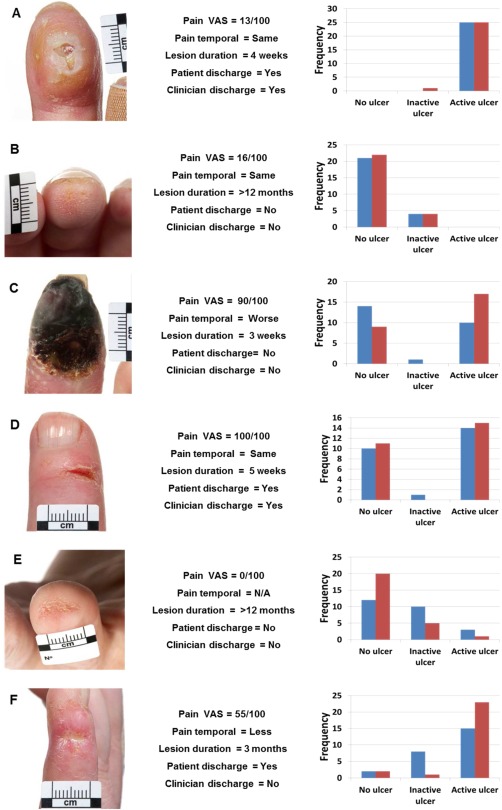
Eighty images of a range of digital lesions were collected from patients with SSc with the clinical context: pain (severity and temporal relationship), lesion duration, and discharge (patient reported and clinician observed). Raters received all images either with or without the clinical context, and graded these images (using a custom-built interface) on an ordinal scale of severity: no ulcer, inactive ulcer, or active ulcer. Patients also graded their lesion(s) on the same scale.
Fifty-one rheumatologists from 15 countries completed the study (26 without and 25 with context): 4,590 (including 510 repeated) image gradings were obtained. Context did not significantly increase (without and with context) either intra- (0.64, 0.71) or interrater (0.32, 0.36) reliability. Pain (visual analog scale and temporal relationship) and discharge (patient reported and clinician observed) were associated with increased lesion severity, and duration with reduced severity. Agreement between individual patients and rheumatologists was poor without and with context (0.19, 0.28).
The overall intra- and interrater reliability of DU grading did not significantly improve with the clinical context. Agreement between patients and rheumatologists was poor.
数字溃疡(DUs)通常是系统性硬化症(SSc;硬皮病)临床试验的主要终点,尽管风湿病学家对DUs进行分级的可靠性充其量只能说是差到中等。近期试验中的DU评估仅基于目视检查,这可能会遗漏“现实世界”的临床背景信息。我们的目的是调查这种临床信息是否能提高风湿病学家对DUs分级的可靠性。第二个目的是评估患者与风湿病学家之间的一致性。
从患有SSc的患者中收集了一系列数字病变的80张图像,并附上临床背景信息:疼痛(严重程度和时间关系)、病变持续时间和分泌物(患者报告和临床医生观察到的)。评分者收到所有带有或不带有临床背景信息的图像,并使用自定义界面按严重程度的顺序量表对这些图像进行分级:无溃疡、非活动性溃疡或活动性溃疡。患者也以相同的量表对其病变进行分级。
来自15个国家的51名风湿病学家完成了这项研究(26名没有临床背景信息,25名有临床背景信息):共获得4590次(包括510次重复)图像分级。临床背景信息并未显著提高(无论有无临床背景信息)评分者内部(分别为0.64和0.71)或评分者之间(分别为0.32和0.36)的可靠性。疼痛(视觉模拟量表和时间关系)和分泌物(患者报告和临床医生观察到的)与病变严重程度增加相关,而持续时间与严重程度降低相关。无论有无临床背景信息,个体患者与风湿病学家之间的一致性都很差(分别为0.19和0.28)。
DU分级的总体评分者内部和评分者之间的可靠性并未因临床背景信息而显著提高。患者与风湿病学家之间的一致性较差。