Davidson Alice E, Liskova Petra, Evans Cerys J, Dudakova Lubica, Nosková Lenka, Pontikos Nikolas, Hartmannová Hana, Hodaňová Kateřina, Stránecký Viktor, Kozmík Zbyněk, Levis Hannah J, Idigo Nwamaka, Sasai Noriaki, Maher Geoffrey J, Bellingham James, Veli Neyme, Ebenezer Neil D, Cheetham Michael E, Daniels Julie T, Thaung Caroline M H, Jirsova Katerina, Plagnol Vincent, Filipec Martin, Kmoch Stanislav, Tuft Stephen J, Hardcastle Alison J
UCL Institute of Ophthalmology, University College London, London EC1V 9EL, UK.
UCL Institute of Ophthalmology, University College London, London EC1V 9EL, UK; Institute of Inherited Metabolic Disorders, First Faculty of Medicine, Charles University in Prague and General University Hospital in Prague, Ke Karlovu 2, Prague 128 08, Czech Republic; Department of Ophthalmology, First Faculty of Medicine, Charles University in Prague and General University Hospital in Prague, U Nemocnice 2, Prague 128 08, Czech Republic.
Am J Hum Genet. 2016 Jan 7;98(1):75-89. doi: 10.1016/j.ajhg.2015.11.018. Epub 2015 Dec 31.
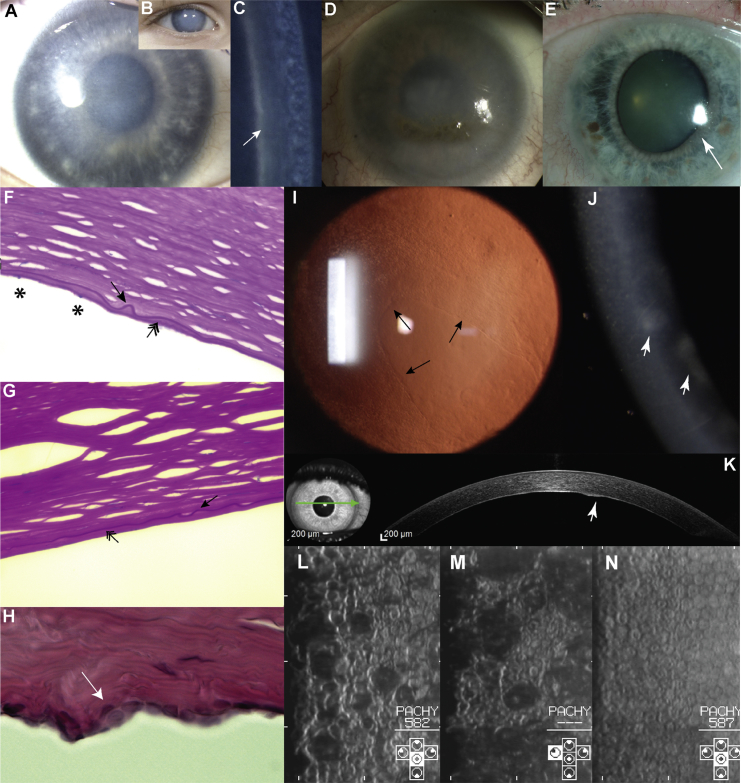
Congenital hereditary endothelial dystrophy 1 (CHED1) and posterior polymorphous corneal dystrophy 1 (PPCD1) are autosomal-dominant corneal endothelial dystrophies that have been genetically mapped to overlapping loci on the short arm of chromosome 20. We combined genetic and genomic approaches to identify the cause of disease in extensive pedigrees comprising over 100 affected individuals. After exclusion of pathogenic coding, splice-site, and copy-number variations, a parallel approach using targeted and whole-genome sequencing facilitated the identification of pathogenic variants in a conserved region of the OVOL2 proximal promoter sequence in the index families (c.-339_361dup for CHED1 and c.-370T>C for PPCD1). Direct sequencing of the OVOL2 promoter in other unrelated affected individuals identified two additional mutations within the conserved proximal promoter sequence (c.-274T>G and c.-307T>C). OVOL2 encodes ovo-like zinc finger 2, a C2H2 zinc-finger transcription factor that regulates mesenchymal-to-epithelial transition and acts as a direct transcriptional repressor of the established PPCD-associated gene ZEB1. Interestingly, we did not detect OVOL2 expression in the normal corneal endothelium. Our in vitro data demonstrate that all four mutated OVOL2 promoters exhibited more transcriptional activity than the corresponding wild-type promoter, and we postulate that the mutations identified create cryptic cis-acting regulatory sequence binding sites that drive aberrant OVOL2 expression during endothelial cell development. Our data establish CHED1 and PPCD1 as allelic conditions and show that CHED1 represents the extreme of what can be considered a disease spectrum. They also implicate transcriptional dysregulation of OVOL2 as a common cause of dominantly inherited corneal endothelial dystrophies.
先天性遗传性内皮营养不良1型(CHED1)和后极性多形性角膜营养不良1型(PPCD1)是常染色体显性遗传性角膜内皮营养不良,其基因已被定位到20号染色体短臂上的重叠位点。我们结合遗传和基因组方法,在包含100多名患者的大家族中确定疾病病因。在排除致病编码、剪接位点和拷贝数变异后,采用靶向测序和全基因组测序的平行方法,在索引家族中OVOL2近端启动子序列的保守区域鉴定出致病变异(CHED1为c.-339_361dup,PPCD1为c.-370T>C)。对其他无关患病个体的OVOL2启动子进行直接测序,在保守的近端启动子序列中又发现了另外两个突变(c.-274T>G和c.-307T>C)。OVOL2编码类卵锌指蛋白2,这是一种C2H2锌指转录因子,可调节间充质向上皮转化,并作为已确定的与PPCD相关基因ZEB1的直接转录抑制因子。有趣的是,我们在正常角膜内皮中未检测到OVOL2表达。我们的体外数据表明,所有四个突变的OVOL2启动子均比相应的野生型启动子表现出更高的转录活性,我们推测所鉴定的突变产生了隐蔽的顺式作用调节序列结合位点,从而在内皮细胞发育过程中驱动异常的OVOL2表达。我们的数据确定CHED1和PPCD1为等位基因情况,并表明CHED1代表了可被视为疾病谱的极端情况。它们还表明OVOL2的转录失调是显性遗传性角膜内皮营养不良的常见病因。