Kuwahara Kazuhiko, Yamamoto-Ibusuki Mutsuko, Zhang Zhenhuan, Phimsen Suchada, Gondo Naomi, Yamashita Hiroko, Takeo Toru, Nakagata Naomi, Yamashita Daisuke, Fukushima Yoshimi, Yamamoto Yutaka, Iwata Hiroji, Saya Hideyuki, Kondo Eisaku, Matsuo Keitaro, Takeya Motohiro, Iwase Hirotaka, Sakaguchi Nobuo
Department of Immunology, Graduate School of Medical Sciences, Kumamoto University, Kumamoto, Japan.
Division of Immunology, Aichi Cancer Center Research Institute, Nagoya, Japan.
Cancer Sci. 2016 Apr;107(4):469-77. doi: 10.1111/cas.12883. Epub 2016 Feb 9.
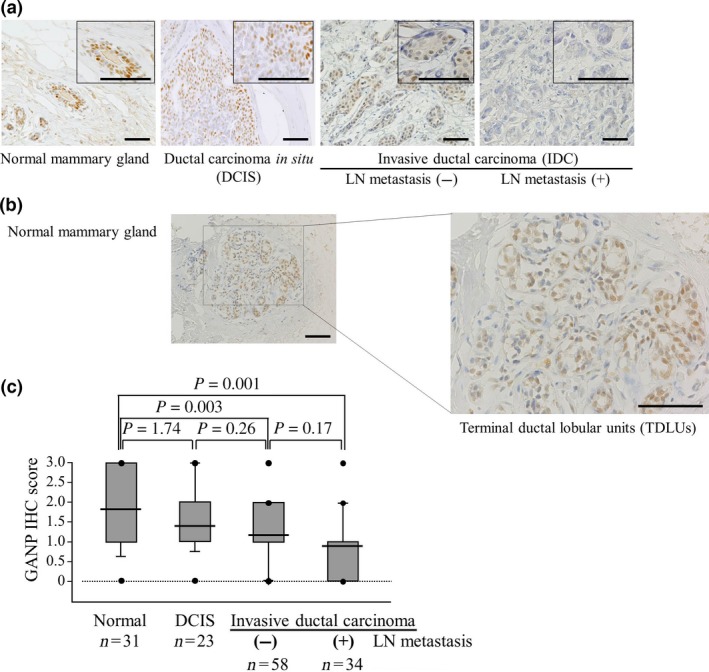
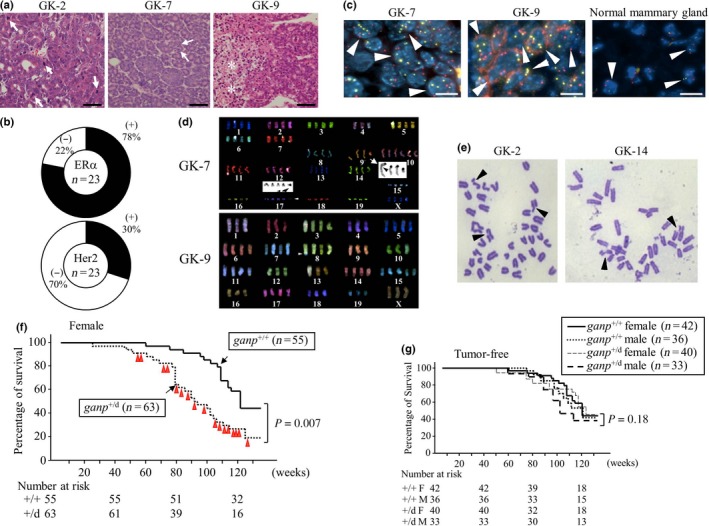
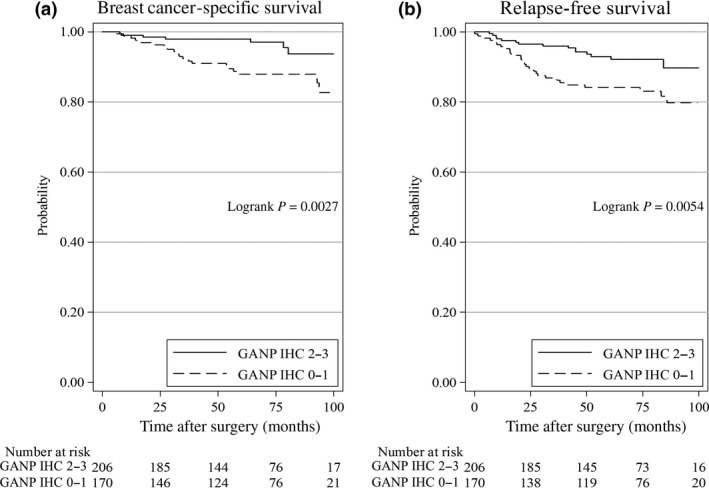
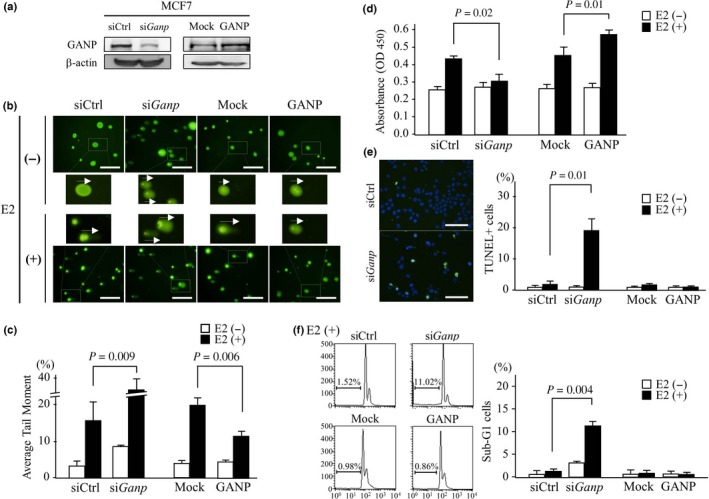
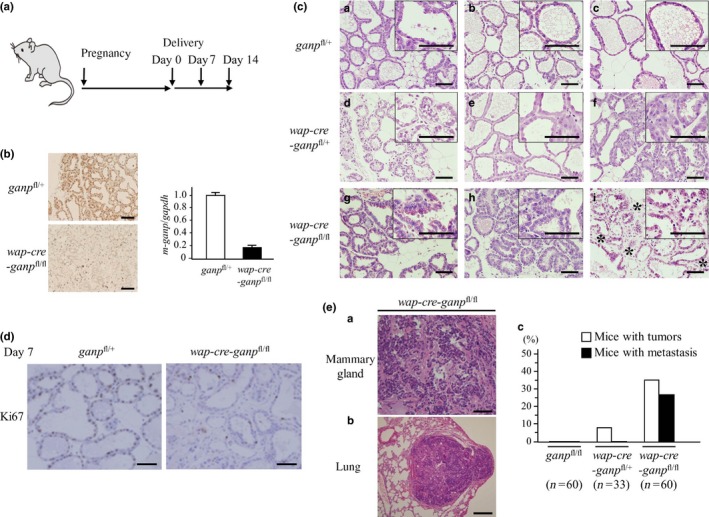
Human chromosome 21 is known to be associated with the high risk of hematological malignancy but with resistance to breast cancer in the study of Down syndrome. In human cancers, we previously observed the significant alterations of the protein expression encoded by the ganp/MCM3AP gene on human chromosome 21q22.3. Here, we investigated GANP protein alterations in human breast cancer samples (416 cases) at various stages by immunohistochemical analysis. This cohort study clearly showed that expression of GANP is significantly decreased in human breast cancer cases with poor prognosis as an independent risk factor (relapse-free survival, hazard ratio = 2.37, 95% confidence interval, 1.27-4.42, P = 0.007 [univariate analysis]; hazard ratio = 2.70, 95% confidence interval, 1.42-5.13, P = 0.002 [multivariate analysis]). To investigate whether the altered GANP expression is associated with mammary tumorigenesis, we created mutant mice that were conditionally deficient in the ganp/MCM3AP gene using wap-cre recombinase transgenic mice. Mammary gland tumors occurred at a very high incidence in female mammary gland-specific GANP-deficient mice after severe impairment of mammary gland development during pregnancy. Moreover, tumor development also occurred in female post parous GANP-heterodeficient mice. GANP has a significant role in the suppression of DNA damage caused by estrogen in human breast cancer cell lines. These results indicated that the GANP protein is associated with breast cancer resistance.
在唐氏综合征的研究中,已知人类21号染色体与血液系统恶性肿瘤的高风险相关,但与乳腺癌的抗性有关。在人类癌症中,我们之前观察到人类21号染色体q22.3上ganp/MCM3AP基因编码的蛋白质表达有显著改变。在此,我们通过免疫组织化学分析研究了不同阶段的人类乳腺癌样本(416例)中GANP蛋白的改变。这项队列研究清楚地表明,作为一个独立风险因素,GANP的表达在预后不良的人类乳腺癌病例中显著降低(无复发生存期,风险比=2.37,95%置信区间,1.27 - 4.42,P = 0.007[单变量分析];风险比=2.70,95%置信区间,1.42 - 5.13,P = 0.002[多变量分析])。为了研究改变的GANP表达是否与乳腺肿瘤发生有关,我们使用wap-cre重组酶转基因小鼠创建了ganp/MCM3AP基因条件性缺陷的突变小鼠。在怀孕期间乳腺发育严重受损后,雌性乳腺特异性GANP缺陷小鼠的乳腺肿瘤发生率非常高。此外,雌性产后GANP杂合缺陷小鼠也出现了肿瘤发展。GANP在抑制人类乳腺癌细胞系中由雌激素引起的DNA损伤方面具有重要作用。这些结果表明GANP蛋白与乳腺癌抗性有关。