
长期摄入日本清酒介导小鼠肝脏辐射诱导的代谢改变。
Chronic Intake of Japanese Sake Mediates Radiation-Induced Metabolic Alterations in Mouse Liver.
作者信息
Nakajima Tetsuo, Vares Guillaume, Wang Bing, Nenoi Mitsuru
机构信息
Research Center for Radiation Protection, National Institute of Radiological Sciences, Chiba, Japan.
出版信息
PLoS One. 2016 Jan 11;11(1):e0146730. doi: 10.1371/journal.pone.0146730. eCollection 2016.
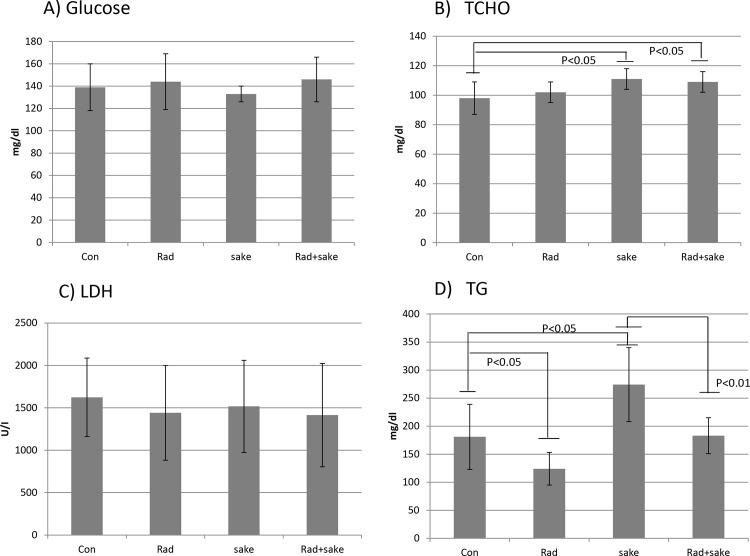
Sake is a traditional Japanese alcoholic beverage that is gaining popularity worldwide. Although sake is reported to have beneficial health effects, it is not known whether chronic sake consumption modulates health risks due to radiation exposure or other factors. Here, the effects of chronic administration of sake on radiation-induced metabolic alterations in the livers of mice were evaluated. Sake (junmai-shu) was administered daily to female mice (C3H/He) for one month, and the mice were exposed to fractionated doses of X-rays (0.75 Gy/day) for the last four days of the sake administration period. For comparative analysis, a group of mice were administered 15% (v/v) ethanol in water instead of sake. Metabolites in the liver were analyzed by capillary electrophoresis-time-of-flight mass spectrometry one day following the last exposure to radiation. The metabolite profiles of mice chronically administered sake in combination with radiation showed marked changes in purine, pyrimidine, and glutathione (GSH) metabolism, which were only partially altered by radiation or sake administration alone. Notably, the changes in GSH metabolism were not observed in mice treated with radiation following chronic administration of 15% ethanol in water. Changes in several metabolites, including methionine and valine, were induced by radiation alone, but were not detected in the livers of mice who received chronic administration of sake. In addition, the chronic administration of sake increased the level of serum triglycerides, although radiation exposure suppressed this increase. Taken together, the present findings suggest that chronic sake consumption promotes GSH metabolism and anti-oxidative activities in the liver, and thereby may contribute to minimizing the adverse effects associated with radiation.
清酒是一种传统的日本酒精饮料,正在全球范围内日益流行。尽管据报道清酒对健康有益,但长期饮用清酒是否能调节因辐射暴露或其他因素导致的健康风险尚不清楚。在此,评估了长期给予清酒对小鼠肝脏辐射诱导的代谢改变的影响。将清酒(纯米酒)每日给予雌性小鼠(C3H/He),持续一个月,在给予清酒的最后四天,小鼠接受分次剂量的X射线照射(0.75 Gy/天)。为了进行比较分析,一组小鼠给予水中15%(v/v)的乙醇而非清酒。在最后一次辐射暴露一天后,通过毛细管电泳-飞行时间质谱法分析肝脏中的代谢物。长期给予清酒并联合辐射的小鼠的代谢物谱显示嘌呤、嘧啶和谷胱甘肽(GSH)代谢有显著变化,而单独的辐射或给予清酒仅使其部分改变。值得注意的是,在长期给予水中15%乙醇后接受辐射治疗的小鼠中未观察到GSH代谢的变化。包括蛋氨酸和缬氨酸在内的几种代谢物的变化仅由辐射诱导,但在长期给予清酒的小鼠肝脏中未检测到。此外,长期给予清酒增加了血清甘油三酯水平,尽管辐射暴露抑制了这种增加。综上所述,目前的研究结果表明,长期饮用清酒可促进肝脏中的GSH代谢和抗氧化活性,从而可能有助于将与辐射相关的不良反应降至最低。


 Zotero 插件