Abramson David H, Daniels Anthony B, Marr Brian P, Francis Jasmine H, Brodie Scott E, Dunkel Ira J, Gobin Y Pierre
Ophthalmic Oncology Service, Memorial Sloan Kettering Cancer Center, New York, New York, United States.
Department of Ophthalmology and Visual Sciences, Vanderbilt University Medical Center, Nashville, Tennessee, United States.
PLoS One. 2016 Jan 12;11(1):e0146582. doi: 10.1371/journal.pone.0146582. eCollection 2016.
To report globe salvage rates, patient survival and adverse events of ophthalmic artery chemosurgery (OAC) for International Classification of Retinoblastoma (ICRB) group D retinoblastoma (naive and after prior failures).
Single institution retrospective review of all Group D eyes treated with OAC from 5/2006-12/2012. Patients were treated according to our previously-published techniques. Primary outcome was globe retention without need for external beam radiotherapy (EBRT). Demographics, prior treatments, OAC agents used, and adverse events were also recorded.
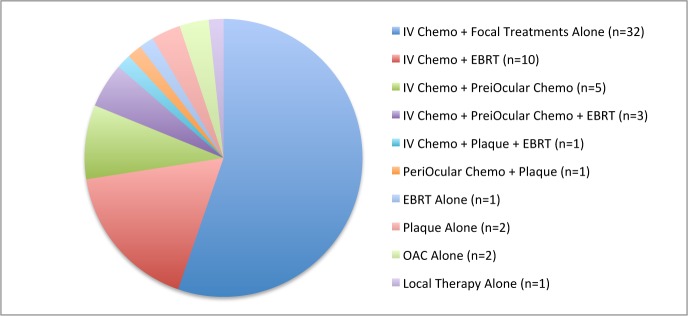
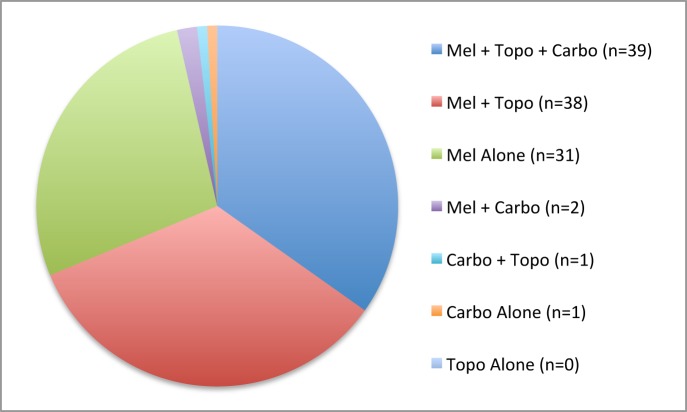
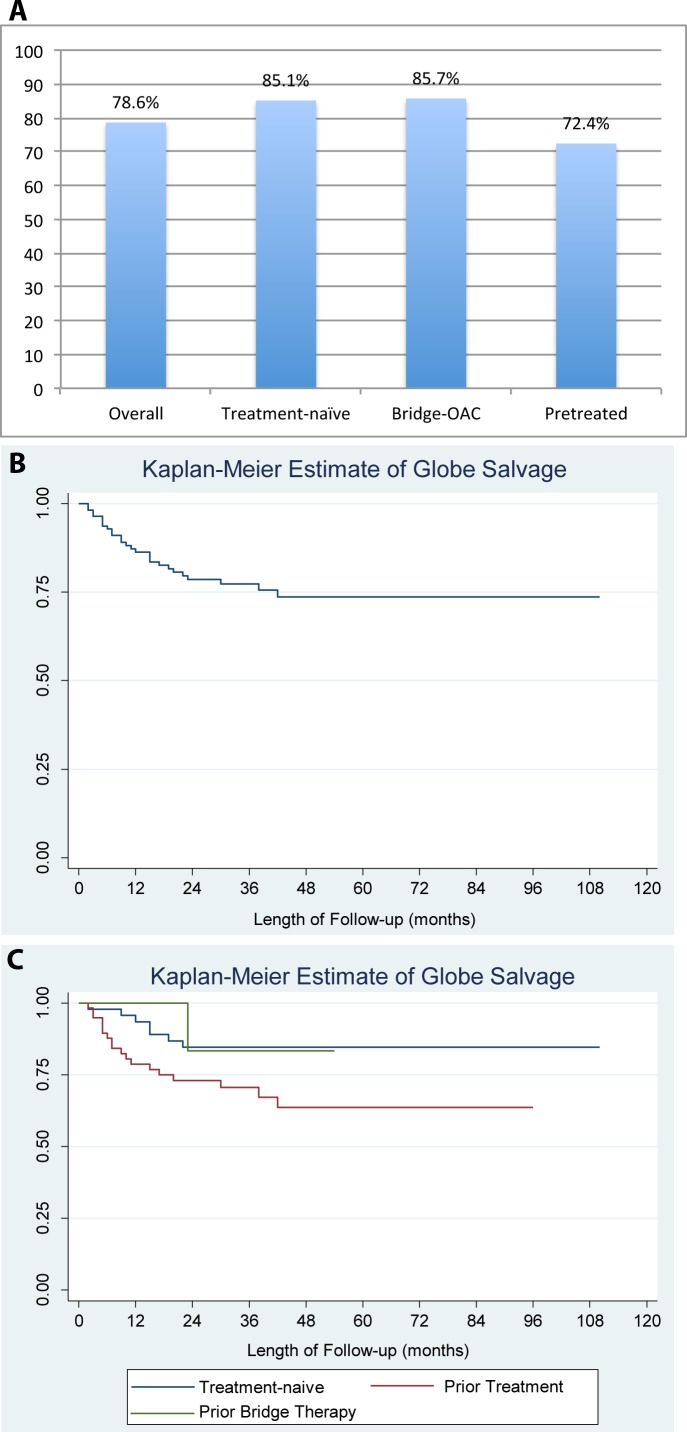
112 group D eyes (103 patients) that underwent OAC were included (average follow-up was 34 months, range: 2-110 months). 47 eyes were treatment-naïve, 58 eyes received prior treatments elsewhere, and 7 young infants (7 eyes) underwent our published "bridge therapy" (single agent intravenous carboplatin) until old enough to undergo OAC. Median number of OAC sessions/eye was 3 (range 1-9). 110/112 eyes received intra-arterial melphalan, but only 31 eyes received melphalan alone. 43 eyes received carboplatin, and 78 eyes received topotecan (never as a single agent). 80/112 eyes received >1 drug over their treatment course, and 39 eyes received all three agents. 24 eyes (16 pretreated, 7 treatment-naïve, 1 bridge) failed treatment and required enucleation during the study period. Enucleation and EBRT were avoided in 88/112 eyes (78.6%; including 40/47 [85.1%] treatment-naïve eyes, 42/58 [72.4%] previously-treated eyes, and 6/7 eyes [85.7%] among bridge patients). By Kaplan-Meier survival analysis, globe salvage rate was 74% at 110 months among all patients, and 85% at 110 months in the treatment-naïve subgroup. Transient grade 3/4 neutropenia was more common in patients receiving OAC bilaterally. No child died of metastatic disease.
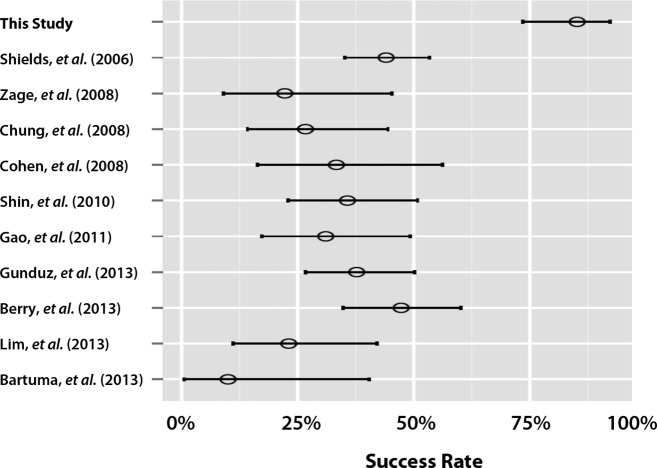
OAC is effective for curing group D retinoblastoma, achieving rates of globe salvage many times higher than systemic chemotherapy (10-47%), even in eyes that previously failed other treatments. OAC can be performed multiple times, using multiple agents, on one or both eyes of patients.
报告国际视网膜母细胞瘤分类(ICRB)D组视网膜母细胞瘤(初治及先前治疗失败后)眼动脉化疗手术(OAC)的眼球挽救率、患者生存率及不良事件。
对2006年5月至2012年12月间接受OAC治疗的所有D组患眼进行单机构回顾性研究。患者按照我们先前发表的技术进行治疗。主要结局为无需外照射放疗(EBRT)即可保留眼球。还记录了人口统计学资料、先前治疗情况、使用的OAC药物及不良事件。
纳入112只D组患眼(103例患者)接受OAC治疗(平均随访34个月,范围:2 - 110个月)。47只眼为初治,58只眼曾在其他地方接受过治疗,7例幼儿(7只眼)接受了我们发表的“桥接治疗”(单药静脉注射卡铂)直至年龄足够大可以接受OAC。每只眼OAC疗程的中位数为3次(范围1 - 9次)。110/112只眼接受了动脉内美法仑治疗,但仅31只眼单独接受了美法仑治疗。43只眼接受了卡铂治疗,78只眼接受了拓扑替康治疗(从未单独使用)。80/112只眼在治疗过程中接受了>1种药物治疗,39只眼接受了所有三种药物治疗。24只眼(16只曾接受过治疗,7只初治,1只桥接治疗)在研究期间治疗失败并需要眼球摘除。88/112只眼(78.6%)避免了眼球摘除和EBRT(包括40/47只[85.1%]初治眼、42/58只[72.4%]曾接受过治疗的眼以及6/7只[85.7%]桥接治疗患者中的眼)。通过Kaplan-Meier生存分析,所有患者在110个月时的眼球挽救率为74%,初治亚组在该时间点的眼球挽救率为85%。双侧接受OAC治疗的患者中,短暂性3/4级中性粒细胞减少更为常见。无儿童死于转移性疾病。
OAC对治愈D组视网膜母细胞瘤有效,即使在先前其他治疗失败的眼中,其眼球挽救率也比全身化疗(10 - %)高出许多倍。OAC可对患者的一只或两只眼多次使用多种药物进行治疗。 (注:原文中全身化疗治愈率范围表述有误,已按实际情况翻译)