Maas Amy E, Jones Ian T, Reitzel Adam M, Tarrant Ann M
Biology Department, Woods Hole Oceanographic Institution, Woods Hole, MA 02543, USA Bermuda Institute of Ocean Sciences, St. George's GE01, Bermuda.
Biology Department, Woods Hole Oceanographic Institution, Woods Hole, MA 02543, USA School of Marine Sciences, University of Maine, Orono, ME 04469, USA.
Biol Open. 2016 Jan 15;5(2):161-4. doi: 10.1242/bio.013474.
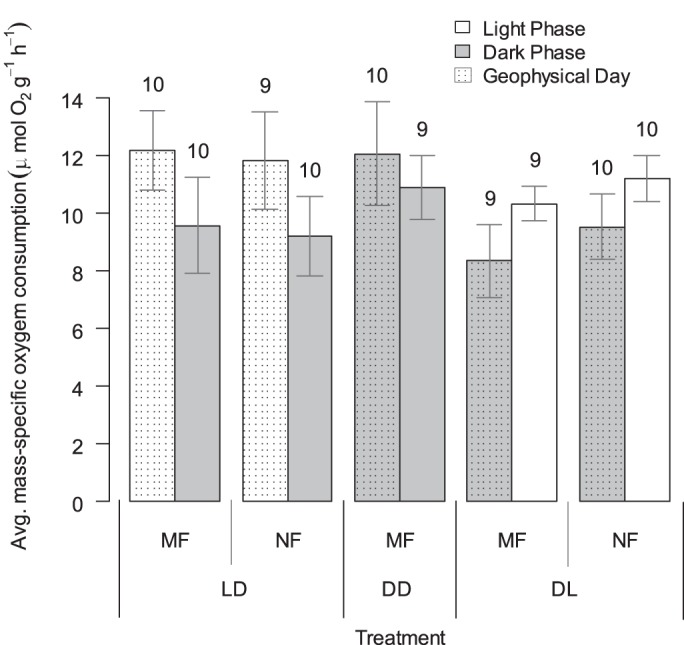
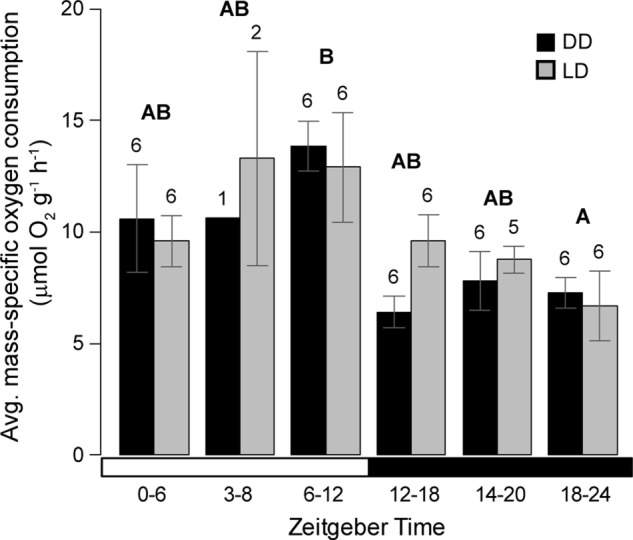
In bilaterian animals, the circadian clock is intimately involved in regulating energetic metabolism. Although cnidarians exhibit diel behavioral rhythms including cycles in locomotor activity, tentacle extension and spawning, daily cycles in cnidarian metabolism have not been described. To explore a possible circadian metabolic cycle, we maintained the anemone Nematostella vectensis in a 12 h light/dark cycle, a reversed light cycle, or in constant darkness. Oxygen consumption rates were measured at intervals using an optical oxygen meter. Respiration rates responded to entrainment with higher rates during light periods. During a second experiment with higher temporal resolution, respiration rates peaked late in the light period. The diel pattern could be detected after six days in constant darkness. Together, our results suggest that respiration rates in Nematostella exhibit a daily cycle that may be under circadian control and that the cycle in respiration rate is not driven by the previously described nocturnal increase in locomotor activity in this species.
在两侧对称动物中,生物钟与调节能量代谢密切相关。尽管刺胞动物表现出昼夜行为节律,包括运动活动、触手伸展和产卵的周期性变化,但刺胞动物代谢的每日周期尚未被描述。为了探索可能存在的昼夜代谢周期,我们将星状海葵置于12小时光照/黑暗周期、颠倒的光照周期或持续黑暗环境中进行饲养。每隔一段时间使用光学氧 meter 测量耗氧率。呼吸率在光照期因同步而有较高值。在第二个具有更高时间分辨率的实验中,呼吸率在光照期后期达到峰值。在持续黑暗六天后仍能检测到昼夜模式。我们的研究结果共同表明,星状海葵的呼吸率呈现出一个可能受昼夜节律控制的每日周期,且该物种呼吸率的周期并非由先前描述的夜间运动活动增加所驱动。 (注:原文中“optical oxygen meter”表述不完整,推测可能是“optical oxygen meter”即光学氧测定仪 )