Dolbeth Marina, Stålnacke Per, Alves Fátima L, Sousa Lisa P, Gooch Geoffrey D, Khokhlov Valeriy, Tuchkovenko Yurii, Lloret Javier, Bielecka Małgorzata, Różyński Grzegorz, Soares João A, Baggett Susan, Margonski Piotr, Chubarenko Boris V, Lillebø Ana I
Biology Department &Centre for Environmental and Marine Studies (CESAM), University of Aveiro, Campus Universitário de Santiago, 3810-193 Aveiro Portugal.
CFE - Centre for Functional Ecology, Department of Life Sciences, University of Coimbra, PO Box 3046, 3001-401 Coimbra, Portugal.
Sci Rep. 2016 Jan 18;6:19400. doi: 10.1038/srep19400.
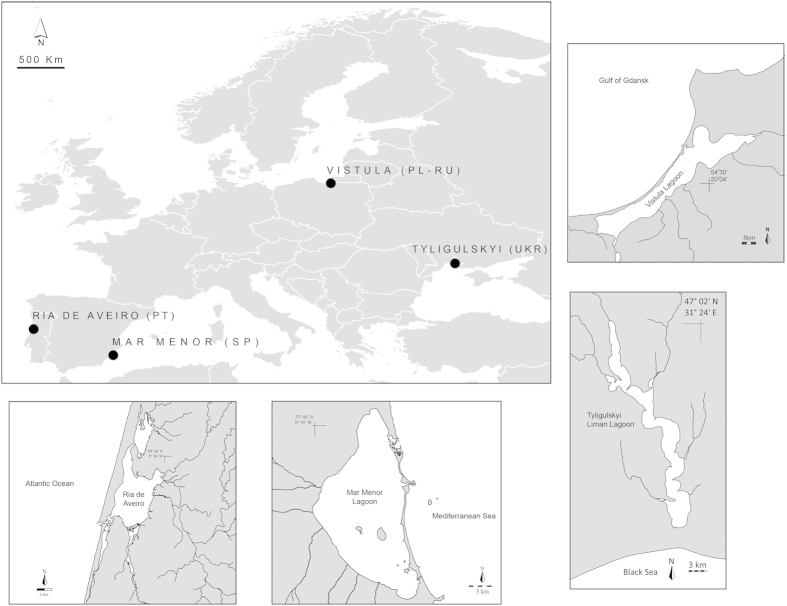
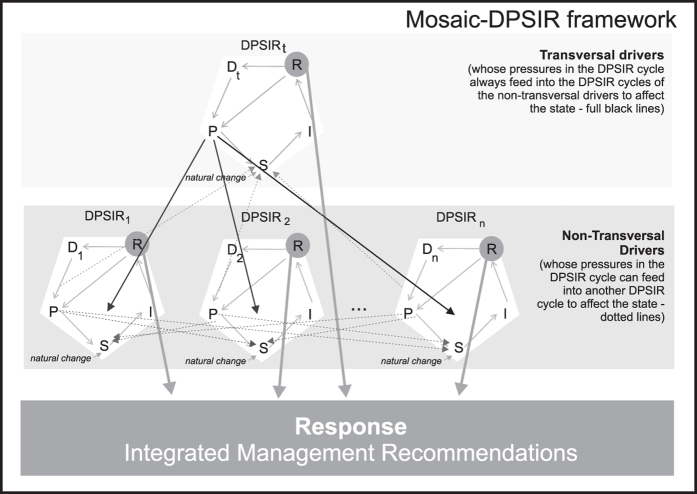
A decision support framework for the management of lagoon ecosystems was tested using four European Lagoons: Ria de Aveiro (Portugal), Mar Menor (Spain), Tyligulskyi Liman (Ukraine) and Vistula Lagoon (Poland/Russia). Our aim was to formulate integrated management recommendations for European lagoons. To achieve this we followed a DPSIR (Drivers-Pressures-State Change-Impacts-Responses) approach, with focus on integrating aspects of human wellbeing, welfare and ecosystem sustainability. The most important drivers in each lagoon were identified, based on information gathered from the lagoons' stakeholders, complemented by scientific knowledge on each lagoon as seen from a land-sea perspective. The DPSIR cycles for each driver were combined into a mosaic-DPSIR conceptual model to examine the interdependency between the multiple and interacting uses of the lagoon. This framework emphasizes the common links, but also the specificities of responses to drivers and the ecosystem services provided. The information collected was used to formulate recommendations for the sustainable management of lagoons within a Pan-European context. Several common management recommendations were proposed, but specificities were also identified. The study synthesizes the present conditions for the management of lagoons, thus analysing and examining the activities that might be developed in different scenarios, scenarios which facilitate ecosystem protection without compromising future generations.
利用四个欧洲泻湖对一个泻湖生态系统管理的决策支持框架进行了测试,这四个泻湖分别是:阿威罗里亚德(葡萄牙)、马略尔湖(西班牙)、泰利古尔湾(乌克兰)和维斯瓦泻湖(波兰/俄罗斯)。我们的目标是为欧洲泻湖制定综合管理建议。为实现这一目标,我们采用了驱动力-压力-状态变化-影响-响应(DPSIR)方法,重点是整合人类福祉、福利和生态系统可持续性等方面。根据从泻湖利益相关者收集的信息,并辅以从陆海角度对每个泻湖的科学认识,确定了每个泻湖最重要的驱动因素。将每个驱动因素的DPSIR循环整合到一个镶嵌式DPSIR概念模型中,以研究泻湖多种相互作用用途之间的相互依存关系。该框架强调了共同联系,同时也强调了对驱动因素的响应以及所提供的生态系统服务的特殊性。收集到的信息用于在泛欧背景下为泻湖的可持续管理制定建议。提出了若干共同的管理建议,但也确定了特殊性。该研究综合了泻湖管理的现状,从而分析和审视了在不同情景下可能开展的活动,这些情景有助于在不损害后代利益的情况下保护生态系统。