Benham Phred M, Witt Christopher C
Department of Biology and Museum of Southwestern Biology, University of New Mexico, 167 Castetter Hall MSC03 2020, 1 University of New Mexico, Albuquerque, NM, 87131, USA.
Present address: Division of Biological Sciences, University of Montana, 32 Campus Dr. HS104, Missoula, MT, 59812, USA.
BMC Evol Biol. 2016 Jan 22;16:22. doi: 10.1186/s12862-016-0595-2.
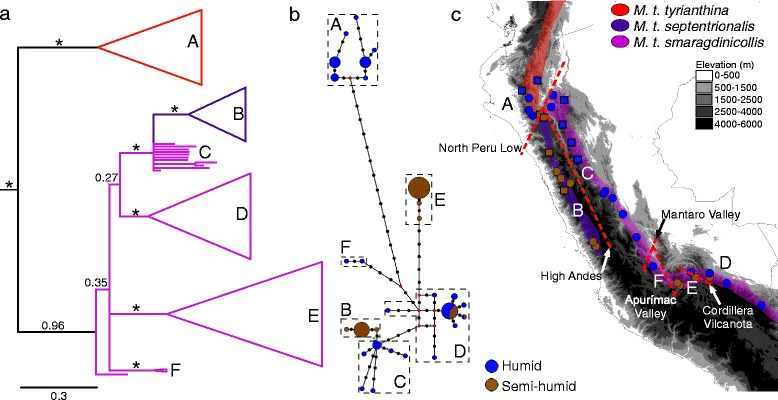
The ridges and valleys of the Andes create physical barriers that limit animal dispersal and cause deterministic local variation in rainfall. This has resulted in physical isolation of animal populations and variation in habitats, each of which has likely contributed to the evolution of high species diversity in the region. However, the relative influences of geographic isolation, ecoclimatic conditions, and their potential interactions remain poorly understood. To address this, we compared patterns of genetic and morphological diversity in Peruvian populations of the hummingbird Metallura tyrianthina.
Phylogenetic and variation partitioning analyses showed that geographic isolation rather than climatic dissimilarity explained the greatest proportion of genetic variance. In contrast, bill length variation was explained by climatic seasonality, but not by genetic divergence. We found that mutation-scaled migration rate (m) between persistently humid and semi-humid environments was nearly 20 times higher when the habitats were contiguous (m = 39.9) than when separated by a barrier, the Cordillera de Vilcanota (m = 2.1). Moreover, the population experiencing more gene flow exhibited a lesser degree of bill length divergence despite similar differences in climate.
Geographic isolation is necessary for genetic divergence. Ecological differences, represented here by climate characteristics, are necessary for functional divergence. Gene flow appears to hinder the evolution of functional traits toward local adaptive optima. This suggests that functional diversification requires geographic isolation followed or accompanied by a shift in ecological conditions. Andean topography causes both isolation and climatic variation, underscoring its dual role in biotic diversification.
安第斯山脉的山脊和山谷形成了物理屏障,限制了动物的扩散,并导致降雨的确定性局部变化。这导致了动物种群的物理隔离和栖息地的变化,每一个因素都可能促成了该地区高物种多样性的进化。然而,地理隔离、生态气候条件及其潜在相互作用的相对影响仍知之甚少。为了解决这个问题,我们比较了秘鲁蜂鸟金属尾翠蜂鸟种群的遗传和形态多样性模式。
系统发育和变异分配分析表明,地理隔离而非气候差异解释了最大比例的遗传变异。相比之下,喙长变异由气候季节性解释,而非遗传分化。我们发现,当栖息地相邻时(m = 39.9),持续湿润和半湿润环境之间的突变尺度迁移率(m)几乎是被维尔卡诺塔山脉屏障隔开时(m = 2.1)的20倍。此外,尽管气候差异相似,但经历更多基因流的种群喙长分化程度较小。
地理隔离是遗传分化所必需的。这里以气候特征表示的生态差异是功能分化所必需的。基因流似乎阻碍了功能性状向局部适应性最优方向的进化。这表明功能多样化需要地理隔离,随后或伴随着生态条件的转变。安第斯山脉的地形导致了隔离和气候变化,突显了其在生物多样化中的双重作用。