Chen Weigang, Jiao Yongqing, Cheng Liangqiang, Huang Li, Liao Boshou, Tang Mei, Ren Xiaoping, Zhou Xiaojing, Chen Yuning, Jiang Huifang
Key Laboratory of Biology and Genetic Improvement of Oil Crops, Ministry of Agriculture, Oil Crops Research Institute of the Chinese Academy of Agricultural Sciences, Wuhan, 430062, China.
BMC Genet. 2016 Jan 25;17:25. doi: 10.1186/s12863-016-0337-x.
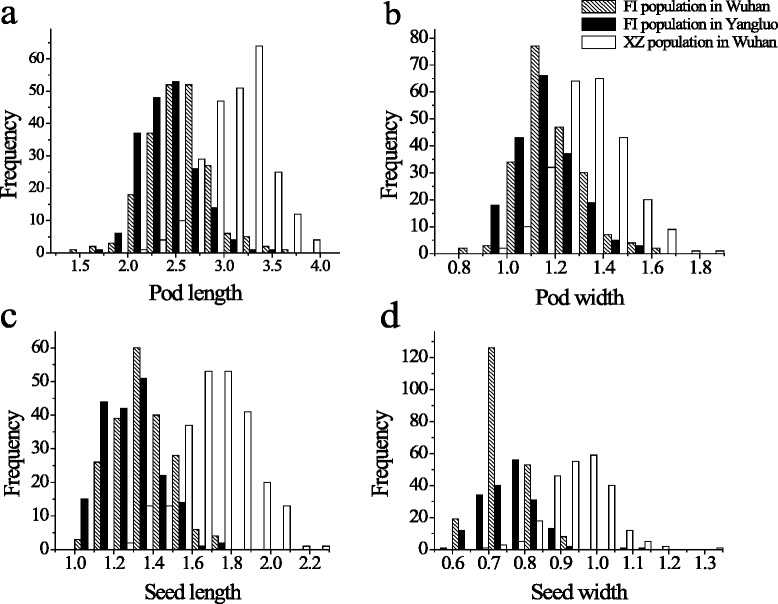
The cultivated peanut (Arachis hypogaea L.) is an important oil and food crop in the world. Pod- and kernel-related traits are direct factors involved in determining the yield of the peanut. However, the genetic basis underlying pod- and kernel-related traits in the peanut remained largely unknown, which hampered the improvement of peanut through marker-assisted selection. To understand the genetic basis underlying pod- and kernel-related traits in the peanut and provide more useful information for marker-assisted breeding, we conducted quantitative trait locus (QTL) analysis for pod length and width and seed length and width by use of two F2:3 populations derived from cultivar Fuchuan Dahuasheng × ICG 6375 (FI population) and cultivar Xuhua 13 × cultivar Zhonghua 6 (XZ population) in this study.
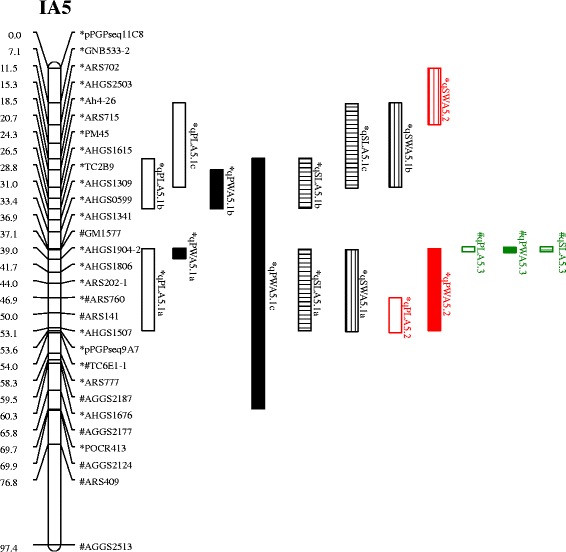
Two genetic maps containing 347 and 228 polymorphic markers were constructed for FI and XZ populations respectively. In total, 39 QTLs explaining 1.25-26.11% of the phenotypic variations were detected in two populations. For the FI population, 26 QTLs were detected between the two environments, among which twelve were not mapped before. For the XZ population, thirteen QTLs were detected, among which eight were not reported before. One QTL for pod width was repeatedly mapped between the two populations.
The QTL analyses for pod length and width and seed length and width were conducted in this study using two mapping populations. Novel QTLs were identified, which included two for pod length, four for pod width, five for seed length and one for seed width in the FI population, and three for pod length, three for pod width and two for seed width in the XZ population. Our results will be helpful for improving pod- and seed-related traits in peanuts through marker-assisted selection.
栽培花生(Arachis hypogaea L.)是世界上重要的油料和粮食作物。荚果和籽仁相关性状是决定花生产量的直接因素。然而,花生荚果和籽仁相关性状的遗传基础在很大程度上仍不清楚,这阻碍了通过标记辅助选择来改良花生。为了了解花生荚果和籽仁相关性状的遗传基础,并为标记辅助育种提供更多有用信息,本研究利用两个F2:3群体(分别来自品种富川大花生×ICG 6375的FI群体和品种徐花13×品种中花6的XZ群体)对荚果长度和宽度以及种子长度和宽度进行了数量性状位点(QTL)分析。
分别为FI群体和XZ群体构建了包含347个和228个多态性标记的两个遗传图谱。在两个群体中总共检测到39个QTL,解释了1.25%-26.11%的表型变异。对于FI群体,在两个环境之间检测到26个QTL,其中12个以前未定位。对于XZ群体,检测到13个QTL,其中8个以前未报道。两个群体之间重复定位到一个荚果宽度的QTL。
本研究利用两个作图群体对荚果长度和宽度以及种子长度和宽度进行了QTL分析。鉴定出了新的QTL,其中FI群体中有2个荚果长度QTL、4个荚果宽度QTL、5个种子长度QTL和1个种子宽度QTL,XZ群体中有3个荚果长度QTL、3个荚果宽度QTL和2个种子宽度QTL。我们的结果将有助于通过标记辅助选择改良花生的荚果和种子相关性状。