Nakashima Hikaru, Matsuoka Yuichiro, Yoshida Ryoji, Nagata Masashi, Hirosue Akiyuki, Kawahara Kenta, Sakata Junki, Arita Hidetaka, Hiraki Akimitsu, Nakayama Hideki
Department of Oral and Maxillofacial Surgery, Graduate School of Life Sciences, Kumamoto University, Honjo 1-1-1, Chuo-ku, Kumamoto, 860-8556, Japan.
Section of Oral Oncology, Department of Oral and Maxillofacial Surgery, Fukuoka Dental College, 2-15-1 Tamura, Sawara-ku, Fukuoka, 814-0193, Japan.
BMC Cancer. 2016 Jan 26;16:41. doi: 10.1186/s12885-016-2079-6.
The Neutrophil to lymphocyte ratio (NLR) has prognostic value in patients with a variety of cancers. However, its prognostic significance in oral squamous cell carcinoma (OSCC) patients has not been fully explored. The purpose of this study was to determine the clinical significance of NLR in patients with OSCC.
OSCC patients who underwent surgery following 5-fluorouracil (5-FU)-based chemoradiotherapy were enrolled in this study. The associations between the NLR status and various clinicopathological features were examined, and the effects of the NLR on the prognosis were evaluated. Analysis of circulating interleukin-6 (IL-6) was carried out and correlation with NLR and C-reactive protein concentration (CRP) was examined.
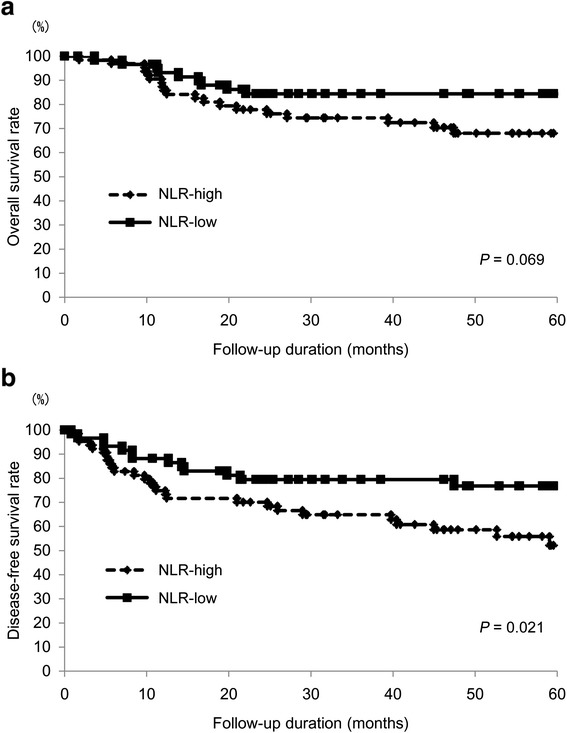
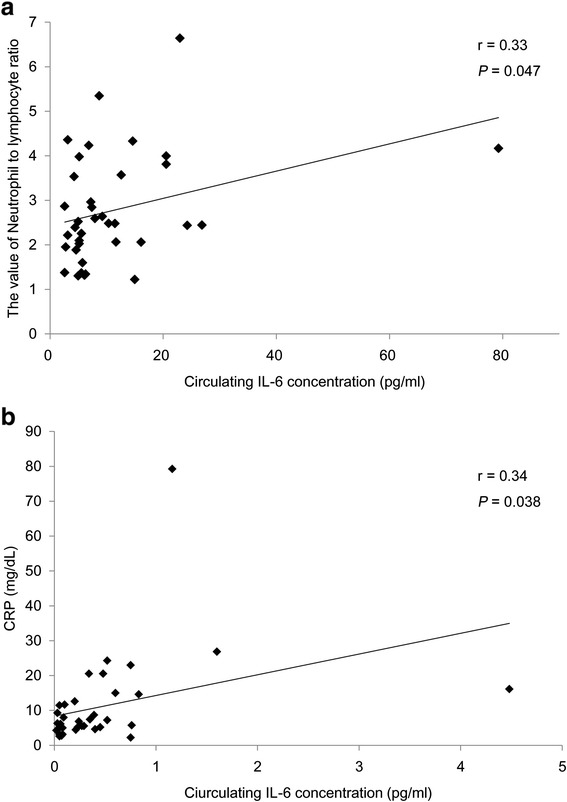
An elevated NLR was significantly correlated with advanced T-stage and poor response to chemoradiotherapy. Moreover, a Cox regression analysis based on the disease-free survival (DFS) revealed the NLR status (hazard ratio, 2.013; P = 0.041) and pathological response to chemoradiotherapy (hazard ratio, 0.226; P = 0.001) to be significant prognostic factors in OSCC patients. Furthermore, circulating IL-6 was found to correlate with NLR and CRP.
The NLR is a potential biomarker for predicting the clinical response to 5-FU-based chemoradiotherapy and the survival in OSCC patients, and the systemic inflammatory response may be potential target for improving patient's prognosis.
中性粒细胞与淋巴细胞比值(NLR)在多种癌症患者中具有预后价值。然而,其在口腔鳞状细胞癌(OSCC)患者中的预后意义尚未得到充分探索。本研究的目的是确定NLR在OSCC患者中的临床意义。
本研究纳入了接受基于5-氟尿嘧啶(5-FU)的放化疗后进行手术的OSCC患者。研究了NLR状态与各种临床病理特征之间的关联,并评估了NLR对预后的影响。进行了循环白细胞介素-6(IL-6)分析,并检测了其与NLR和C反应蛋白浓度(CRP)的相关性。
NLR升高与晚期T分期和放化疗反应差显著相关。此外,基于无病生存期(DFS)的Cox回归分析显示,NLR状态(风险比,2.013;P = 0.041)和放化疗的病理反应(风险比,0.226;P = 0.001)是OSCC患者的重要预后因素。此外,发现循环IL-6与NLR和CRP相关。
NLR是预测OSCC患者对基于5-FU的放化疗的临床反应和生存的潜在生物标志物,全身炎症反应可能是改善患者预后的潜在靶点。